
How William the Conqueror transformed England after 1066, reshaping its aristocracy, government, military defenses, Church and culture, and laying the foundations of medieval England.
The Battle of Hastings, fought on the 14th of October 1066, decided the immediate fate of the English throne. King Harold Godwinson lay dead, his army had been defeated, and William, Duke of Normandy, had secured the military victory necessary to pursue his claim to the English crown. On Christmas Day that year, William was crowned king in Westminster Abbey, apparently bringing the succession crisis to a conclusion. Yet the coronation was not the end of the Norman Conquest. In many respects, it was only the beginning.
Terry Bailey explains.
Read part 1 on the pre-invasion world of 1066 here, part 2 on the road to invasion here, part 3 on the Battle of Stamford Bridge here, part 4 on the Battle of Hastings here, and part 5 on William conquering England after Hastings here.
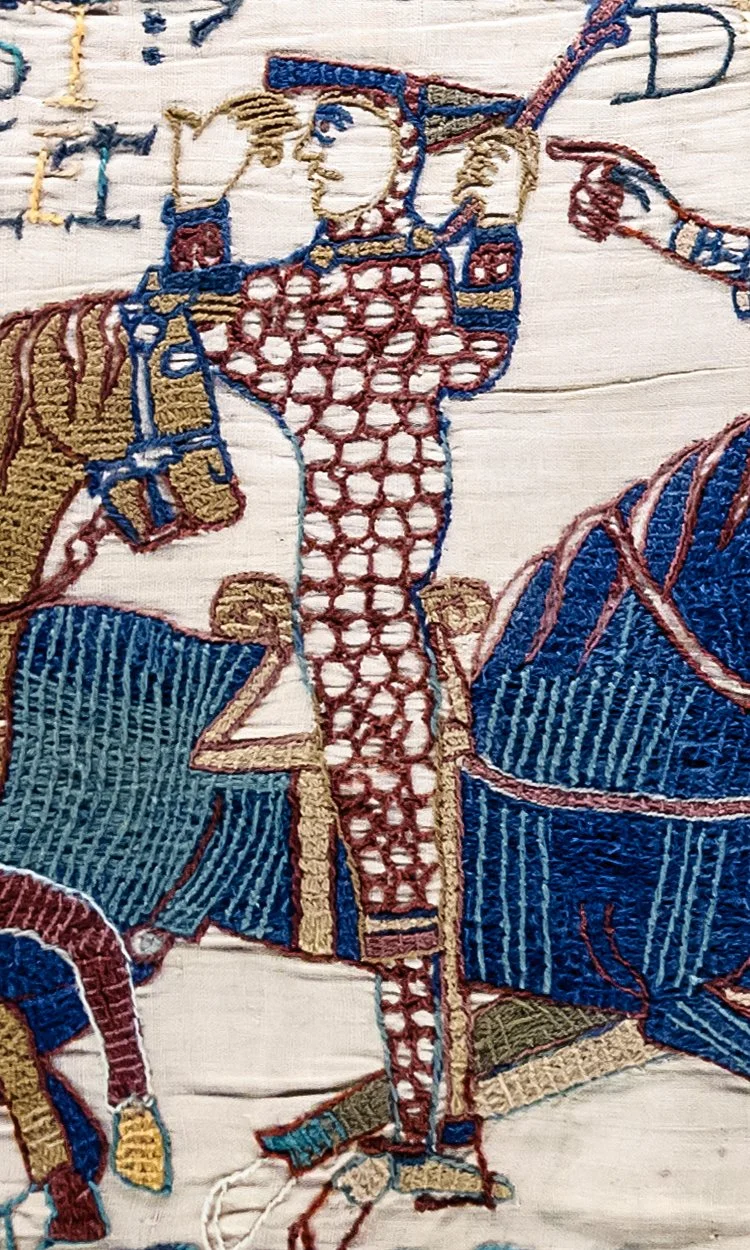
William the Conqueror at the Battle of Hastings in the Bayeux Tapestry. Source: Public domain, Bayeux Tapestry Museum, available here.
Winning a kingdom on the battlefield was one thing; governing it was quite another. England possessed an established monarchy, an experienced administrative system, a powerful aristocracy, a sophisticated network of shires and royal officials, and a Church deeply embedded in the political and social life of the country. William could not simply discard these institutions and expect his new subjects to accept an entirely unfamiliar system of government. Nevertheless, the new king intended to rule as more than a foreign conqueror who had inherited the authority of his defeated predecessor. He sought to establish a dynasty, reward his followers, secure his frontiers, suppress resistance and ensure that the wealth of England sustained the monarchy that he had fought so hard to obtain.
The consequences were profound. Land changed hands on an extraordinary scale, castles appeared across the landscape, the upper ranks of society became increasingly Norman, and the relationship between the Crown, the aristocracy and the Church was transformed. Over subsequent generations, French-speaking rulers governed a predominantly English-speaking population, while Norman and Anglo-Saxon traditions gradually combined to create a distinctive medieval kingdom.
To understand the significance of 1066, therefore, it is important to look beyond the battlefield and examine what happened when William attempted to turn conquest into government.
The central question is how a succession crisis transformed England from an Anglo-Saxon kingdom into a Norman state, and what survived of the world that had existed before the Conquest.
William's first challenge was to establish that his victory at Hastings had given him not merely possession of the English throne, but the authority to govern the kingdom. His coronation on the 25th of December 1066 was carefully calculated to legitimize his rule. By receiving the crown in Westminster Abbey, William presented himself as the lawful successor to the English monarchy rather than simply a foreign duke who had conquered a neighboring country. His claim rested on his assertion that Edward the Confessor had promised him the throne, together with his contention that Harold Godwinson had broken an earlier oath supporting William's succession.
The English political community, however, had already recognized Harold as king following Edward's death. William's victory therefore did not erase the competing claims that had precipitated the crisis. Instead, it allowed him to impose his own interpretation of legitimacy through military force, royal ceremony and the gradual submission of the kingdom's surviving leaders.
Initially, William retained some existing English officials and continued to employ familiar methods of government. He needed the machinery of the old kingdom to collect revenue, administer justice and maintain order. Yet beneath this outward continuity, a fundamental redistribution of power was taking place. Resistance continued after the coronation. Rebellions erupted in different parts of England, particularly in the north, where opposition to Norman rule became especially fierce. William responded with military campaigns, the construction of fortifications and, in northern England, a devastating campaign of destruction during the winter of 1069–1070. Known as the Harrying of the North, this campaign involved the destruction of settlements, crops and livestock in rebellious territories. Its consequences included widespread suffering, hunger and economic devastation. The precise scale of the destruction remains debated, but the campaign demonstrated the brutal lengths to which William was prepared to go to suppress opposition.
The message was unmistakable: resistance to the new king could bring consequences far beyond the battlefield.
William's consolidation of power was therefore a combination of political calculation, administrative continuity and coercion. He preserved those institutions that strengthened royal government while replacing many of the people who had previously controlled them. By the time of his death in 1087, William had established a durable Norman monarchy. Nevertheless, its stability depended upon military strength, the loyalty of powerful landholders and the king's continuing ability to ensure that no rival could successfully challenge his authority.
Perhaps the most consequential social change following the Conquest was the transformation of land ownership. In Anglo-Saxon England, land was the foundation of wealth, political influence and social prestige. Great landholders commanded resources, exercised local authority and supplied military service to the king. The most powerful nobles, particularly the earls, could exert considerable influence over royal decisions. William understood that his position depended upon controlling this same source of power.
As resistance was suppressed and the former English elite lost favor or rebelled, their estates were confiscated and redistributed among William's supporters. Norman lords, knights, administrators and ecclesiastical figures acquired properties that had previously belonged to English landowners. By the time Domesday Book was compiled in 1086, the upper ranks of landed society had been transformed dramatically. This redistribution was not simply a reward for military service. It was a means of establishing a new political order.
William placed substantial estates in the hands of men whose fortunes depended upon the continuation of his dynasty. Their prosperity was tied to the king's success, while their responsibilities included the defense of their holdings and the provision of military resources when required. Yet the arrangement also contained an inherent danger. Powerful nobles could become wealthy enough to threaten the Crown itself, particularly if they controlled extensive territories on both sides of the English Channel.
William therefore had to balance generosity with supervision. He needed his followers to possess sufficient resources to maintain their positions, but he could not permit them to become independent rulers within the kingdom. Nor should we imagine that every English landholder was immediately dispossessed. Some retained property, particularly at lower levels of society, and certain Englishmen continued to hold land under Norman overlords. Nevertheless, the displacement of the Anglo-Saxon aristocracy was one of the most sweeping consequences of the Conquest.
The new aristocracy was predominantly Norman, although it was not exclusively so. Other continental families also benefited from the redistribution, and over time the interests of these landholders became increasingly connected to England. The result was a society in which the language, ancestry and political loyalties of the ruling class had changed far more rapidly than those of the population as a whole.
One of the most visible symbols of Norman authority was the castle. Before 1066, England possessed fortified towns, burhs, defensive earthworks and other important strongholds. The Normans did not introduce fortification to an unfamiliar country. What they did introduce was a rapid expansion of castles as instruments of occupation, regional control and aristocratic power. Early Norman castles were frequently of the motte-and-bailey type. A raised mound, or motte, supported a fortified enclosure or keep, while an adjoining bailey contained buildings, accommodation and space for the garrison. Timber defenses could be erected relatively quickly, making these fortifications particularly useful during the uncertain years following the invasion.
In strategic locations, castles could command roads, river crossings, towns and important routes through the countryside. They provided secure bases from which soldiers could patrol the surrounding district and respond to rebellion. The Tower of London, founded under William's authority, became one of the most enduring expressions of this new royal presence. Its great White Tower, constructed principally in the later eleventh century, symbolized the power and permanence of the Norman monarchy.
Other castles were established throughout England, sometimes on land taken from existing owners and sometimes within or beside important settlements. Their presence altered the physical appearance of towns and countryside alike. However, castles were more than military installations. They also communicated a political message. A castle overlooking a town reminded inhabitants that authority ultimately rested with an armed lord or royal representative. Its garrison offered protection in some circumstances, but its presence could equally signify domination and the capacity for punishment.
As the decades passed, timber structures were replaced or supplemented by stone fortifications, and castles became permanent centers of aristocratic administration. They served as residences, strongholds, courts and storehouses, binding military power to the everyday management of land and people. The Norman Conquest consequently changed not only who commanded England's armies, but also how power was displayed across the landscape.
It would be misleading to suggest that William created English government from nothing. Anglo-Saxon England already possessed a comparatively sophisticated administrative system. The kingdom was divided into shires, royal officials collected revenue, local courts dealt with disputes, and written records supported the operation of royal authority. The Anglo-Saxon kings had developed institutions that enabled them to govern a substantial and economically productive realm.
William recognized the value of this inherited machinery. Rather than replacing every existing arrangement, the Norman regime adapted it to serve a new ruling class. Shires continued to function, royal officials remained essential, and established methods of assessment and taxation survived. Sheriffs, known in Old English as scīrgerefas, continued to play an important role in collecting revenue and exercising royal authority. The significant change was the relationship between these institutions and the people who controlled them.
Royal government increasingly operated through Norman-appointed officials and landholders whose positions depended upon the king. Existing administrative structures were therefore retained, but their operation became part of a political system dominated by the conquerors. This distinction is essential to understanding the Conquest. The Norman regime was revolutionary in the distribution of power, yet pragmatic in its use of established administrative practices.
The king also travelled extensively between England and Normandy, managing interests on both sides of the Channel. There was no permanent capital in the modern sense, although Winchester remained an important center of royal finance and administration. The monarchy's strength rested upon its ability to draw together local government, landed wealth, military obligation and royal justice. William's achievement was not the invention of an entirely new state, but the adaptation of England's existing machinery to sustain a transformed political order.
Norman England developed around a close but sometimes uneasy relationship between the king and his aristocracy. Landholders owed obligations to the Crown, while the king was expected to protect the kingdom and maintain the conditions under which their estates could prosper. Military service, the provision of resources and the performance of political duties helped sustain this relationship. These arrangements are often described through the language of feudalism. However, medieval landholding and political obligation varied considerably, and historians caution against imagining that a single, uniform feudal system was suddenly introduced in 1066.
What is clear is that William expected his leading supporters to recognize his superior authority. At Salisbury in 1086, he assembled important landholders and required them to swear an oath of allegiance. The event, commonly known as the Oath of Salisbury, reinforced the principle that the king's authority stood above the competing claims of individual lords. This was particularly important because many Norman magnates possessed lands in both England and Normandy. Their obligations could become complicated when William's continental interests conflicted with the ambitions of his vassals or with the claims of other rulers.
The king could not rely on goodwill alone. He had to maintain sufficient military and financial strength to enforce obedience, resolve disputes and prevent the aristocracy from becoming too powerful. The relationship was therefore neither one of unrestricted royal domination nor one of complete noble independence. It was a continuing negotiation, backed by the threat of force. This tension would remain a defining characteristic of English politics long after William's death.
The Norman Conquest transformed the English Church almost as profoundly as it transformed the aristocracy. Before 1066, the Church was an established part of Anglo-Saxon government and society. Bishops and abbots held extensive lands, advised kings, administered religious institutions and exercised considerable political influence. Monasteries preserved learning, produced manuscripts and maintained traditions of religious scholarship. William did not seek to dismantle this system. Instead, he sought to bring its leadership more firmly into line with his government and with the wider ecclesiastical reforms developing across western Europe.
One of his most influential appointments was Lanfranc, a distinguished scholar from northern Italy who became Archbishop of Canterbury in 1070. Lanfranc helped reorganize the English Church, strengthen ecclesiastical discipline and improve the relationship between the English hierarchy and continental religious institutions.
Norman bishops and abbots increasingly replaced their Anglo-Saxon predecessors. By the end of William's reign, the senior clergy were overwhelmingly drawn from the continent, although the transition occurred over time rather than through a single, universal dismissal.
This change brought England more closely into the religious and intellectual world of Western Europe. Monastic reform, ecclesiastical administration and architectural developments all reflected these connections. Norman patrons established religious houses, supported monasteries and commissioned ambitious church buildings. Romanesque architecture, characterized by massive walls, rounded arches, substantial piers and imposing towers, became one of the most recognizable expressions of the new age.
The rebuilding of major cathedrals was particularly significant. Great churches were not simply places of worship; they were monuments to ecclesiastical authority, aristocratic patronage and the permanence of the new order. Nevertheless, the relationship between Crown and Church was not one of complete subordination. William defended his rights as king while also recognizing the authority of the Church in its own sphere. Questions concerning appointments, ecclesiastical jurisdiction and the limits of royal intervention would continue to generate disputes in later generations. The Norman Church thus helped legitimize the new monarchy, while the monarchy provided the political conditions in which the Church could reorganize and expand.
Perhaps the most enduring transformation of the Norman Conquest was linguistic. Following 1066, the ruling elite increasingly spoke varieties of Norman French, while Latin remained the principal language of formal ecclesiastical writing and many official documents. The overwhelming majority of the English population, however, continued to speak English, descended from the Old English language of the Anglo-Saxon period.
For generations, England was therefore a kingdom in which different languages served different social functions. The royal court, aristocratic households and many centers of legal and political power became associated with French. Latin retained its importance in religious scholarship, administration and record-keeping, while English continued to be spoken in villages, towns, households and local communities.
This did not mean that English disappeared. It meant that the language of the majority lost much of its former prestige within the highest levels of society. The consequences were particularly significant for the development of the English language itself. As Norman French and English came into sustained contact, thousands of French-derived words gradually entered English vocabulary. Words associated with government, law, warfare, fashion, food and social status became increasingly common.
Consider the influence of words such as court, justice, government, army and prison. These illustrate the French contribution to English vocabulary, although not every word entered the language immediately after 1066, and several developed through later linguistic changes. The distinction between English words for animals and French-derived words for certain meats is particularly revealing. English speakers might tend the living animal, while French-speaking elites consumed the prepared meat. Thus, cow and beef, sheep and mutton, and pig and pork reflect different linguistic histories that became intertwined in medieval society.
The transformation was not instantaneous. Old English continued to evolve, and French influence accumulated over generations. By the later medieval period, English had emerged in a substantially altered form, enriched by the linguistic encounter that followed the Conquest. The Norman Conquest therefore changed more than the language spoken at court. It helped shape the vocabulary through which English speakers would eventually discuss government, justice, social relationships and everyday life.
William's government also reshaped the relationship between royal authority and the administration of justice. The Norman kings inherited a legal system that was already well established. Anglo-Saxon Engla