
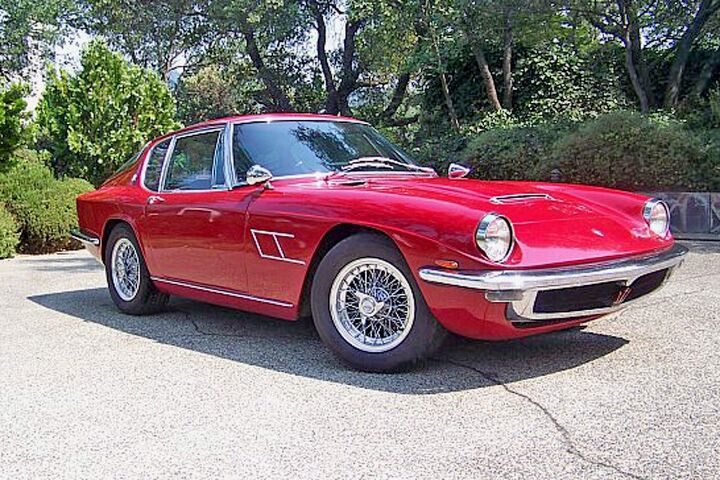
In the early 1960s, Maserati was undergoing a quiet transformation. The Modena marque, forged in the crucible of Grand Prix racing, was transitioning from low-volume racing specials to ultra-sophisticated Gran Turismos for the jet-set elite.
While the mid-60s ushered in the era of high-revving Italian V8s and mid-engine layouts, the 1963–1970 Maserati Mistral (Tipo AM109) stood proudly as the final guardian of the factory’s greatest racing legacy: the double-overhead-cam, twin-spark inline-six engine.
Named after the fierce Mediterranean wind that blows through southern France, the Mistral was the first in a storied line of wind-named Maseratis (preceding the Ghibli, Khamsin, and Bora). Styled by Pietro Frua, its silhouette remains one of the most balanced GT shapes of the mid-century era—a long, sweeping hood, glass fastback tailgate, and a purposeful stance anchored by classic Borrani wire wheels.
The Heart of a Grand Prix Winner
Underneath the aluminum-and-steel body lies mechanical lineage directly connected to the 1957 Formula 1 World Championship.
The Mistral’s 4.0-liter inline-six was the ultimate evolution of the engine that powered Juan Manuel Fangio’s legendary 250F Grand Prix car. By 1967, enlarged to a displacement of 4,014 cc, this ultimate iteration produced roughly 255 to 265 horsepower, making the 4.0L the most potent and sought-after variant of the 844 coupés produced during its production run from 1966 to 1970. Capable of hitting 155 mph, it mated directly to a ZF S5-20 5-speed manual transmission and four-wheel Girling disc brakes.
Chassis AM109.A1.1390 is a 1967 European-delivery 4.0-liter model, fitted with its original ZF 5-speed manual transmission. Finished in a striking Red-on-Red leather combination, it carries European-market metric gauges showing just 29,423 kilometers.
- The Weber Conversion: Originally, late Mistrals left Modena equipped with a Lucas mechanical fuel injection system. While sophisticated for its day, the early Lucas system was notoriously difficult to tune and maintain once aged. Like many period drivers and contemporary collectors, this chassis was converted to triple Weber carburetors. For period Italian GT purists, this is often seen as a practical upgrade—replacing finicky early fuel injection with the reliable, throatier, and infinitely tunable song of three twin-choke Webers.
- The Provenance & Value: The current seller notes over 10 years of ownership, capped by a notable 'Best in Class' victory at Concorso Italiano during Monterey Car Week. While the Hagerty Price Guide cites a condition-one value around $195,000 for factory air-conditioned 4.0L models, the seller has listed this example at $150,000 (OBO). Given that the listing shows rebuilt Girling dual-power brakes, fresh Yokohama rubber on restored 15x6" Borrani 72-spoke wire wheels, and excellent cosmetic condition, this price point presents a compelling opportunity for a buyer looking for a proven event car over a concours garage-queen.
In today's collector market, the Mistral often lives in the shadow of the V8 Ghibli that followed it. But for those who value mechanical pedigree, the Mistral is arguably the richer driving experience. It represents the absolute peak of Maserati's six-cylinder GT evolution—a hand-crafted, high-speed touring car designed to cross continents without drama.
At $150,000, chassis AM109.A1.1390 offers a rare entry point into a multi-award-winning Italian GT with direct ties to Maserati’s golden age of motorsport. For the enthusiast who values driving over static display, the Weber setup and mechanical readiness mean this Red-on-Red cruiser is ready for its next rally.
Find the original listing on Hagerty Marketplace.
Become a TTAC insider. Get the latest news, features, TTAC takes, and everything else that gets to the truth about cars first by subscribing to our newsletter.