
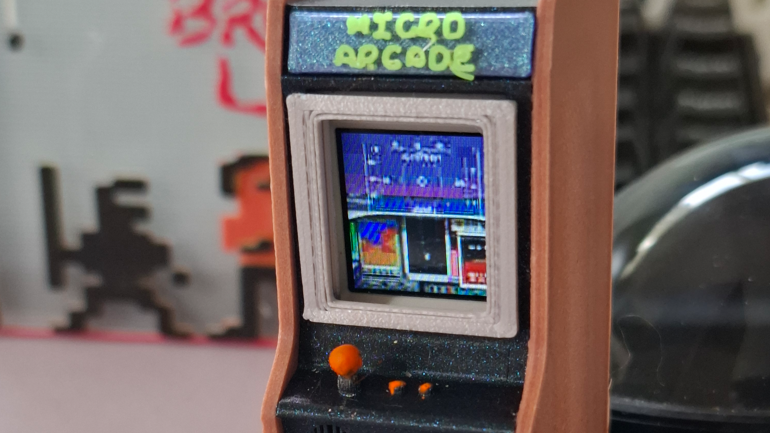
Classic DOS games never ran from within stand-up arcade cabinets in dollhouses, but [Juha Lilja] imagines a world in which they did. His Micro DOS arcade cabinet is described as a device that “runs nothing” because the tiny unit is actually streaming the games over Wi-Fi from a nearby PC. That doesn’t mean it’s just a glorified movie player, though — the cabinet is playable, if a bit awkward to do so.
An economical development board and a 3D-printed enclosure is all it takes to put classic DOS games into dollhouse-sized arcade cabinet.The core of the micro arcade cabinet is a M5Stack AtomS3R running as an embedded remote terminal. One tilts the whole cabinet as if it were a virtual joystick to send up, down, left, and right. Button presses are done by pushing on the physical screen; it supports single, double, and long-clicks. While in theory one could install a micro joystick and buttons instead, [Juha] aimed to keep everything self-contained and use only what was already built into the AtomS3R. In this case, that’s a motion sensor and the single button which is activated by pressing the screen.
The games themselves run on a PC, with screen contents being streamed wirelessly to the little display and inputs being sent back. The firmware on the AtomS3R doesn’t know or care what game is being played; all it does is display what it’s told, and send back input events. The back end does the rest. This makes it pretty flexible, and a tiny arcade cabinet is a handy way to demonstrate the whole system. It’s a pretty slick addition to his daughter’s dollhouse, too.
If streaming DOS games (or whatever else) to economical endpoints is giving you some ideas, the GitHub repository holds code and a fuller explanation of how it works. There’s a deeper discussion on some of the finer technical points, as well. Watch it in action in the video embedded just below the page break.