
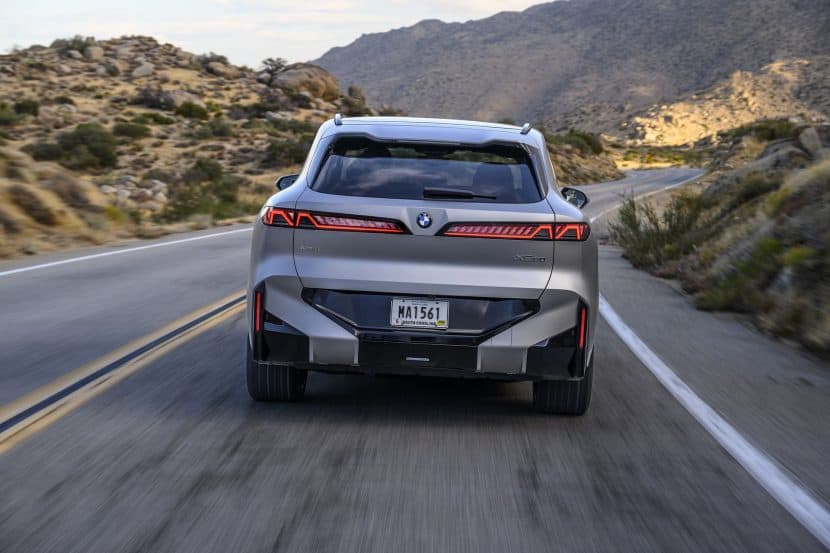
I think the BMW iX is one of the best SUVs BMW has ever made. It was smartly designed around a bespoke chassis, it had huge amounts of interior space, it was efficient for its size, and its air suspension rode beautifully while still letting the car be fun on a good road. So the BMW iX5 60 xDrive has big shoes to fill as a daily driver, at least in my house, where an iX is the car it would replace.
A day of California canyon roads, freeway miles and city traffic was enough to know the iX5 fills most of them. Its air suspension is every bit as good as the iX’s despite the extra weight, its seats are better, its regenerative braking is a generation ahead, and the extra speed is addictive. It gives up some rear-seat space to the iX, the sound system isn’t as special, and a few of its design decisions, the door handles above all, I’d undo tomorrow. It’s still the X5 I’d buy.
How Does A 6,400-Pound X5 Handle A Canyon Road?The first thing I did was floor it from a stop, because everyone wants to know what 6,400 pounds does to an X5. The timer showed 4.59 seconds to 60 mph, measured without the one-foot rollout behind BMW’s 4.4-second claim, and with the rollout it would likely have beaten BMW’s number. Also, keep in mind that the iX5 is roughly 600 kg (about 1,300 lb) more than the gas X5 40 I drove the day before, and around 700 lb more than an iX xDrive60.
2027 BMW iX5 60 xDrive
Good
- Air suspension rides as well as the iX’s
- The best regenerative braking BMW has built
- 460-kW charging and a range of 450 miles
Bad
- Winglet door handles with no keyhole
- Sound system falls short of the iX’s Bowers & Wilkins Diamond setup
- Less rear-seat space than the iX, and no physical vent controls
But do you feel its weight? That depends. In normal driving, unlikely, especially in the California traffic. Now push it into the canyons, and yes, that weight is noticeable but not to the extent that would make the drive unbearable or less fun. In fact, the iX5 drives phenomenally well: planted, quick to react, and smooth in everything it does. The rear EESM motor, which needs no permanent magnets or rare earths, does most of the work, while the front ASM motor decouples when it isn’t needed and joins in at higher speeds or when you ask for everything. BMW’s new central computer, the Heart of Joy, manages both motors and the braking, and on the mountain roads I found it read what the wheels were doing so quickly that hard exits from tight corners produced no wheelspin at all. I pushed the car to its limit and never felt it lose traction, which is more impressive on low-rolling-resistance Michelin Pilot Sport 5 tires rather than stickier sport tires.
This Neue Klasse hardware makes the iX5 a lot more fun and more eager in corners than the iX. The steering turns the car in quickly and carries decent weight without going vague on center, though it isn’t as aggressive as an M car’s, and I expect the coming iX5 M70 to be the sharper tool. The straight-line speed, even in the 60, is genuinely addictive. With BMW’s Iconic Sounds switched off it becomes dangerously easy to reach illegal speeds without noticing, so I left them on, because they tell you what the car is doing.
You still feel the mass in fast direction changes as the body leans onto the outside wheels, and even with rear-axle steering and active anti-roll stabilization fitted, my camera operator in the back was always going to get car sick before I got bored.
The Best Regenerative Braking BMW Has Ever BuiltThe regen is a huge step forward. Most of the slowing is now done by the electric motors before the friction brakes are needed at all. In the strongest setting, lifting off before a hairpin scrubs off enough speed that I barely touched the brake pedal, and the energy goes back into the battery instead of into the pads. You can choose low, medium or high regen, let the adaptive mode pick the strength from the road and driving conditions, or shift into B for one-pedal driving. It’s miles better than anything BMW offered before, including in the iX.
The soft-stop function is the part I keep bragging about everyone since I had a chance to experience it in the BMW iX3 as well. It eases off the brakes so gently at a standstill that with your eyes closed you’d struggle to feel the moment the car stops. It’s a touch less smooth than in the lighter iX3, because you can feel the weight pitch forward when you lift off, but it’s still excellent.
The drive modes are spread further apart than in older BMWs, which I count as progress. Switch to Sport and you feel it immediately, as the two-axle air suspension and adaptive dampers firm up, the steering gains weight and the throttle gets more eager. You can also build your own Personal mode by setting the powertrain, regen, chassis and steering separately.
The Air Suspension Is As Good As The iX’s, With More Weight To CarryBMW didn’t want the gas and electric X5 to feel like different cars, so the iX5 uses the same suspension links on the same CLAR platform as the rest of the G65 family, a platform BMW adapted for every drivetrain it offers, including hydrogen. That’s the opposite of the X3 and iX3, which sit on separate platforms. The iX5 does get its own front and rear subframes for the extra weight, higher spring rates, and slightly smaller brake pads, since the motors handle so much of the braking that the pads should also last longer.
The air suspension is the star. I was impressed by it in the current-generation X7 and in the iX, and the iX5’s is every bit as good as the iX’s, which is remarkable given the extra weight it carries. In Comfort, with chassis, steering and powertrain all at their softest, the car settles immediately, floats slightly into corners and gains extra play in the steering, so it’s the wrong mode for the canyon and exactly the right one for everything else. Speed bumps and broken pavement barely registered, and the 22-inch wheels on the test car never brought too much noise or harshness into the cabin, although the 21s would likely ride even better. You can also set the ride height to High, Auto or Low; High lifts the body 1.1 inches, and Low drops it 0.8 inches below normal at speeds under 30 mph to make loading easier.
The top driving package is now called Adaptive Chassis Control Professional, and it’s the one I’d order. It pairs the air suspension with rear-axle steering and active anti-roll stabilization. The rear wheels turn up to 3.2 to 3.4 degrees, which cuts the turning circle from 12.8 to 12.1 meters and makes the car easier to maneuver in town and smoother through lane changes. The anti-roll system is decoupled side to side, so each wheel responds to its own bump instead of reacting to the one opposite, and the car stays more planted on uneven roads. The X5 40 I drove the day before had neither, and it rolled a little more through the same kind of corners. If you’re spending this much on an X5, add this package and the Highway Assistant; if you’re more frugal, you can skip both and still have a car that’s fun to drive.
How Far Does The iX5 60 Go, And How Fast Does It Charge?The 800-volt battery uses BMW’s new 120-mm cylindrical cells and holds about 144 kWh, in a pack roughly 40 percent larger than the iX3’s. The EPA rates it at 450 miles, and BMW drove an iX5 500 miles from San Francisco to Los Angeles and arrived with more than 50 miles left. That’s impressive, and patient drivers in good weather should be able to beat the official number.
It’s also the fastest-charging BMW on sale. DC charging peaks at 460 kW, against the iX3’s 400 kW, and a 10 to 80 percent charge takes about 22 minutes. The charging curve will differ from the iX3’s because the iX5’s cells are taller. The port takes a NACS (Tesla-style) plug, so Superchargers work, and according to BMW the flap opens on its own when the car detects it has pulled into a charging station.
My day was nothing like a hypermiling run. After an hour and 21 minutes of hard driving, the trip computer showed 2.13 mi/kWh, with 87 percent of the energy going to the drivetrain, 7.3 percent to climate and 5.7 percent to electronics. After a little over two hours and 101 miles, including a highway run back at 70 to 80 mph, it had climbed to 2.8 mi/kWh. If you live somewhere cold, plan on losing 25 to 30 percent of your range in winter, although preconditioning the battery at home helps.
Driver Assistance Has Taken A Real Step Forward Since The iXThe driver assistance features are the other big improvement over the iX. Highway Assistant allows hands-free driving at up to 80 mph (130 km/h in Europe) for as long as you like, provided the camera in the rearview mirror sees your eyes and head pointed at the road. Look away too long and it hands control back to you. More importantly, steering, braking or accelerating no longer switches the system off, so you no longer have to reactivate it with a button on the wheel every time you touch the pedals. Even though it doesn’t always happen, in theory, when you come up behind slower traffic it offers a lane change, and a glance at the mirror approves it; you can also start one yourself with a light nudge of the turn-signal stalk. Near an exit, it moves to the right lane, asks you to take the wheel at the ramp, then helps steer you through it.
US cars also get City Assistant, which reads traffic lights. In town it stopped for a red light I had stopped paying attention to and then pulled away again by itself, although it only allows about 10 seconds of hands-free driving at a time before asking you to take over. It’s a Level 2 system, not the point-to-point driving Tesla’s FSD attempts.
The new assist view is very cool. Like the displays in Teslas and Rivians, it shows a live rendering of the cars, people and road around you, and it can stay on even without an active navigation route. It’s a bit laggy right now in some scenarios, but hopefully over-the-air updates will improve it.
The cabin is also quieter than I expected. BMW did a good job keeping out wind and road noise, and at 70 mph on smooth pavement a decibel app on my phone read 60 to 70 dB, a little quieter than the X5 40 and a little louder than an i7, without the optional acoustic glass. You can talk to the kids in the back without raising your voice, and 570 hp and 593 lb-ft (805 Nm) makes passing easy, even in a car this heavy.
Panoramic Vision, The 3D Head-Up Display And A Few Lost ButtonsFor me, Panoramic Vision is instantly a better format for driving. It simply and elegantly puts the information I used to look down for, behind the steering wheel, at the base of the windshield, and I had zero issues reading it through polarized sunglasses. If it shows too much, one tap on its silent mode clears everything except the legally required information. The optional 3D head-up display is amazing. It’s huge, renders the road ahead in 3D, and outlines very clearly where you need to go.
There’s one thing I miss from the iX. That car could show Apple Maps or Waze in the instrument cluster behind the wheel; in the iX5 I have to turn my head to the center screen. I hope BMW adds phone navigation to Panoramic Vision. The 17.9-inch center display itself is a lot easier to use than the iX’s, both ergonomically and in its software. iDrive X runs on Android Open Source, responds faster than iDrive 8.5 or 9, and looks built to receive frequent updates over a long life.
The optional passenger screen works like a built-in tablet, with Spotify, YouTube, Amazon Prime and other streaming apps, but you can’t use it from the driver’s seat. A camera watches the driver, and if your eyes linger on it, it shuts off; even a brief glance in its direction can do that, which gets old. I probably wouldn’t order it, but if you take a lot of long trips with a passenger, it’s worth a look.
The losses are harder to forgive. There are no physical vent controls anymore, only presets (Direct, Indirect, Personal and Wave) and that’s far from idea. It’s certainly distracting having to adjust the vents via the screen while driving, so there is little argument that can be made in favor of digital presets. The iDrive controller is gone too, replaced by haptic steering-wheel buttons that light up based on context, such as offering the Highway Assistant on a freeway, and a small touchpad for scrolling. The rotary controller was easier to use. One clever new trick: you no longer have to press Park. Come to a stop, unbuckle your seatbelt, open the door, and the car shifts into Park by itself.
Better Seats Than The iX, But A Weaker Sound SystemThe M Sport seats in the iX5 are better than the iX’s. They’re a lot more supportive, in the side bolsters and the backrest, and the cushion is longer, especially with the thigh extension, which the iX doesn’t have and which I missed on long drives in that car. A button on the door brings up the seat controls on screen, where you can tighten the bolsters for corners, loosen them for long trips and adjust the lumbar support, and the passenger gets the same settings. The ventilated seats were very nice too. I’m 6-foot-2, and these seats felt great over long distances. I’m still amazed at how comfortable yet supportive they are compared to the iX, for example. I keep bringing up that model since I didn’t have a chance to spend too much time with the G05 X5 in the last year or so, so it’s tough to draw a direct comparison on comfort.
The steering wheel deserves a warning. The base and sport wheels put their spokes at 12 and 6 o’clock, and while that makes little difference in normal driving, I kept looking at the roundel while parking to check which way the front wheels were pointing. The M Sport wheel has conventional spokes at 4 and 8 o’clock, and it’s the one I’d order.
Interior quality feels higher than in the iX3, but I would say, below the iX. Opinions vary on whether the new X5 is a step down from the G05, and I think quality in most new BMWs has slipped a little; there’s plenty of hard plastic where you touch the car most, around the door handles and switches. Even the real slate in the center console feels more like plastic. That said, I like the iX5’s optional glass controls which beats piano-black plastic, and the dash is covered in leather.
The sound system is the biggest step back. The iX’s Bowers & Wilkins Diamond system, with 30 speakers and 1,615 watts, was amazing. The iX5 offers an 18-speaker, 775-watt Bowers & Wilkins system over a standard 280-watt, 12-speaker unit, and it sounds good overall, but it doesn’t reach the iX’s level. Having heard the Harman Kardon system in the iX3, I would definitely choose the Bowers & Wilkins.
Design: A Gas X5 Lookalike With Door Handles I Don’t LoveBMW wanted the X5 to look the same whatever powers it, so from a distance you won’t tell the iX5 from the gas car. Up close, it gets the X-shaped lighting signature, which you can switch off, and the enlarged, illuminated kidney grille shared with the gas X5 rather than the smaller one on the iX3. The test car had the M Sport Package, and M Sport Pro darkens the trim further. A valley in the bodywork surrounds the new BMW logo front and rear, and the nose stands more upright than the outgoing G05’s, which makes the car look massive from the front.
Wide shoulders make room for the motors, the roofline drops toward a more coupe-like tail for better aerodynamics, and at 196.6 inches long, it’s about the size of the current X7. The Frozen Space Silver paint suits it, shading from bright silver to darker gray across the body lines, and with no tailpipes the rear diffuser is cleaner.
The door handles are not my favorite. BMW calls them winglets, and the doors open on their own once sensors confirm nothing is in the way, stop short if a car or cyclist is approaching, and soft-close. But there’s no keyhole and no physical door handle anymore. If the car loses power, you have to pull the hood release hidden near the windshield, open the hood, find the hatch for jump-starting the car, and power it up before you can open a door. I’d rather have regular handles or the flush ones BMW used before, because they simply work. I suspect BMW wanted the cleanest possible side profile for the monolithic design it’s pushing.
Trunk, Frunk And Rear Seats Against The iXThe cargo area is one place where the iX5 beats the iX. It holds 655 liters (23.1 cubic feet) behind the rear seats and 1,850 liters (65.3 cubic feet) with them folded, against the iX’s 500 and 1,750 liters. The iX’s oddly shaped rear end limited both its cargo space and the height of its trunk opening. There’s also useful storage under the floor for charging cables. Compared with the gas X5 40, though, the iX5 gives up about four cubic feet. The split tailgate is gone, and I still think that’s a mistake. BMW says shorter owners struggled to reach bags at the back of the cargo area over the lower section, but the split tailgate made loading and sliding things into the car much easier, and I suspect cost played a part.
The frunk holds 53 liters, five fewer than the smaller iX3’s, because the CLAR platform has to package it around hardware that the dedicated Neue Klasse architecture doesn’t. It’s fine for a charging cable or small items and not much else.
The rear seats are excellent. They’re not quite as sumptuous as the front seats, but they have everything you’d want as a passenger. The bench is angled up to free more headroom, and with the front seat set for my 6-foot-2 frame I still had a full outstretched palm, six to seven inches, above my head. Legroom is plentiful, and scoops in the backs of the front seats add another inch and a half to two inches of knee room, which will help anyone 6-foot-2 or taller. The floor still has a housing for a transmission tunnel, so the middle seat is not as comfortable as in the iX, for example. Even the iX3 has that nice scoop in the bench which makes it somehow more comfortable for a passenger riding center.
Also, because you sit higher in an EV, my knees ended up above a comfortable 90 degrees. The iX still has more rear-seat space, the price of the iX5 sharing the flexible CLAR platform instead of a bespoke EV chassis. There’s no third row; for seven seats you’ll have to wait for the next X7.
Should You Buy The iX5 60, The iX Or The X5 40?The iX5 60 starts at $79,800 ($81,250 with destination), against $73,550 with destination for the gas X5 40. An X5 50e plug-in hybrid and more M Performance models, including a new V8, are coming, and next year’s iX7 will complicate things further, since it’ll be built on the same technology, likely with more power and a bigger battery.
If you’re coming from a BMW iX, as I would be, the iX5 is the natural replacement. You give up some rear-seat space, the iX’s spectacular sound system and a little interior quality. In return you get a car that’s more fun to drive, rides just as well despite the extra weight, charges faster, goes farther, has better seats, a bigger trunk, a far better regen system and a big step forward in driver assistance. The comparison with the X5 40 is harder. Its B58 inline-six gives it a rawer, more emotional character and a sound no EV can match, and it never feels underpowered. With gas as expensive as it is, though, the electric car sho