
See more Toronto Sun on Google — save as a Preferred Source
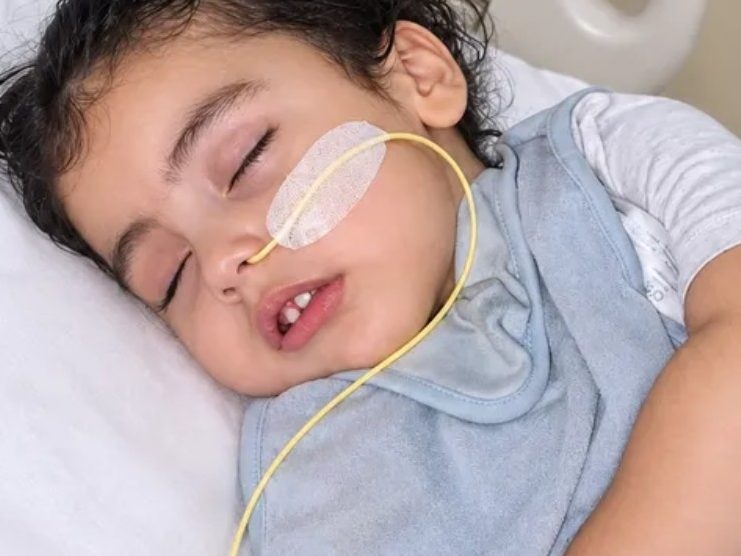
The $3 million mark has been reached in the fundraising journey for little Zorawar Chandi – a two-year-old Brampton boy suffering from a rare genetic disorder.
But another $2.5 million still needs to be raised for the toddler to have a shot at a better life courtesy of an expensive treatment in the Unites States that’s not covered in Canada.
“We are feeling blessed by the community,” the tot’s father, Mandeep Chandi, told the Toronto Sun on Saturday. “So, it’s really a blessing for us. It’s been really good.”
This grassroots campaign has attracted an audience outside of North America as more than 55,000 donations have poured into the GoFundMe site from the United Kingdom, New Zealand, Australia and elsewhere.
Family more than halfway to $5.5M goal
The family was 55% of the way to reaching their goal of $5.5 million on Saturday afternoon.
“To all who live in the UK like I do, please donate,” a campaign contributor said. “When I next hug my niece, who like Zorawar is 2yrs old, I will give her an extra hug just for him.”
The number one donation was an anonymous $10,000 gift sent a week ago. And more than $1 million has been raised since the family’s plight gained media attention last weekend.
The Brampton toddler was diagnosed with a rare genetic disorder called Aromatic L-amino Acid Decarboxylase (AADC) deficiency.
The treatment for the disorder comes by the infusion of a drug called Kebilidi into a precise region of the brain. A small hole is drilled into the skull prior to surgery. If and when surgery happens, it is scheduled to take place at Boston Children’s Hospital.
No escape from stark reality
The Brampton man says his thoughts are consumed by concern for his two-year-old son and there really is no escape from the stark reality of the situation.
During his brief conversation with the Sun, Chandi sounded exhausted and overwrought.
“Every day is like a battle for us,” he said. “So, it’s really hard for us. We think about it every day, and what is going on because of our future.”
In November 2024, the U.S. Food and Drug Administration approved Kebilidi. The one-time therapy costs approximately $3.95 million US.
But including out-of-pocket expenses, such as specialized inpatient surgical care and follow-up, the price tag may exceed $5.5 million.
Despite approaching individuals within the medical community and various levels of bureaucracy for funding, the Ontario government has turned away the family’s request for funding.
“Despite our efforts, we are still searching for a way forward,” Mandeep said.
Parents hopeful treatment can rewrite son’s future
AADC is an inherited disorder that affects the way nerve cells transmit information to other cells. Signs and symptoms usually make themselves known in the first six months of life.
Affected infants may have feeding problems, weak muscle tone, sleep disturbances, developmental delays and intellectual disabilities.
A previous report from the Boston hospital stated that after 48 weeks of follow, up three-quarters of treated patients had achieved “new gross motor milestone, including full head control, sitting with or without assistance, and walking.”
A father’s hope is pinned on positivity that this procedure will allow his child to rewrite his future.
“Something is going to change,” Mandeep said. “We know that. After this treatment something is going to change.”
There is no reliable data on the number of people affected globally by this disorder. PTC Therapeutics, the New Jersey-based company that developed the therapy, estimates the number at 5,000.
- Canadians seeking health treatments hit record wait, survey finds
- OPINION: Flatly equal is not enough — Canada's healthcare
- JAY GOLDBERG: Bureaucracy is putting Canadians’ lives on the line
- WARMINGTON: Toronto taxpayers to pay for gender-affirming care for city staff, including surgeries
Other Ontarians in need of out-of-country care
Sabrina Apitz-Grossman, Kevin Nash and Alex Shved are three additional Ontario residents seeking out-of-country care in the U.S.
Apitz-Grossman was diagnosed with synovial sarcoma – a rare and aggressive soft-tissue cancer. Treatment is available in the U.S. but the Ontario government won’t cover the cost.
Apitz-Grossman and her lawyers are asking an Ontario court to order the Ford government to pay for Tecelra – a specialized T-cell therapy.
Apitz-Grossman has also launched a GoFundMe page in an effort to raise the money. The treatment costs approximately $730,000 US and, as of Saturday afternoon, Apitz-Grossman has raised nearly $265,000 of the $785,000 she’s hoping for.
Nash, a 59-year-old with Stage 4 melanoma, is also challenging the province’s refusal to fund a T-cell treatment not available in Ontario. He is seeking tumour-infiltrating lymphocyte (TIL) therapy in the U.S. Nash is also challenging the ruling in an Ontario court.
Shved, a 37-year-old father of two children, has Stage 4 melanoma. The Ontario government denied his request to receive TIL therapy in Florida at an approximate cost of $600,000 US, citing the fact that the therapy is under consideration for public funding in Ontario.
ganderson@postmedia.com