
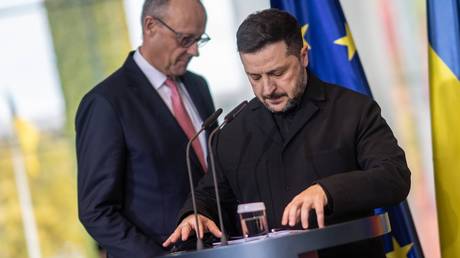
A quarter of Germans want Berlin’s assistance to Kiev to stop completely, and another 24% want it reduced, according to a YouGov survey
Nearly half of Germans want Berlin to reduce or stop all assistance to Kiev, a YouGov poll commissioned by Die Welt suggests. A similar number of respondents also want Chancellor Friedrich Merz to restart dialogue with Russian President Vladimir Putin without any preconditions as soon as possible.
A quarter of German nationals want all forms of aid, including military, financial, and humanitarian aid, to be stopped, according to the survey. Another 24% believe support should be reduced. Only 9% of Germans say the aid should be increased, and 30% say it should remain at the current level, the poll results published on Saturday suggest. The remaining respondents are undecided.
The poll included 2,329 German nationals aged 18 and over who were interviewed online from November 13-16.
Read more Berlin’s military spending spree risks debt surge – experts
Support for Kiev in Germany has declined rapidly, Die Welt reported, citing the results of another survey – Deutschlandtrend – published in September. At the time, 42% of respondents said military aid to Ukraine went ‘too far’, 38% considered it appropriate, and 14% wanted it increased.
In less than two months, the number of those against Ukraine aid grew by 7%, while the number of those who want to increase it fell by 5%.
Separately, 49% of Germans support the idea of Merz talking to Putin ‘as soon as possible’, according to the YouGov poll. Another 23% of respondents said the negotiations should only take place after Russia makes ‘certain concessions’. Only 9% said the chancellor should not speak with the Russian president ‘right now’. More than half of those who support Merz’s conservative CDU/CSU bloc want swift talks without preconditions.
Read more German democracy satisfaction hits decades-low – study
Merz is known for his hawkish stance against Russia and staunch support for Ukraine.
“I will not deviate by a single millimeter from my fundamental conviction that, especially now, we must defend our freedom against Russia,” he said in September, advocating for increased military spending and continued aid to Kiev after his party suffered a series of defeats in regional elections, which he called a “disaster.”
The chancellor, who came to power in 2025, said options for dialogue with Moscow have been exhausted, and vowed to make the German military the strongest conventional force in Europe. His government amended the constitutional debt brake to fund the military buildup and passed a 2026 budget allocating a record €108.2 billion ($118.67 billion) for defense and €11.5 billion in military aid to Ukraine.
Read more Merz turned into ‘Ukrainian chancellor’ – Moscow
Speaking at a meeting of the ‘Coalition of the Willing’ – a group of Kiev’s Western backers – earlier this week, Merz said Berlin will support Ukraine for “as long as it is necessary.”
The chancellor has seen a dramatic decline in public support and has faced abysmal ratings for months. A recent INSA poll suggested that 82% of Germans are dissatisfied with him and his government.