
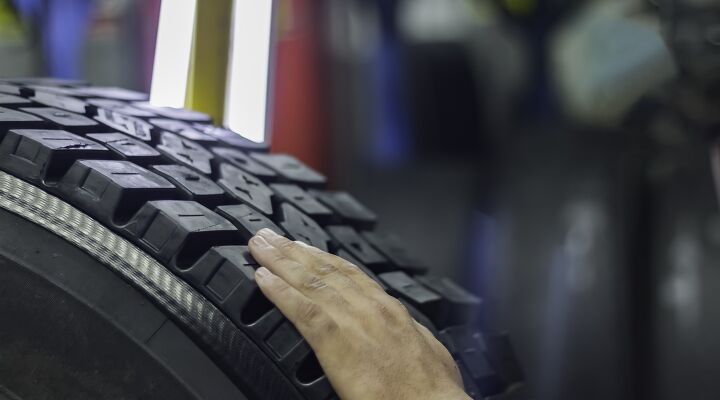
The tire industry looks to be evolving and appears to be taking a page out of the same book automakers have been using. Businesses want to trim overhead and increase their profit margins to appease investors. Sadly, this has resulted in numerous factory closures for North America and is allegedly setting the industry up for some major changes.
Over the last two years, roughly a dozen tire plants have either closed or announced plans to gradually ramp down operations.
Goodyear, BFGoodrich, Bridgestone, Michelin, Sumitomo, and Yokohama have all stated that they would be shuttering production facilities located in North America. According to a recent report from Automotive News, this is allegedly due to legacy brands losing ground to budget-focused brands stemming primarily from Asia.
While you’re likely to see a name you know on the wheels of a brand new automobile, retailers know that plenty of customers don’t want to pay top dollar for premium tires. Considering that most drivers are not enthusiasts, they’re not going to be stressing over something like cross-climate performance. In all likelihood, they probably don’t even understand just how important tires are in general. They just want to save themselves some money.
However, tire technology has also improved by leaps and bounds over the decades. The budget tires of today are often significantly better than what would have been available a generation earlier and the premium tires are head-and-shoulders superior to anything you could have gotten before. That’s thanks primarily to the companies who were obsessively focused on R&D to develop the best quality tires money could buy. Sadly, this has encouraged many of those same brands to lean ever more dramatically into the premium category.
Retailers are reportedly selling more cheap rubber because that’s what customers want, especially under the current economic conditions. Meanwhile, automakers want their vehicles to perform extremely well in testing and comply with regulations. This creates a situation where legacy tire brands are developing more rubber for OEMs and enthusiasts while they increasingly ignore the bottom end of the secondary market.
This trend is probably most overt when it comes to space savers. As automakers have moved away from offering spare tires, so did the legacy brands that produced them. Instead, they’re now focused on fielding rubber for brand new vehicles and developing specialty tires for heavy all-electric models. In order to appease emissions and maximize range, manufacturers are asking tire companies for a lot of counterintuitive things.
The need for tires that have low rolling resistance that can still accommodate a lot of weight and offer sufficient grip is arguably something only the top-tier brands can deliver. This, along with developing rubber for specific models, arguably places them into a situation where they may be able to corner the market on select models. The California Energy Commission is even pushing new rules that would mandate replacement tires to have the same rolling resistance as the original rubber. While framed as a way to reduce emissions in the state, it likewise advantages whatever company originally produced the OEM tires.
Many tire companies have claimed that simply having large-scale manufacturing capabilities is now less important than being highly adaptive. By eliminating older production facilities in North America, claim that they can pivot more of their focus to speciality tires catering to speciality vehicles (e.g. performance cars, larger trucks, and EVs).
This means that they’re likewise giving up ground to industry upstarts focusing on the lower end of the market. However, if nobody is buying your high-volume replacement tires, then there’s little reason to continue manufacturing them.
Goodyear CEO Mark Stewart touched upon this earlier this year following announcements that the company would be closing its factory in Fayetteville, North Carolina. He argued that there simply wasn’t enough money in budget tires targeting more mainstream automobiles. Instead, the company plans to focus more on all-terrain, oversized, and performance applications.
The company’s recent financial performance has been rather mixed. But it looks to be following the same business path as Michelin, which has enjoyed superior profitability. That said, both companies have experienced a decline in business due to automakers simply producing fewer cars than they used to and supply constraints stemming from regional conflicts.
Claiming that their decisions are exclusively down to modernizing doesn’t tell the whole story. Many tire manufacturers are indeed losing ground on the global market due to various economic issues, automakers suddenly selling fewer vehicles, and customers flocking to cheaper brands when it comes time to replace their old tires.
However, some companies seem to be doing just fine while they shutter Western plants. Yokohama has been enjoying stable growth and record profit margins. But the company still opted to close its production facility in Salem, Virginia, earlier this year. The claim was that demand for smaller-diameter tires was on the decline and that the site was simply outdated.
Despite the government often associating quadrants of the automotive industry with national security, there appear to be a lot of blind spots. Semiconductors, data collection breaches, and even the ability to manufacture batteries within the United States have all been framed as deathly serious issues. Being overly reliant on imported goods is something the government always claims to be concerned with. But domestic tire plants don’t seem to be much of concern, even though rubber rationing was commonplace during World War II.
The lingering question is where things go from here. If the automotive industry plans to continue running with lower volumes and higher margins, some of these higher-end tire brands will need to downsize. The alternative is for them to try and compete on the budget market, which has only gotten more saturated in recent years.
[Images: pamir/Shutterstock; Hryshchyshen Serhii/Shutterstock; Zigmunds Dizgalvis/Shutterstock; action sports/Shutterstock; Standret/Shutterstock]
Become a TTAC insider. Get the latest news, features, TTAC takes, and everything else that gets to the truth about cars first by subscribing to our newsletter.