
In Anchorage, exploring nature isn’t only for a rare free day or a well-planned vacation; it’s a part of daily life, as integral to the city as its infrastructure and cultural offerings. A day here may start with a morning walk on any of the hundreds of miles of trails, continue with freshly caught salmon for lunch at a restaurant with coastal views, and end with a sunset picnic on a rocky outcropping, where the only sounds are crashing waves and the fleeting glimpses of beluga whales.
Located on a coastal plain that shifts into alpine slopes farther east, Anchorage is unique in how its different ecosystems overlap, creating rich diversity in wildlife, botany, and geology. You can experience the best of nature while still enjoying all the creature comforts of urban life and stumble across breathtaking sights without even looking for them. In this guide, we’ve given you some starting points for exploring the wild from Alaska’s biggest city, with wonders ranging from undisturbed wooded trails to marshes that all kinds of animals call home. Ready to take a walk on the wild side?
Ship Creek
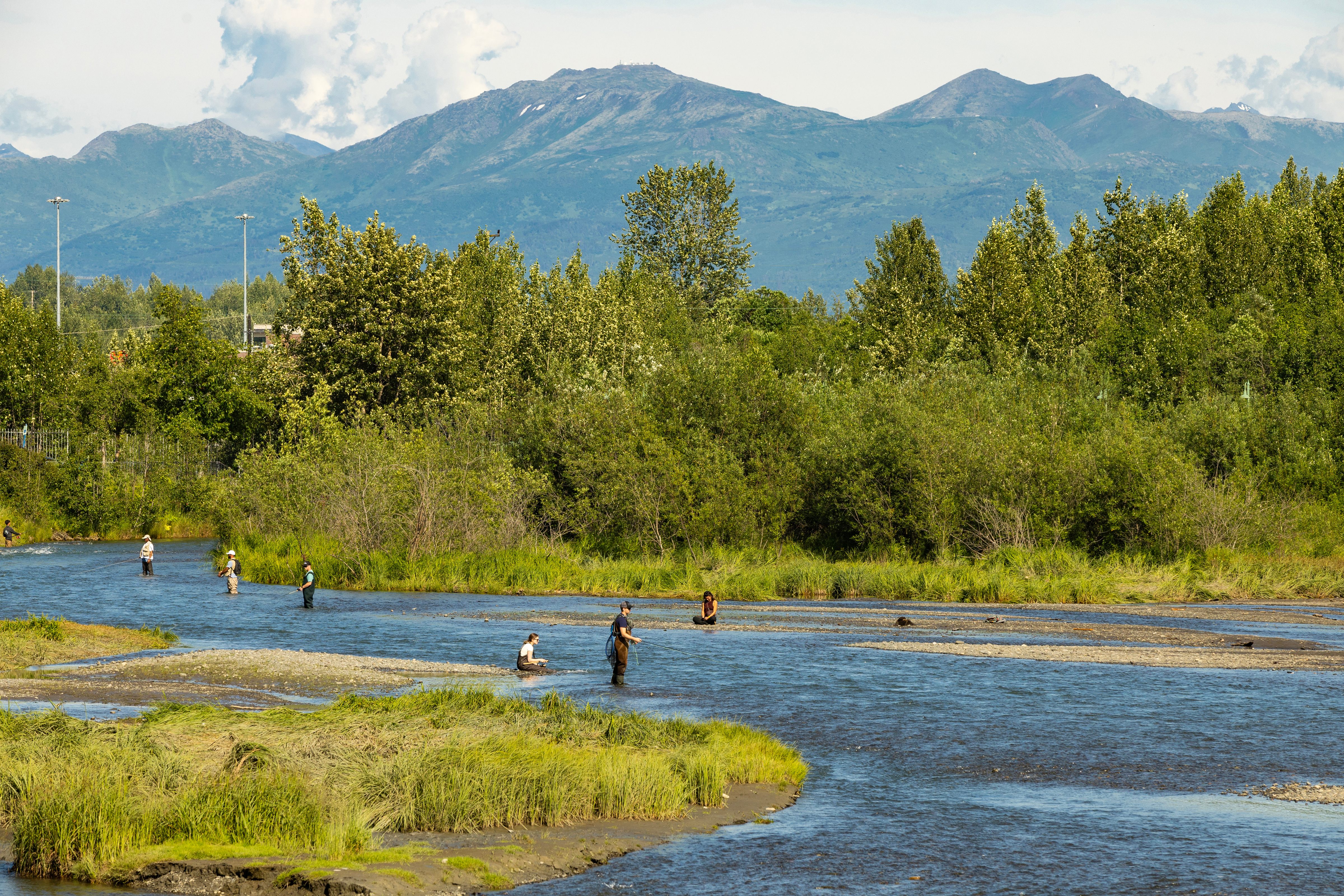
This 25-mile-long river flows from the Chugach Mountains down into the Port of Alaska on Anchorage’s northern side, where it’s become a popular spot for sport fishing and bird watching. Thanks to its mud and sedge flats, and ocean-fed waters, this area is home to a massive annual run of coho and Chinook salmon. In fact, it’s the only urban Chinook fishery in the world.
The 5.8-mile Ship Creek Trail is a perfect way to spend time in nature without leaving the city limits, providing views of salmon spawning and swimming upstream during the summer. Stops along the way, like Ship Creek Overlook Park and the pedestrian bridge just off King’s Landing, provide especially great panoramas of the river and the surrounding mountains. It’s not uncommon to see anglers trying their luck for 20- to 30-pound salmon, and you can even visit the statue of Dena’ina matriarch Grandma Olga, fish filets in her hands and a bronze drying rack behind her.
Tony Knowles Coastal Trail
For a longer walk, try this 11-mile path that stretches from downtown Anchorage all the way to the Kincaid Park Chalet. However, if you’re looking for a shorter trek, have no fear: The trail is accessible from multiple points in the city, meaning you can hop on or off. You don’t have to explore on foot either, as the trail can be traversed easily by bike and, in the winter, cross-country skis. No matter how you travel the trail, you’re guaranteed some incredible views of downtown Anchorage, Mount McKinley (Denali), Mount Susitna, and Fire Island, especially as you reach the hills near Point Woronzof.
The trail offers a rare chance to pass through a number of different biomes, as it winds through marsh, muskeg (acidic, waterlogged peatland), and thick spruce forest. There’s also plenty of wildlife nearby, with moose, in particular, enjoying long walks on the path during the winter. Other animals often spotted include sandhill cranes, ermine, bald eagles, and even beluga whales in Cook Inlet, so don’t forget your camera.
Kincaid Park
For even more great hiking, visit Kincaid Park, a 1,400-acre green space that was once a Cold War missile base. There’s plenty to do in Kincaid: walk down the 40 miles of cleared trails, practice archery on a designated range, paddle through Little Campbell Lake, or play disc golf on an 18-hole course. There are also seven different soccer fields, a motocross course, and a giant sand dune with stunning views of Cook Inlet and the Kenai Peninsula. In the winter, the park becomes a premier destination for sledding and cross-country skiing, with trails for every skill level.
Potter Marsh
Just 15 minutes south of downtown, this part of the Anchorage Coastal Wildlife Refuge is one of the best wildlife viewing spots in all of Alaska, offering sweeping vistas of the Turnagain Arm tidal waterway and half a mile of boardwalk across the channels and sedges. This wetland ecosystem is full of creatures big and small, from muskrats paddling through the water to the occasional moose taking a dip. And birders, rejoice: The marsh is home to more than 130 bird species, including Arctic tern, Canada geese, trumpeter swans, red-necked grebes, and northern pintails.
Pro tip: Visit in April for the greatest variety of migrating birds, or in midsummer to see three different species of salmon schooling under the boardwalk. Information panels and telescopes along the path make it easy to enjoy a self-guided tour and take in the sights and sounds of the marsh at your own pace. You can also see the marsh from aboard the Alaska Railroad or while driving down the Seward Highway.
Beluga Point
Also along the Seward Highway sits Beluga Point, a rocky promontory named for the population of beluga whales that can be spotted each July and August when they come to catch salmon in the inlet. However, no matter what time of year you visit, 180-degree views of the Chugach Mountains make this a worthwhile place to stop and take in your surroundings.
Nearly every day, the Turnagain Arm bore tide — a dramatic wave caused by incoming tides — sweeps through the inlet. At a height of 6 to 10 feet, it’s one of the largest bore tides in the world, and because it’s relatively slow moving, surfers from all over the globe come to tackle it.
Flattop Mountain
The most-climbed mountain in Alaska is just east of Anchorage in Chugach State Park, accessible from the Glen Alps Trailhead (reachable by a shuttle that leaves from downtown Anchorage). It’s a 1.5-mile hike from the trail parking lot to the top of the plateau, with an elevation gain of 1,500 feet and incredible views of the Anchorage skyline, as well as Denali, Mount Foraker and Mount Spurr on clear days. For an even greater challenge, visitors can make their way up an additional trail to the peak, though this is a steep journey best suited for experienced outdoor adventurers.
Aside from hiking, Flattop is a popular destination for berry picking in the summer and fall, with its trails (especially the Powerline Pass) taking you past wild blueberries, crowberries, and lowbush cranberries. The summit of Flattop is also a hub for paragliders, with its level surface and multidirectional open areas allowing for many possible setups (and plenty of photo ops).
With all this and more to explore, what are you waiting for? Embark on your Anchorage adventure today!