
Source: Apple.
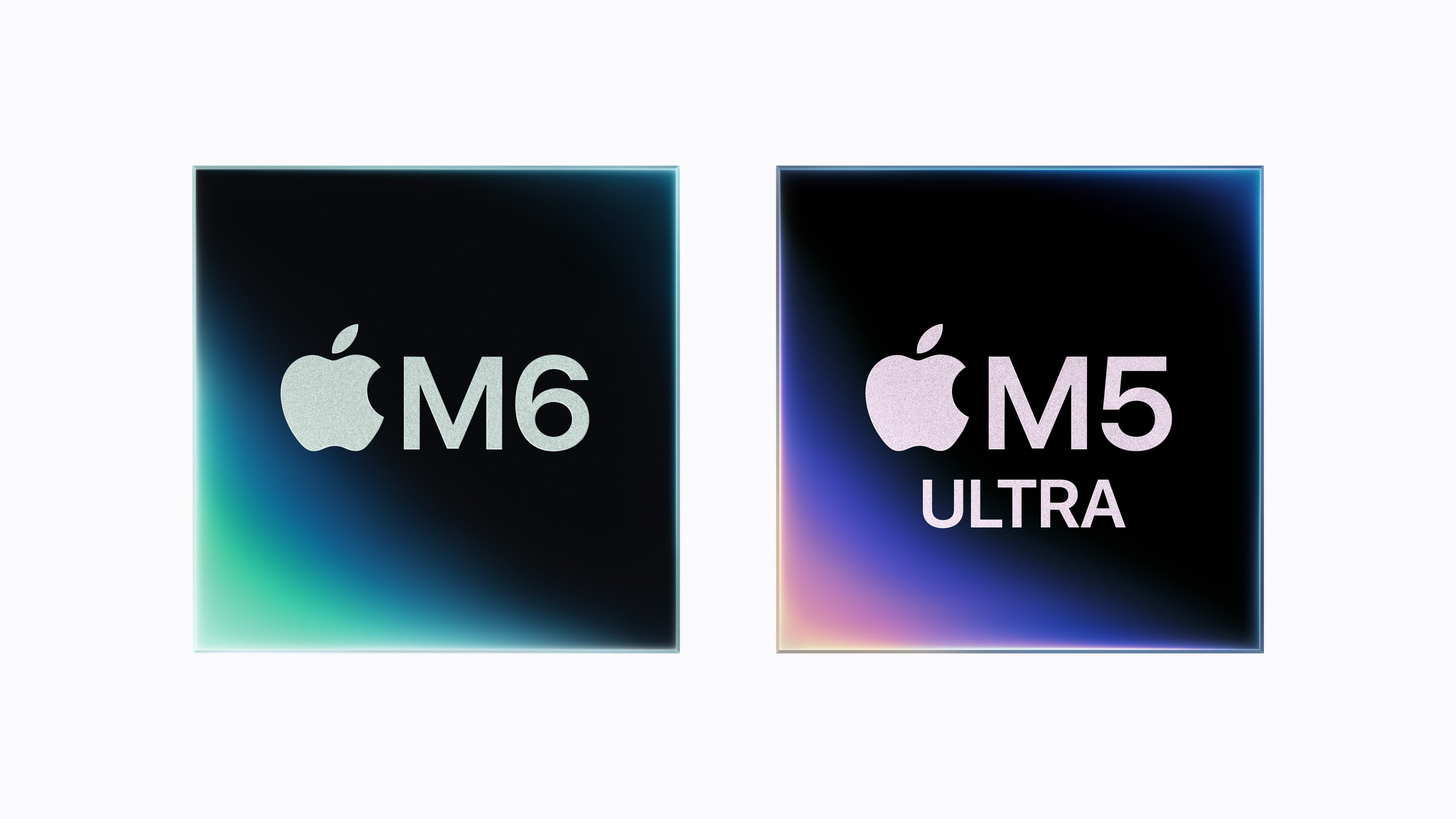
Today, Apple announced a new M6 chip that will debut in the Mac mini and an M5 Ultra that is coming to the Mac Studio. The company also announced an M5 Pro Mac mini and an M5 Max Mac Studio. Let’s take a look at the headline specs.
The headline feature of the M6 chip is that it’s Apple’s first 2-nanometer chip. The chip also includes “a larger 12-core CPU complex with the world’s fastest CPU core, a larger 12-core GPU with Neural Accelerators, a Dual 16-core Neural Engine, and up to 170GB/s of unified memory bandwidth.”
Looking more closely at the M6, Apple says it consists of two super cores, four performance cores, and six efficiency cores and is 1.2x faster in multithreaded performance than an M5 and up to 2.4x faster than an M1. Apple says the GPU delivers nearly 30% more peak GPU compute for AI than the M5. The M6’s 10% faster memory bandwidth will help with AI tasks, too, but its 32GB memory ceiling will limit which models can run locally.
Source: Apple.
The M6 mini’s GPU sounds impressive, too, with two more cores, Neural Accelerators for each core, which is a first for the mini. According to Apple, that leads to an up to four-fold increase in AI performance and a 2x graphics bump compared to the M4 mini. The Neural Engine has also been improved.
Apple also introduced an M5 Pro mini. It’s understandable if you find it confusing that the base model Mac mini has a more recent generation chipset than the more expensive model. What matters more than the chip generation is the “Pro” in M5 Pro, which makes it more capable than the M6, which has been designed for entry-level models. The same sort of asymmetry occurred with the 2025 Mac Studio, which included an M4 Max model alongside the M3 Ultra. A big part of that difference is the M5 Pro mini’s support for 64GB of memory (double the M6 version’s top memory spec) and its 307GB/s of memory bandwidth compared to the M6 model’s 170GB/s memory bandwidth.
Source: Apple.
As for the M5 Ultra, which debuts in the Mac Studio, it sounds like a beast. According to Apple, the chip uses a next-generation version of its UltraFusion technology, resulting in a quad-die architecture for the first time in an Apple silicon chip. In addition, the M5 Ultra features an “up-to-36-core CPU and up-to-80-core GPU with a massive 1.2TB/s of unified memory bandwidth, 50 percent more than M3 Ultra.”
Here’s what Sri Santhanam, Apple’s vice president of Silicon Engineering Group, had to say about the new chips:
Today, we’re debuting the next giant leap in performance and AI compute for Apple silicon with the incredibly advanced M6 and the most powerful M-series chip yet, M5 Ultra. Built using the cutting-edge 2 nm process, M6 combines a new CPU complex, two additional CPU and GPU cores, a Dual 16-core Neural Engine, and more unified memory bandwidth to power through workloads with amazing energy efficiency. And for the ultimate desktop performance and the ability to run massive AI models, M5 Ultra features a massive GPU, now with Neural Accelerators, and more unified memory bandwidth, pushing the boundaries of what a desktop can do.
Apple is fusing two dual-die M5 Max chips to create a single quad-die architecture. Apple says the M5 Ultra is “up to 1.25x higher single-threaded performance and up to 1.3x higher multithreaded performance than M3 Ultra”, the fastest Mac previously for sale. The M5 Ultra also supports up to an 80-core GPU with up to 4.5x the peak GPU compute for AI tasks compared to the M3 Ultra and features an upgraded Media Engine, according to Apple.
Source: Apple.
For those who don’t need the bleeding-edge performance of the M5 Ultra, Apple also introduced what sounds like a very capable M5 Max Mac Studio. The M5 Max version of the computer “features an 18-core CPU, an up-to-40-core GPU with Neural Accelerators built into each core, and up to 128GB of unified memory, accelerating complex pro and AI workloads.”
Macs featuring the new chips won’t be available immediately. You can preorder both online today for delivery on September 22 with the caveat that the M5 Ultra Mac Studio with 512GB of memory won’t be available until later in October.
Prices have risen too. The Mac mini models are both $100 more than the models they replace, while the M5 Ultra Mac Studio’s base configuration has risen $200. However, the M5 Max Mac Studio’s starting price hasn’t changed.
The Mac mini has been a lot of things to a lot of people over the years. From a compact, minimalist desktop system to a headless server, the mini is Apple’s jack-of-all-trades. More recently, demand for the tiny computer has surged as people put them to work for a variety of AI tasks, including running LLMs locally and serving as standalone Hermes and OpenClaw machines.
With memory and storage constraints, it’s no surprise that the base prices of the mini have risen. Despite those challenges, I hope Apple is able to produce enough to meet demand. I’ve loved having an M4 Pro model working away day and night in the background. It’s fast, relatively cool, energy efficient, and easy to run remotely. If the claims of Apple’s press release hold up under real-world use, I expect the new models will be the same, but faster and more capable, which is especially important for tasks like running models locally.
I’m also looking forward to seeing how the new Mac Studios perform in real world tests. I’ve used an M1 Max Mac Studio for a few years now and it’s been every bit the workhorse computer I need for my day-to-day work. However, it’s beginning to show its age when it comes to AI tasks, coding, and other tasks. It may finally be time for me to upgrade.