
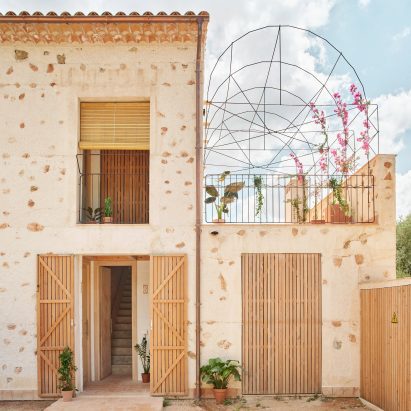
Social housing in Spain's Balearic Islands has won this year's Obel Award for demonstrating that public administration can be "a genuine engine for change".
Carried out by the Balearic Social Housing Institute (IBAVI), the Balearic social housing model involved addressing housing shortages with a more sustainable approach to procuring, designing and building public housing.
We investigated the housing programme as part of our Social Housing Revival series.
It is the eighth winner of the Obel Award, which celebrates architectural contributions to people and the planet.
This year's theme was Systems' Hack, which required entrants to consider how existing structures can be adapted when they are no longer fit for purpose.
The Balearic social housing model has won this year's Obel Award. Photo of Ses Veles by Jose Hevia"What makes the Balearic social housing model remarkable is how innovative architecture can be found not just in design and material choice but also in procurement, policy and process," said jury chair and MVRDV founding partner Nathalie de Vries.
"Public housing shortages are not unique to the Balearic Islands; the same structural pressure is playing out in cities and regions across the world," she continued.
"What this model offers is a framework wherein public institutions can adapt to their own context along with proof that public administration itself can become a genuine engine for change."
It was praised for driving environmental, social and economic change. Photo of Salvador Espriu 39 by Jesús GranadaBetween 2019 and 2023, the Balearic Islands in Spain transformed the administration of its social housing, spearheaded by economist Cris Ballester Parets and architect Carles Oliver Barceló, who both worked for IBAVI.
The housing overhaul involved developing a model for the commission, procurement, design, build and inhabiting of public housing that prioritised local materials, circular construction principles and climate-responsive design.
It sought to quickly increase public housing without sacrificing quality, amidst a housing shortage and a limited supply of public rental housing in the Balearic Islands.
Read: Four projects by RA Architecture Prize winner Cris Ballester ParetsThe Obel Award praised the Balearic social housing model as an example of how public institutions can drive environmental, social and economic change.
"It's significance lies not in a particular building, material or architectural language, but in the way it connects public policy, architectural experimentation, environmental responsibility, local productive capacity, and dignified housing delivery as parts of one system," read the jury citation.
"The jury sees the Balearic social housing model as a powerful example of how systems can be transformed from within. By using public administration itself as a space for experimentation, the model demonstrates how public procurement, investment and management can become tools for systemic change."
The social housing model was led by Cris Ballester Parets and Carles Oliver Barceló. Photo of Lope de Vega 3 by Adria GoulaAccording to the Obel Award, Ballester Parets and Oliver Barceló will use part of the prize fund to work on spreading the international reach of their Balearic social housing model.
Oliver Barceló renounced his personal share of the prize fund, which will instead go towards emergency housing initiatives in the Balearic Islands, and IBAVI also renounced the award and the prize.
Alongside announcing the Balearic social housing model as this year's winner, the Obel Award said it will launch a second award cycle, granting a prize to another initiative designed to the Systems' Hack theme in spring 2027.
Previous winners of the award include non-profit organisation HouseEurope!, which won for its contribution to promoting a more sustainable construction industry across Europe, and a "visionary" coastal defence system in New York City by landscape studio Scape.
The top photo of Pere Matutes 72 is by Jesús Granada
The post Balearic Islands' model for social housing wins Obel Award 2026 appeared first on Dezeen.