
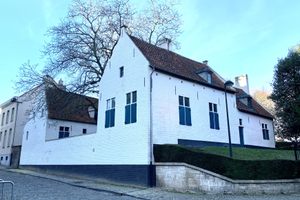
Tucked away in the historic centre of Anderlecht, just a stone's throw from the Collegiate Church of Saints Peter and Guido, lies one of Brussels' lesser-known historical treasures: the Beguinage of Anderlecht. Founded in 1252, it is considered the smallest beguinage in Belgium and once provided a home to a community of just eight women.
Unlike traditional convents, beguinages offered women an opportunity to live in a religious community without taking permanent monastic vows. The beguines were typically unmarried women or widows who chose a life of prayer, work and mutual support. They followed rules of chastity and obedience but remained free to leave the community whenever they wished. This offered women a degree of independence that was relatively unusual in medieval society.
The Anderlecht beguinage consists of two modest buildings surrounding an enclosed courtyard garden with an old well. The buildings date from different periods, with sections originating in the 16th and 18th centuries. From the garden, visitors can enjoy a view of the neighbouring Gothic collegiate church.
Interestingly, the beguinage was locally nicknamed the Klaphuis, meaning 'chatterbox' in Dutch, a playful reference to the conversations that supposedly took place among its residents.
Following the French Revolution, the religious community disappeared and the buildings were converted into a hospice for disadvantaged women. They continued serving this purpose until 1928. In 1930, the complex became a local history museum, displaying archaeological finds, religious art and objects illustrating Anderlecht's past.
After decades of use as a museum, the buildings underwent an extensive restoration, completed in 2022. The restoration aimed to recover the original appearance of the complex, allowing visitors to appreciate its historic architecture. Today, the beguinage offers a rare glimpse into the everyday lives of medieval women and the history of one of Brussels' oldest communities.
Despite being surrounded by the busy streets of Anderlecht, stepping through its entrance feels like discovering a little pocket of tranquillity that has survived for almost eight centuries.