
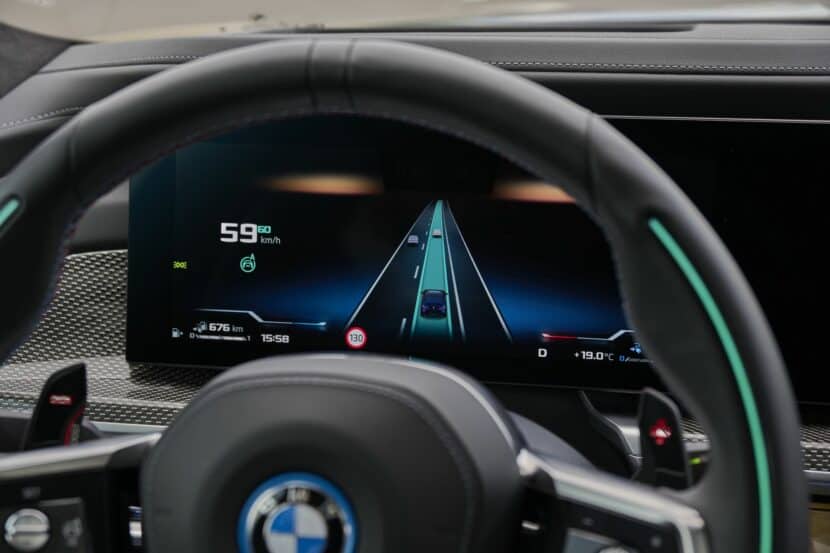
Remember when Level 3 autonomy was supposed to be the next big thing in luxury cars? It seems the future has been postponed. With the 7 Series and i7 mid-cycle facelift, BMW has dropped the Personal Pilot L3 option from the order books.
Our colleagues at Motor1 Germany asked BMW’s development chief, Dr. Joachim Post, what happened. His answer was blunt: not enough customers were buying it. When buyers compare what today’s Level 2+ and Level 2++ systems offer for the money, Post says the decision is easy.
It’s not hard to see why. The 7 Series’ Level 3 system lets drivers take their eyes off the road on approved stretches of highway, but only at speeds up to 37 mph (60 km/h), and it costs around €6,000. BMW’s Highway Assistant, meanwhile, debuted in late 2023 on the 5 Series and has since spread across the lineup. It lets you take your hands off the wheel indefinitely at up to 81 mph (130 km/h), and you can confirm suggested lane changes with a simple glance at the mirror.
There’s a catch, of course. With Level 2++, you’re still legally the driver and must monitor traffic at all times. Level 3 allows you to hand over the driving task under certain conditions, as long as you’re ready to take back control when the car asks. That’s a big difference on paper, but it matters much less when the system only works in slow-moving traffic.
Level 3 Comes With Added CostsLevel 3 is also expensive to build. It requires extra sensors, such as LiDAR, additional cameras, and radar, plus redundant brakes, steering, power supply, and control units, so that a single fault can’t cause a loss of control. Post acknowledged that not every customer will want to pay for all that hardware.
That doesn’t mean BMW is calling it quits. The company is still developing Level 3 and expects some cars will eventually need it, but not in large numbers. Regulatory hurdles remain, and China will likely lead the way, which is why BMW is working with Chinese tech partners to stay close to developments there. In the mass market, Post is convinced that advanced Level 2 systems will become the norm thanks to their value.
Up next
-
The Ultimate Self-Driving Machine: BMW Owners Logged 200 Million Hands-Free Kilometers
BMW made a name for itself by selling some of the most dynamically capable cars in the business, but it’s celebrating a milestone... -
BMW Says Safety Always Come First For Self-Driving Tech
Everyone knows that BMW prides itself on being the “ultimate driving machine.” At the same time, it also doesn’t want to be...
Here’s how Post put it:
“We continue to focus on Level 3 systems. Development in China is very dynamic, and that’s exactly where we’re keeping our finger on the pulse alongside leading Chinese technology partners. We’ll see in what form these systems ultimately gain widespread acceptance. After all, Level 3 requires additional sensors, which not every customer will be willing to pay for.”
“Will Level 3 eventually be needed in certain cars? I think so. That’s why we’re working on it. However, it won’t be widely adopted. In addition, several regulatory steps are still needed before such systems can be approved in all respects. We still have a long way to go here. China will certainly continue to be the driving force in this area. In the mass market, on the other hand, highly advanced Level 2 systems will become the norm due to their price-performance ratio. I’m convinced of that.”
For now, BMW’s message is clear: Level 3 isn’t dead, but it isn’t ready for the mainstream either. With Level 2++ systems offering hands-off driving at higher speeds for less money, most buyers see little reason to pay extra for technology that works only in limited conditions. Until the hardware gets cheaper, regulations catch up, and speed limits rise, eyes-off driving will remain a niche feature, with China setting the pace.
Source: Motor1 Deutschland
First published by https://www.bmwblog.com