
EPA range figures only tell you so much, since automakers don’t always test their cars the same way. That’s why Out of Spec Reviews has its own yardstick: a constant 70 mph run from a full charge until the car can’t hold the speed. For the latest round, the team brought in the new BMW iX5 and lined it up against the Lucid Gravity Grand Touring, the Rivian R1S, and the Porsche Cayenne Turbo Electric.
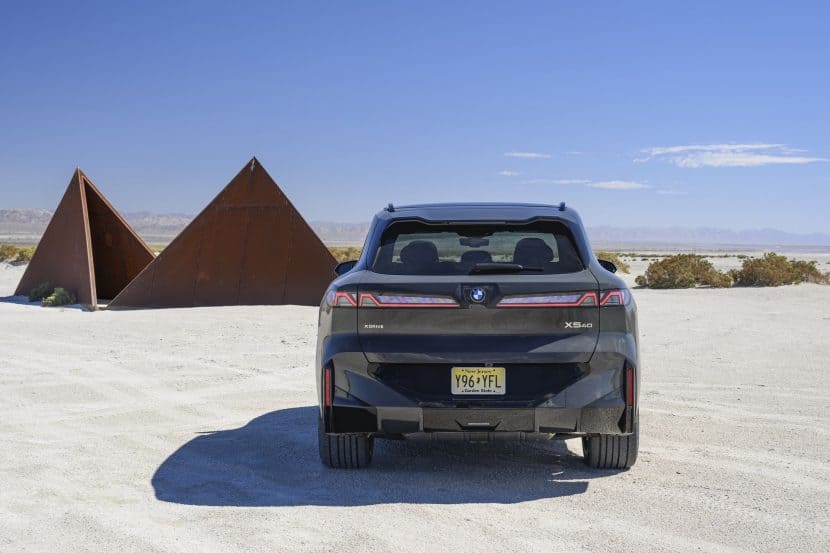
The G65 test car was an iX5 60 xDrive in M Sport flavor, riding on 22-inch wheels with summer performance tires. That setup carries an EPA rating of 426 miles, while with the most aero-efficient wheels, it jumps to 456 miles. So this was far from the best case for BMW.
The electric SUV did 410.8 miles before running out of juice, but the result comes with a footnote. The iX5 actually shut itself off at roughly 399.9 miles, having used about 143.9 kWh, which lines up almost exactly with the pack’s claimed 144 kWh of usable energy in the US. Upon restart, the iX5 kept going at highway speed for about another 10 miles. In total, 148.3 kWh came out of the pack, averaging 2.8 miles per kWh.
The BMW iX5 Beat The Lucid Gravity, Rivian R1S, And The Porsche Cayenne ElectricOn paper, the Gravity was supposed to be the range king with its 450-mile EPA rating. It managed 367.7 miles, an improvement over the 97-mile shortfall in Out of Spec’s first test, but still well short of the number on the window sticker. It was the most efficient car in the group at around 3 miles per kWh, helped by a smaller frontal area, but its 123-kWh pack couldn’t match the BMW’s capacity.
The R1S has a battery of similar size to the BMW’s, but a much boxier shape. It ran out at around 349 miles after using 136 kWh. That’s notably less than the same vehicle managed before: 145 kWh in its first test and about 140 kWh in its second. With roughly 30,000 miles on the clock, the team believes the pack is showing some degradation, so this is a slightly unfair comparison.
With the smallest pack of the group at 108 kWh, the Cayenne used nearly all of it and went about 309 miles, just above its EPA rating. That’s respectable for a Turbo with a tow package and a more powerful rear motor, and the standard Cayenne Electric managed 344 miles in an earlier test. The Porsche also lost power sooner than expected, and the testers suspect its 9,000 hard miles and frequent DC fast charging may have eaten into its low-end buffer.
Up next
-
BMW iX5 Keeps Going For Almost 22 Miles After Hitting 0% Battery
Running out of battery juice in an electric vehicle isn’t something anyone wants to experience, but what happens when the ba... -
BMW Puts The iX5’s 460-kW Charging To The Test In America
We already knew the new iX5 was a charging monster, with an official peak rate of 460 kW, putting it among the fastest-charging EV...
Out of Spec points out some awkward math for Porsche. The iX5 costs roughly $110,000 less than the Cayenne Turbo Electric as tested, yet it went about 100 miles farther. Porsche will counter with driving dynamics, and the testers admit the BMW doesn’t handle like a Cayenne. Even so, they called the iX5 the value play of the day, which is not something they expected to say about a BMW.
Out of Spec’s conclusion is simple: a huge battery paired with decent efficiency delivers the longest range. The iX5’s roughly 150 kWh usable pack, helped by its rear motor, did exactly that, on a platform that also underpins gasoline, diesel, plug-in hybrid, and hydrogen models. Testers expect even better numbers from an iX5 equipped with the aero wheels in the future.
Worth noting: the iX5 is currently offered exclusively as the 60 xDrive model, but that’s unlikely to last long. Given how BMW has rolled out its other Neue Klasse models, it’s reasonable to expect additional variants to join the lineup in 2027 or later. It’s easy to imagine cheaper and more powerful derivatives positioned below and above the 60 xDrive.
Video: Out of Spec Testing / YouTube
First published by https://www.bmwblog.com