
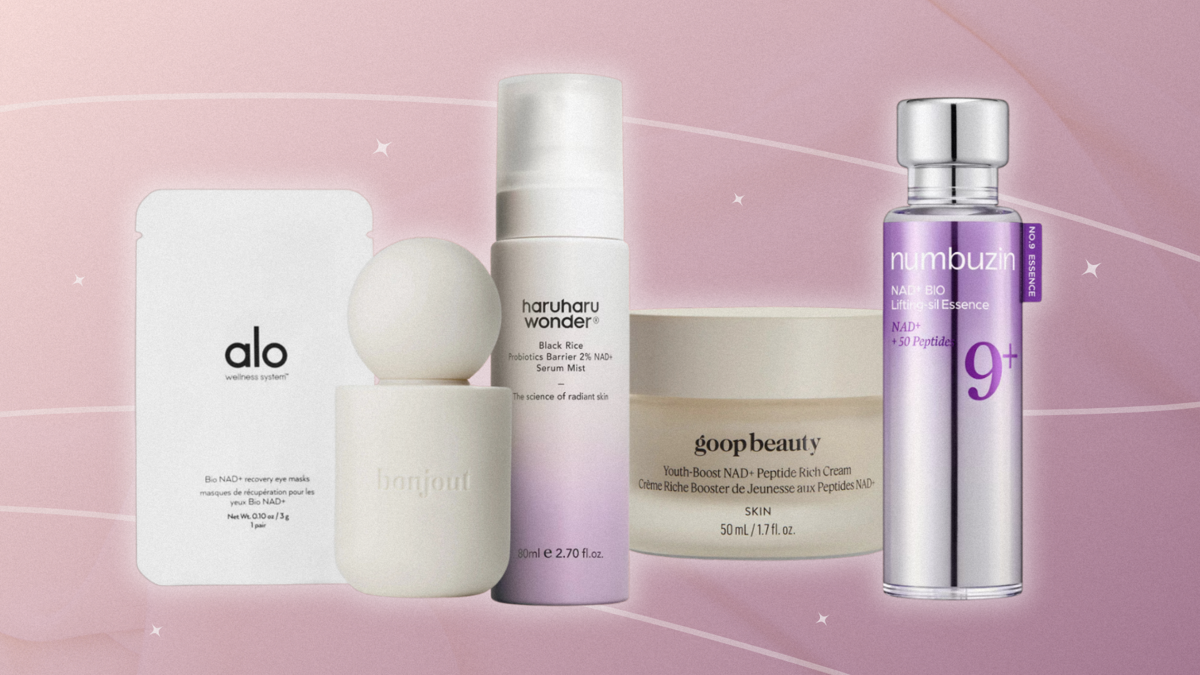
Welcome to our series “Buzzy Beauty Ingredient of the Moment,” the premise of which is pretty self-explanatory: In each installment, we’ll explore an ingredient that’s currently trending in the industry, springing up in a variety of different products lining the beauty aisle. We’ll consult experts to find out about the science behind it — and why it’s having a major moment right now.
Step aside, “anti-aging” — “longevity” has come for the beauty industry.
In recent years, consumers have increasingly prioritized healthy aging over age prevention. In response, beauty brands are adding NAD+ (nicotinamide adenine dinucleotide) to their formulations. The molecule is found in every cell in the body. It supplies cellular energy, which then boosts functions like DNA repair and skin barrier strengthening.
NAD+ products have most popularly been used in the wellness space through supplements and IV drips. Because the molecule is so large, it’s easier to reap its benefits when ingested than when applied topically (say, through creams or serums). According to research, oral NAD+ precursors may help increase NAD+ levels in the body, which plays a role in cellular energy production and repair.
Yet demand for longevity-focused products — topical skin-care formulas targeting cellular and molecular health — is rising, according to McKinsey & Company’s 2025 Future of Wellness report. As a result, more skin-care labels are formulating topical products with NAD+. For example, in February, Nakery Beauty launched a Methylene Blue- and NAD+-powered night cream; and last month, Noble Panacea unveiled the RetiNAD+ Renewal Booster, an intensive serum booster that works to visibly smooth, firm and plump skin.
When NAD+ is incorporated into skin-care products, it activates the skin’s own repair process, which helps with DNA recovery, firmness retention and inflammation reduction. “Like collagen, NAD+ naturally declines with age,” says Dr. Natacha Bonjout, French pharmaceutical doctor, cosmetic chemist and founder of Bonjout Beauty. “As those levels decrease, skin becomes less resilient, repairs itself more slowly and visible signs of aging become more apparent.”
So what’s the secret to getting NAD+ benefits through topical application, even though the molecule is so large that it doesn’t readily penetrate skin? Brands use precursors, or smaller building blocks that can create NAD+. The most popular of these are niacinamide (a vitamin B derivative) and nicotinamide mononucleotide (NMN), says Dr. Kseniya Kobets, board-certified dermatologist and director of Cosmetic Dermatology at Montefiore Einstein Advanced Care. These precursors can not only help increase NAD+ levels in the body, but also have considerable clinical data demonstrating benefits for skin-barrier function, hyperpigmentation, inflammation and signs of photoaging, Dr. Kobets adds.
When shopping for NAD+ (or precursor, NAD+-promoting) products, consumers should keep in mind that it’s one of the best-tolerated ingredients on the market, according to Nakery Founder and Licensed Esthetician Liz Folce. It typically performs well on all skin types (oily, dry and combination), stages and tones. Folce adds that medical clearance to use topical NAD+ is generally only needed for people with serious skin conditions, such as eczema flares, rosacea or a compromised barrier. (But you should always check with your dermatologist if you aren’t sure.)
Product-wise, NAD+ can be used in a range of formulations, including in moisturizers, serums and peels, says Ron Robinson, a cosmetic chemist and the founder of skin-care brand BeautyStat. Experts especially recommend night treatments for applying the ingredient, since it targets skin repair and barrier strengthening. “Your skin does its heaviest repair work overnight, so that evening application is non-negotiable,” Folce explains.
Related: Buzzy Beauty Ingredient of the Moment: Magnesium
How often to apply NAD+ products depends on a consumer’s individual routine: If a user has an active (like retinoids and vitamin C)- or exfoliant acid (such as glycolic or lactic)-heavy routine, then it’s best to apply NAD+ products once or twice a week, according to the experts we consulted. The user should alternate between NAD+ products one day and acid-backed products the other, so skin isn’t overloaded with too many active ingredients at once. Conversely, consumers with gentler, non-active or exfoliant-heavy routines can use NAD+ once or twice daily, Folce says.
Though NAD+ isn’t a brand-new discovery, it remains less well known than other topical ingredients like vitamin C or niacinamide: Scientists first discovered NAD+ in the early 20th century through fermentation studies. Over the years, experts have expanded their research to explore how NAD+ can support age-related, long-term health. In 2015, Elysium Health was among the first companies to release commercial NAD+ supplements (focusing on ingestibles).
To date, significantly more research exists on administering NAD+ through direct ingestive methods like supplements and IV drips than on topical use. “There is extensive scientific literature on NAD+ biology, aging, mitochondrial function and NAD+ precursors, but that should not be confused with clinical trials of intact NAD+ applied to human skin,” Dr. Kobets says. “The human topical clinical evidence for intact NAD+ itself is extremely limited.”
That’s why she strongly recommends NAD+-supporting niacinamide. She says the precursor ingredient is inexpensive, well-tolerated, yields the same benefits as NAD+ and has more clinical research behind it. She believes that intact NAD+ products need more human clinical data to prove their effectiveness.
Dr. Bonjout agrees that the scientific literature around NAD+ is still emerging and needs more data. She also cautions shoppers to read the product formulas carefully, as some brands will use NAD+ as a buzzword despite the formulation containing ingredients like humectants, peptides or antioxidants that can independently improve skin health and appearance.
“This is still an evolving category,” Dr. Bonjout says. “The science is exciting, but we are still learning how to best formulate and deliver these molecules effectively into the skin.”
But the newness is also what makes NAD+ so exciting, Folce says. “The broader cellular science behind NAD+ and aging is extremely well-established…the topical delivery is just the newest frontier. And that’s actually exciting to me, because we’re getting in early on something the science is only going to continue to validate.”
Ahead, we’ve compiled the best topically applied NAD+ (and precursor!) products to shop.
Bonjout La Cream, $170, available here
Numbuzin No. 9 NAD Bio Lifting Essence, $29, available here
Haruharu Wonder Black Rice Probiotics 2% NAD+ Serum Mist, $20, available here
Augustinus Bader The Elixir, $550, available here
Goop Youth-Boost NAD+ Peptide Rich Cream, $105, available here
Dime Dewy Recovery Mask, $42, available here
Bliss Pro NAD+ Peptide Serum, $38, available here
Noble Panacea RetiNAD+ Renewal Booster, $240, available here
Alo Bio NAD+ Recovery Eye Mask, $55, available here
BeautyStat Universal Triple Action Daily Peel, $19, available here
Nakery Beauty SkinRecovery Night Shift High Dose Concentrate Gravity Reset, $44, available here
Occasionally, we use affiliate links on our site. This in no way affects our editorial decision-making.
Do you have an emerging brand you want to share with Fashionista readers? Jumpstart your business with our affordable digital offerings.