
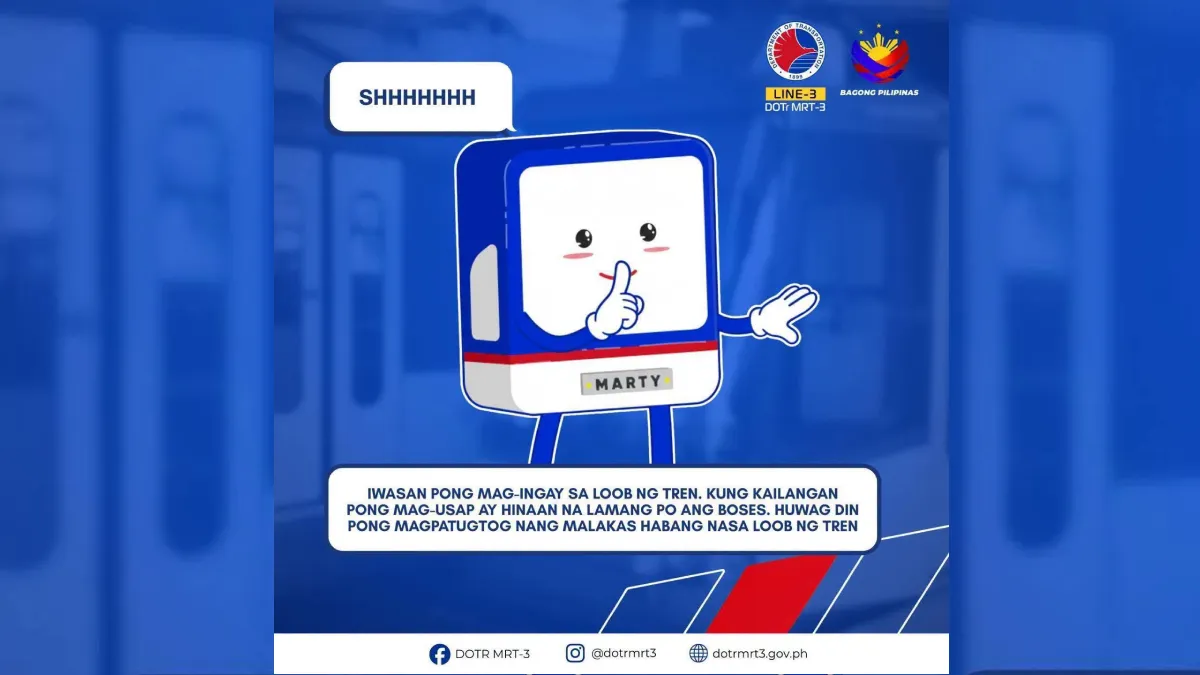
The Department of Transportation Manila Metro Rail Transit Line 3 reminded passengers to keep conversations to a minimum and avoid making too much noise inside enclosed train carriages to maintain a peaceful environment for all passengers.
On their official Facebook page, the train management posted a reminder discouraging passengers from talking loudly in public transportation like buses and trains.
PHOTO BY DOTr-MRT-3
“MAHALAGANG PAALALA: Shhhhhh... Bawal po ang maingay sa MRT-3. Mga Ka-Riles! Iwasan po natin ang pakikipag-usap at pagpapatugtog nang malakas habang nakasakay po tayo sa loob ng MRT-3. Alalahanin po natin na hindi lamang po tayo ang sakay ng tren.”
OTHER STORIES YOU MIGHT HAVE MISSED:
The R Garage car museum in La Union just bagged a Tripadvisor Travelers’ Choice Award
Specs, prices, features: Everything you need to know about the 2027 Ford Everest
Train authorities also advised passengers to report incidents and address complaints to train marshals, security guards, or relevant authorities, who have the power to step in and take action against perceived public nuisances at any time.
PHOTO BY Department of Transportation Facebook Page
“Kung sakali naman po na kayo ay may reklamo ukol sa ingay na inyong naranasan, agad itong i-report sa ating Train Marshall, Security Guard, Coast Guard, o anumang MRT-3 personnel para maagapan.”
The reminder follows reports of passengers taking loudly and taking lengthy phone calls, watching TikTok videos on speakerphones, listening to music on full blast, and preaching inside trains and buses, among others.
In 2022, the Light Rail Transit Authority for Line 2 also posted an infographic detailing prohibited items and acts inside the trains and stations for hassle-free commuting, including “talking and playing music, games or movies aloud.”
PHOTO BY Light Rail Transit Authority-LRT Line 2
While keeping noise to a minimum aboard public transport should be a matter of common sense and decency, some passengers seem to be blissfully unaware (or just don’t care) about the rules. And in cases when you do call them out, they’re the ones who get angry.
So are public transport users legally protected to have a peaceful commute? Here’s a quick look at some local laws that have something to do with excessive noise and public disturbance.
What is noise disturbance?PHOTO BY Ruth Veluz
As detailed by the law firm Respicio & Co., in the Philippines, noise disturbance or nuisance is governed by the Civil Code and local ordinances.
Article 694 of the Civil Code defines a nuisance as “any act, omission, establishment, business, or condition of property, or anything else that:
- Injures or endangers the health or safety of others; or
- Annoys or offends the senses; or
- Shocks, defies or disregards decency or morality; or
- Obstructs or interferes with the free passage of any public highway or street, or any body of water or
- Hinders or impairs the use of property.”
Loud talking, music, and unpleasant sounds in public transportation, especially if they reach a level that disturbs the general peace of fellow passengers, could be classified as a public nuisance.
This is especially true if the disturbance is significant enough to affect multiple passengers, which is the case in enclosed carriages of buses and trains.
Public vs. personal spacePHOTO BY DOTr MRT-3 Facebook Page
A nuisance may either be public or private. Article 695 of the civil law states that public nuisance affects the community, a neighborhood, or any considerable number of persons. Public nuisance may be addressed by public authorities, with remedies including abatement (removal of the nuisance), damages, or injunctions.
Article 26 of the Civil Code also states that people shall protect the “dignity, personality, privacy and peace of mind of his neighbors and other persons.” This reinforces the right to be free from unwarranted intrusions, including noise that invades personal space.
Friendly reminders on commuter etiquettePHOTO BY Kara Santos
Many passengers who take trains and buses, especially after work, are tired and prefer to rest during their commute.
There’s nothing wrong with listening to music or watching shows. Just put on headphones or earphones, keep the volume low, and avoid using speakers. If you don’t have headphones, then save your watchlist and games for when you get home.
And while it may sometimes be unavoidable to take phone calls on public transport, you still have to respect shared public spaces.
PHOTO BY Billy Caluag
The online community Railfans of the Philippines shared some friendly reminders regarding common courtesy and basic etiquette on trains.
- Don’t talk loudly when taking phone calls.
- Avoid taking calls on loudspeaker mode and at maximum volume inside the MRT and LRT trains.
- Control the volume of your speaking voice when talking to someone on a call.
- Use earphones if you can.
- If the call is not urgent, decline the call and send a chat/text message instead.
Ride safe, everyone.