
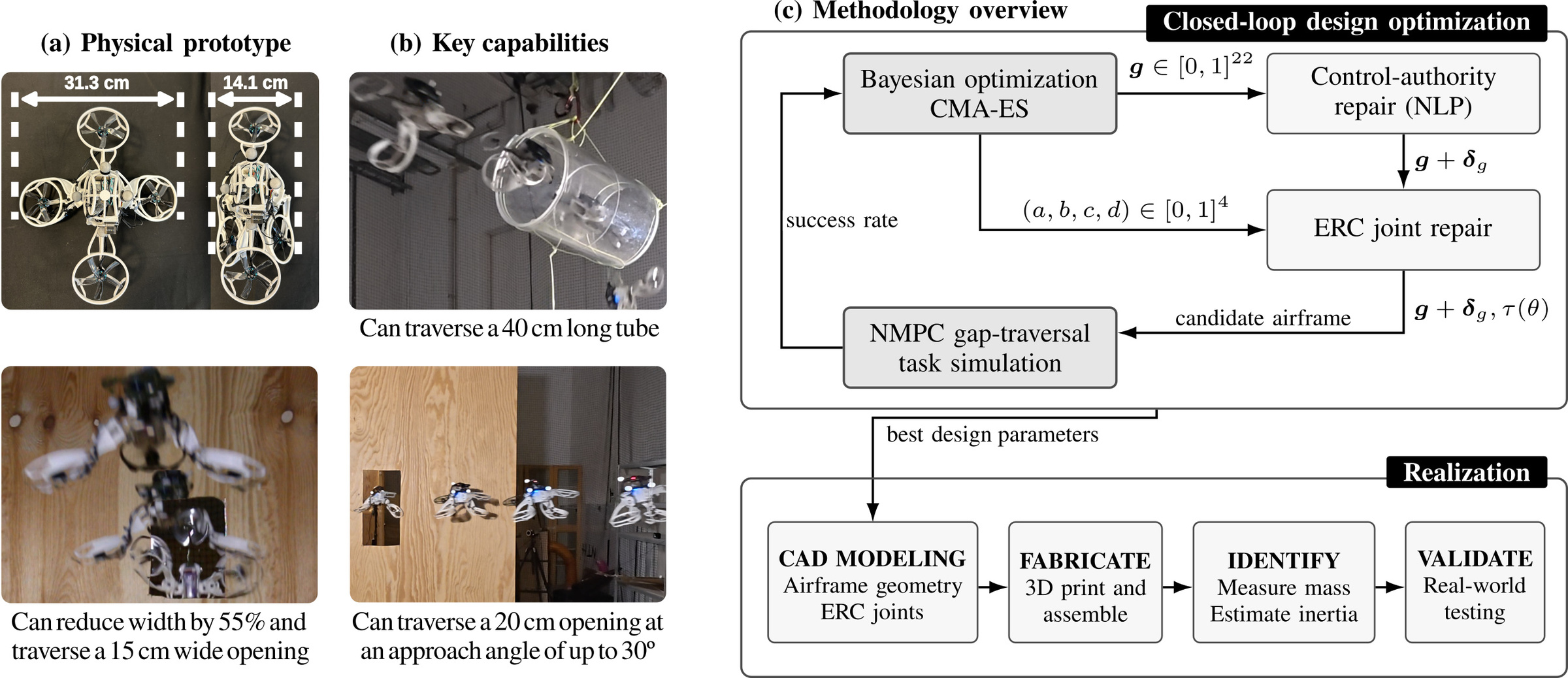
Generally when a quadcopter attempts to occupy the same space as an immovable object, the quadcopter comes out as the loser. Although you can add active systems that detect and morph the quadcopter’s shape before trying to e.g. squeeze through a narrow tunnel, this adds a lot of complexity. In comparison, [Etor Arza] et al. chose to passively morph their quadcopter design upon encountering resistance.
Their prototype can change its width from 31.3 to 14.1 cm, which is demonstrated to fly through gaps as small as 15×20 cm and 40 cm long tubes. Although passively morphing quadcopter designs aren’t new, the challenge with such a design is to reliably transform and restore to nominal configuration only when needed.
To achieve this they made two of the quadcopter’s arms flexible using elastic rolling cam (ERC) joints, with the details covered in the paper over at arXiv. They also ran many simulations to figure out the best angles under which to approach a narrow gap, following which the built-up tension in the ERC joint pushes the arm back into its nominal position.