
For children, learning rarely begins with a theory. It begins with a gesture: picking something up, turning it around, trying to fit two pieces together, making a mistake, and trying again.
This simple sequence is at the heart of Ekoplay's approach to educational design. For more than 25 years, the Hyderabad-based company has been developing and manufacturing learning materials designed to make education tangible, engaging, and playful. Its products range from wooden educational puzzles to geography and curriculum-based learning materials, but the underlying design challenge remains consistent: how can an object invite a child to explore an idea rather than simply explain it?
For Ekoplay, the answer lies in designing for the hands as much as for the mind.
In 1985, Rajika Dhiren opened a kindergarten in Hyderabad, inspired by her mother's long-standing commitment to education. The experience revealed a practical problem: schools and children often lacked high-quality learning materials that could make educational concepts accessible through direct experience.
That insight eventually led to the creation of Edcraft in 1994, with a focus on research-based educational tools. The company also collaborated with the National Institute for the Mentally Handicapped, now NIEPID, to co-develop and distribute learning materials for children across India, from pre-primary through vocational education
The Indian company has been developing educational materials for children, with a particular focus on wooden puzzles and hands-on learning. Its approach grew from a background in early childhood education and work with children with different learning needs, an experience that continues to influence how the company thinks about design.
The central question is deceptively straightforward: How do you design an object that makes a child want to learn?
From information to interactionEducational content is often presented as something to be read, watched, or memorized. A puzzle proposes something different. It asks the child to act.
The learning experience begins with the hands: picking up a piece, turning it, testing a relationship, making a mistake, trying again. Information is no longer static. It becomes something that can be manipulated.
For Ekoplay, this physical dimension is fundamental. Its products are intended to encourage children to explore, think, solve problems and learn through play, while also developing focus and patience through screen-free interaction. This impacts the designer's role, as the task is not simply to represent knowledge visually, but to construct an interaction around that knowledge. The product has to be understandable enough to invite participation, but open-ended enough to leave room for discovery.
The complexity hidden inside a simple puzzle
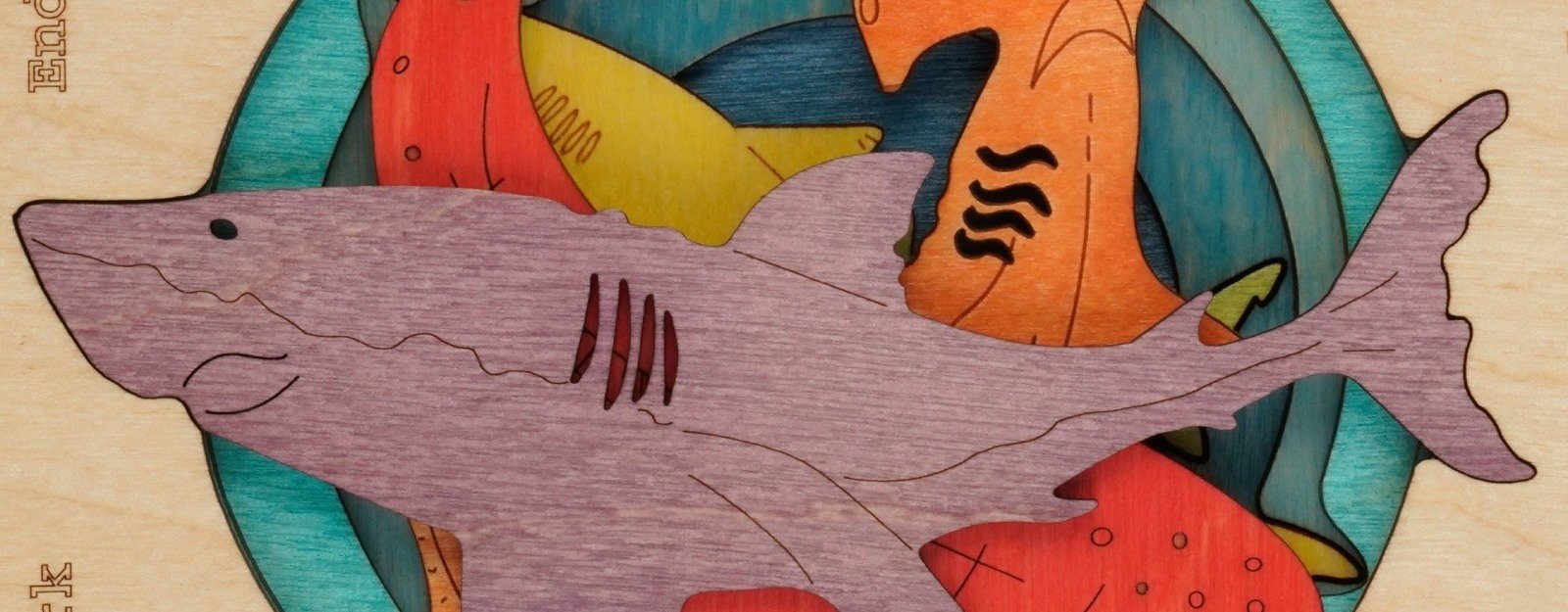
One of the most intriguing aspects of Ekoplay's work is the development of multi-level puzzles. Educational concepts such as three-dimensionality, depth and sequence must be translated into a physical product—and often into a format whose visual language remains essentially two-dimensional.
This is a challenging design problem. It involves translation: from concept to image, from image to object, and from object to interaction. The designer has to establish a visual hierarchy while considering how the child will encounter the product. What should be immediately visible? What should become clear only after manipulation? Which relationships should the object suggest, and which should the child discover independently?
The most successful educational objects do not necessarily explain more.They reveal more. A product that provides every answer can reduce the space for exploration. A product that provides just enough information can turn the user into an active participant in constructing meaning.
In that sense, the puzzle is not merely an educational illustration broken into pieces. It is an interface.
Designing the moment of discoveryThe word "interface" might seem unusual when talking about a wooden children's puzzle. But consider what happens when a child encounters one. There is an initial visual reading. Then a physical exploration. Pieces are lifted and moved. Relationships are tested. Patterns begin to emerge. The image changes as the object is assembled.
The product communicates through action. This makes playability a central design consideration. Form is not only about appearance; it determines how an object is approached, held, manipulated and understood.
For Ekoplay, this principle is closely connected to its origins in education. The company began from the experience of working directly with children and from the recognition that schools needed quality learning materials that could make education more engaging and inclusive.
The history places the object inside a broader design question: What happens when educational knowledge is translated into something a child can physically experience?
Wood as an active design elementThe choice of wood reinforces this relationship between learning and physical experience.
A wooden puzzle is not an intangible interface. It has weight, texture and physical presence. It can be picked up, carried, rearranged and returned to again and again. These qualities matter because children do not encounter products as static images. They encounter them through their bodies. For an educational product, therefore, material is part of the communication.
Ekoplay identifies sustainable and non-toxic materials as important aspects of its design approach, while its products are manufactured in Hyderabad and tested for international markets. Here, sustainability, safety and durability become connected to the design of the experience itself.
The object has to be engaging enough to be used, robust enough to be used repeatedly, and considered enough in its material choices to fit within a broader environmental responsibility.
Inclusion is not an add-onThere is another layer to the way Ekoplay approaches design: inclusion.
The company's experience with children with different abilities has influenced not only its educational products but also its workplace. Ekoplay describes itself as an inclusive organisation, with neurodivergent adults among its team and an active focus on creating opportunities for women across leadership and production. This creates an important continuity between the products and the organisation behind them.
If design is ultimately about understanding different ways in which people interact with the world, then diversity within the making process can become part of that understanding. In Ekoplay's case, inclusion is presented not as a separate social programme but as part of the way the company operates. That perspective is particularly relevant to educational design, where the idea of a "typical" user is often inadequate.
Children learn differently. They perceive differently. They interact with objects differently. Designing for learning therefore means designing with that variation in mind.
From classroom experience to contemporary designEkoplay's development has also brought design into a more explicitly international context. The company works with a UK-based designer and an Italian designer to develop distinctive, trend-focused products for international markets. This introduces another challenge: how can an educational object retain its clarity and purpose while developing a contemporary visual language?
The answer lies less in adding decoration than in understanding the relationship between visual appeal and function. A child has to want to pick up the object. Once they do, the design has to give them a reason to continue. This is where graphic design, product design and interaction begin to overlap. Illustration communicates information. Form guides manipulation. Material establishes physical presence. The overall composition creates an invitation to play. The product becomes a small, integrated design system.
Designing for hands, minds and timeThere is a tendency to think of children's products as simple because their users are children, but the opposite may be closer to the truth.
Designing for children requires decisions to be made across multiple levels simultaneously: visual language, physical interaction, educational content, safety, durability, material choice and emotional engagement. And unlike many digital experiences, a physical learning object is expected to remain meaningful over time.
A good puzzle can be used repeatedly. It can be solved, forgotten, rediscovered and approached differently. Its value is not exhausted by the first interaction. That durability is both physical and cognitive. The object remains the same, while the child changes.
The object as an invitationThis may be the most interesting lesson in Ekoplay's approach. The purpose of an educational product does not necessarily have to be to deliver knowledge directly. It can be to create an invitation, an invitation to touch, to look closer, to make a connection, to make a mistake, to try again, and eventually, to understand.
This is where the design of play becomes particularly relevant beyond the children's-product category. Ekoplay's puzzles demonstrate how a physical object can transform information into an active experience, using material, form and interaction to create space for curiosity.
The company describes its ongoing challenge as creating engaging designs capable of captivating young minds, while bringing together sustainability, inclusivity, playability and learning. Seen from this perspective, the puzzle is not the final product of the learning process. it is the beginning.
And perhaps that is one of the most useful things design can do: not provide the answer, but create an object that makes us want to discover it.
______________________________________________________________________________