
See more Toronto Sun on Google — save as a Preferred Source
Commuters passing nearby construction of the Ontario Line subway in North York earlier this month may have done a double take.
That’s because they were met with profane and anti-government messages displayed on what appeared to be a hacked traffic sign.
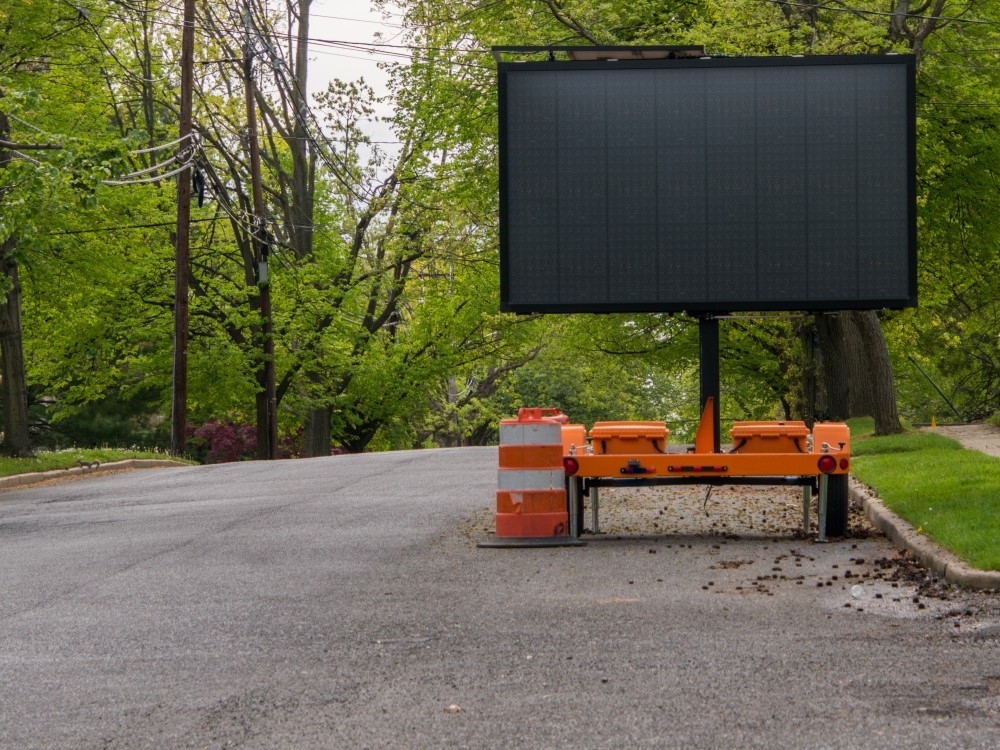
The mobile digital message board – used to alert drivers to road conditions ahead – rotated through three messages including two that displayed profane language while stationed on the centre median of Don Mills Rd., north of Wynford Dr. and near Eglinton Ave. E., according to a social media post.
“F— THE GOVERNMENT,” “F— MASS SURVEILLANCE,” and “DE FLOCK CANADA” were displayed, with the latter a reference to Flock cameras used to monitor and record licence plates and are typically under contract to law enforcement agencies and municipalities.
“Ummm, thinking someone hacked the sign?” Thea Silver, who shared a video clip of the altered board on Sept. 6, wrote on X.
WARNING: VULGAR LANGUAGE
Ummm, thinking someone hacked the sign? Don Mills north of Wynford Drive 🤣 @cityoftoronto @CityNewsTO @NewsRadioTO #sign #hack #Toronto pic.twitter.com/iOUOqJHMrl
— Thea Silver (@SilverThea) September 6, 2026
Provincial politics outlet The Trillium also reported on the compromised sign .
Metrolinx said in a statement to the outlet that the hacked traffic board is operated by a contractor for the Ontario Line project and has since been removed.
It is unknown who is responsible for the modified messages or how long the sign was hacked.
Video tutorials widely available
Hacking into these digital signs doesn’t appear to be too difficult as video tutorials are widely available online.
Last year, a picture was shared to Reddit of an electronic traffic sign with a hacked message stationed at Ellesmere Rd. and Military Trail, east of Morningside Ave. and near the University of Toronto’s Scarborough campus.
The sign read “MILFS AHEAD,” the vulgar slang acronym for mothers or older women.
“Had to do a double take to be sure I saw what I thought I just saw on the sign,” wrote the Redditor who uploaded the image.
Meanwhile, automated licence plate reader (ALPR) cameras have come under increasing backlash over its use by law enforcement in the United States. Police forces and municipalities in Canada, mainly in city and suburban areas, also use ALPR cameras.
According to the Electronic Frontier Foundation , an organization that defends civil liberties and digital rights, crowdsourced mapping projects like DeFlock and FlockHopper have sprung up in the U.S. to track and expose ALPR and artificial intelligence cameras.
RECOMMENDED VIDEO
Protests against surveillance tech
Protests have popped up this summer in the U.S., including Palo Alto, Calif. , and Reno, Nev. , over the use of surveillance technology.
In Canada, the open-source Panoptica Map has documented at least 770 ALPR cameras and 981 government closed-circuit television (CCTV) surveillance cams across the country, which they say is a serious risk to your privacy and civil liberties.
Police in Toronto, Peel Region, Hamilton and Waterloo Region say they use the technology mounted on patrol vehicles to receive real-time alerts for stolen vehicles, wanted criminals, and to investigate serious and violent crimes.
“All data collected is secure, never sold to third parties, and used solely for law enforcement purposes by authorized personnel only,” Toronto Police say on its ALPR web page . “The Service’s use of ALPR adheres to strict rules of limited access and operational protocols that have been subject to a Privacy Impact Assessment.”
In Brampton, the city installed 360-degree cameras at 50 intersections earlier this year, the first Canadian municipality to implement this type of system they say is being used to enhance community safety.