
In 2016, my wife and I embarked on a road trip together across central Mexico — starting on Jalisco’s Pacific Coast and, over a month later, ending up on the Gulf Coast of Veracruz with innumerable side quests along the way in Michoacán, Guanajuato, Querétaro, Hidalgo, Mexico City, Estado de México and Puebla.
It wasn’t our first time in Mexico. We had, after all, spent our lifetimes visiting our extended families in Mexico as the children of immigrants.
But now we were able to see it on our own terms, as independent adults with our own incomes to spend and itineraries to plan. We rediscovered the country through our own eyes.
That summer, we had a revelation: We wanted to live in Mexico.
“Between 2024 and 2025, registrations for Mexican citizenship skyrocketed by 161% at the Los Angeles consulate,” according to De Los and the Los Angeles Times. (Dual Citizenship US — Mexico/Facebook)Three years later, in 2019, we prepared a similar trek around the southern part of the country, beginning in Oaxaca’s capital, then winding our way through mountain towns en route to the coast on a colectivo. Months prior, we had left our jobs as high school teachers with the intent to live in Mexico long term. Then, COVID-19 happened while we were staying in Mexico City’s central Narvarte Poniente neighborhood.
It was an uncertain and frightening time to be traveling. We ultimately decided, as U.S. citizens with a travel visa, to return to California after nearly half a year away. As tourists, we would have violated our 180-day limit and didn’t want to risk overstaying; had we been dual citizens, we would have had less pressure to return so suddenly.
Navigating the consulate and paperworkBut we hadn’t given up on our ambitions to live in Mexico as Mexican Americans. Shortly after returning to the San Francisco region, I began my application process to become a dual Mexican citizen.
I moved to Mexico City in my 20s. Here’s what I learned
In my case, I had a major advantage: My mom never rescinded her Mexican citizenship, despite having lived in the United States for more than 30 years after immigrating as a young woman. When she eventually moved back to Mexico, it inspired me to follow her southward. Through her, my direct path to citizenship had already been laid out.
The process took me a couple of years, though it could have been completed much more swiftly. I took my time and wasn’t in a rush during the pandemic. I visited different consulates in California, and after waiting in many lines and talking to many people, I gathered all of the documents — most importantly, proof of my mother’s citizenship and birth certificate — and approvals.
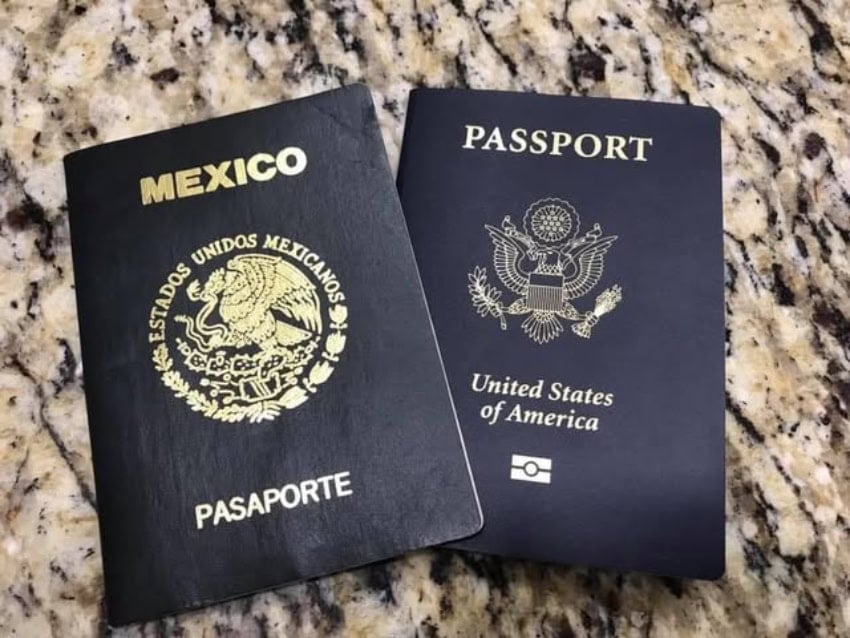
Then, it happened: I had become a Mexican citizen, and I had my Mexican passport. (I would eventually get my INE, but I opted to do it in Mexico, rather than at any Mexican consulate in the U.S.).
My wife had a trickier path. Her Mexican-born father’s documents had a typo. Therefore, some of his documents didn’t exactly match. If you aren’t yet familiar with the distress an aberrant punctuation mark can trigger in the imperfect machinery of Mexican bureaucracy, I pray you never have to.
Ultimately, my wife was forced to hire a specialist who helps Mexican descendants obtain their Mexican citizenship — it was frictionless and worth the price. To date, we highly recommend it for anyone who has the funding or has experienced any complications with the process.
A historic surge in binational applicants The process for gaining dual citizenship may not be frictionless, but it opens up another world of possibilities. (Roger Ce/Unsplash)During that time, we weren’t alone in our journeys toward Mexican citizenship. Many of our Mexican American friends had expressed a desire to do the same, and in some cases, a few had already started their processes as well. In fact, dual citizenship applications — particularly for the U.S.-born descendants of Mexican immigrants — are reaching a historic apex. De Los, a Latino-focused branch of the Los Angeles Times, recently reported that “Between 2024 and 2025, registrations for Mexican citizenship skyrocketed by 161% at the Los Angeles consulate.”
The trend is universal throughout the U.S. In Boise, Idaho, reports indicate a rise in applicants due to Mexico’s law change in 2023, which simplified the route to dual citizenship for anyone with at least one Mexican-born parent. Combined with the ongoing pressures of xenophobic turmoil, immigration raids and other sociopolitical factors, more people are looking to gain a sense of security and connection on both sides of the border through binational citizenship.
The benefits of dual citizenship are certainly ample: Traveling as a dual citizen offers financial breaks and accessibility perks (there are fewer foreign fees to be paid at Mexican airports and museums, for example); purchasing property in Mexico involves fewer legal hurdles; and at large, it grants unrestricted freedoms on both sides of the border, which is an ultimate privilege.
The unexpected costs of double bureaucracySheinbaum bill would ban dual nationals from top political offices: Thursday’s mañanera recapped
But that’s where things can get a little complicated, depending on your plans and lifestyle. In my case, I don’t use my Mexican passport solely for a beach getaway once a year; I live and work in Mexico as a dual citizen, with employers and responsibilities in both countries, and the implications are different.
Vehicle registration in California expired and needs to be updated in person? Guess who’s flying back for a visit to the California Department of Motor Vehicles? Navigating Mexico’s monthly tax payments? Might require a tax accountant. Of course, each scenario comes with a cost, and many life lessons.
When I applied for dual citizenship, I wasn’t necessarily thinking about those realities, or how I would have to pay and renew double the amount of things as someone fully integrated into two federal systems. Of course, in retrospect it makes complete sense. But it’s not the sort of thing that a bright-eyed applicant has at the forefront of their mind while pursuing dual citizenship — nor is it the kind of thing that parents or friends who are encouraging dual citizenship are thinking about, either.
Political debates and balancing two worlds Balancing your life between two worlds comes with challenges … but also with benefits. (Kyle Petzer/Unsplash)The issue of dual citizenship has even caused some political strife. Just weeks ago, President Claudia Sheinbaum proposed a ban on dual citizens being able to reach the highest levels of office within Mexico’s borders. “Why have dual nationality if you’re going to represent the people of Mexico?” she rhetorically posed. The bill has been criticized by the Institutional Revolutionary Party (PRI) as a discriminatory human rights violation.
However, for the average person who doesn’t intend to run for the Mexican presidency, dual citizens generally don’t have much to shy away from. If you plan to work in both countries as a dual citizen, be prepared to pay the taxes (literally and metaphorically). If you don’t plan to work in Mexico for Mexican-based companies, you can simply declare your non-working status in Mexico when registering for your INE, and your biggest potential taxation headaches will disappear — at least in one of the two countries.
The benefitsFor all of its potential downsides, there are double the benefits. On days when I enter the U.S. through California airports and switch over to using English with my U.S. passport, it feels like I’m home. I’m just as happy and relieved as soon as I arrive back in Mexico, activate my Spanish mode, and show my Mexican passport.
As someone who grew up around many undocumented Mexican immigrants in California, I don’t take that lightly. And I use it to constantly toggle my way between both worlds, as my fullest self.
Alan Chazaro is the author of “These Spaceships Weren’t Built For Us” (Tia Chucha Press, 2026), “Notes from the Eastern Span of the Bay Bridge” (Ghost City Press, 2021), “Piñata Theory” (Black Lawrence Press, 2020), and “This Is Not a Frank Ocean Cover Album” (Black Lawrence Press, 2019). He is a graduate of June Jordan’s Poetry for the People program at UC Berkeley and was selected as a Lawrence Ferlinghetti Poetry Fellow at the University of San Francisco. His work can be found in NPR, The Guardian, SLAM, GQ, L.A. Times, and more. He is currently based in Veracruz.
The post Does having dual citizenship have any downsides? appeared first on Mexico News Daily