
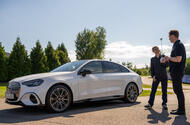
Mercedes-Benz CEO Ola Källenius is clearly proud of the new C-Class Electric saloon. Proud enough to travel from Stuttgart to Helsinki to pop into the launch event and, after spending 20 minutes fielding questions from a buying pack of eager reporters, take me on a private 45-minute drive of the Finnish countryside. He wants to show off this car and is keen for Autocar readers to understand what it can do.
“It’s nice and quiet and feels more like an E-Class,” says Källenius, as we glide along in notable tranquillity. “We’re doing 80kph [50mph] now, but if we were on the autobahn doing 200 [124] you’d have the same feeling…"
At this point Källenius is interrupted, not by me with a probing follow-up question but by the C-Class itself: “The feeling of driving at high speeds on the autobahn can be exhilarating.”
Having his own car vocally interrupt an interview is a first for Källenius, but this surreal moment encapsulates the complex, balanced transition that Mercedes is undergoing, as it adds huge digital capabilities to its vehicles while still maintaining the traditional premium strengths that have underpinned them for 140 years.
With its first generation of electric vehicles, Mercedes kept the two strands separate – for example, selling the EQE beside the combustion-engined E-Class. But the new C-Class and closely related GLC mark a distinct shift in offering you the choice of powertrain – albeit with the ICE and EV versions built on different platforms.
“We had buyers enter the brand with those first electric models in the market. They learned to love Mercedes later in their life, maybe,” says Källenius. “The traditional Mercedes customers are now coming into this. But if they still want a high-tech combustion engine, we can do that. It’s not a problem. Customers will decide when to switch at their own convenience.”
The introduction of the new MMA and MB.EA electric platforms (which respectively underpin the new CLA and GLA and new C-Class and GLC) has kick-started a rapid rollout of new EVs, along with heavy updates to keep their ICE equivalents in line. Mercedes is midway through launching 40 models in three years by the end of 2027. Even for an industry giant, that’s a huge undertaking.
“The key is a thought-through architecture strategy,” says Källenius. “If every nut and bolt on every one of those cars was new, you could never do it, but if you have a modular strategy and an operating system platform strategy – the whole brain and central nervous system of the car – you don’t have to fundamentally develop a new each time.”
Thus the MB.OS operating system of the C-Class Electric in which we’re currently sitting is also used in the new GLC and CLA EVs as well as the new ICE S-Class and forthcoming ICE C-Class. As Källenius notes, it’s not only Mercedes’ new generation of EVs that will be ‘software-defined vehicles’.
Källenius has been chairman and CEO of Mercedes-Benz since 2019, when he took over from the much-admired Dieter Zetsche. Having worked for the company since 1993, he was an establishment choice, but the Swede was still a notable appointment as the first non-German to lead Mercedes (his wife is German and he now holds dual citizenship).
Automotive CEOs usually come from either a business or engineering focus, but Källenius’s 33-year career has spanned every aspect of the firm.
“I started my career as a trainee on the management side and meandered over to the engineering side,” he laughs. He initially worked in procurement (“if you work in procurement and supply, you’re like the wingman of the engineers”), eventually being made executive director of operations for McLaren in 2003, when Woking was developing the SLR McLaren. From there he had stints running Mercedes’ Formula 1 engine division in Brixworth and its US arm, then in 2010 returned to Germany to lead Mercedes-AMG. He joined the board of management in 2015, leading sales then engineering before becoming CEO.
“I went through production, management and sales and then ended up as engineering director for the whole company,” says Källenius.
“But I do believe that fundamentally, if you’re working for a car company, whatever you do centres around the product and the technology. You must have that constant curiosity to look at what’s happening with the product. Technology remains at the centre of Mercedes’ strategy.”
Electric cars and software remain hard sells to some car fans – especially the sort Källenius tried to appeal to in his AMG days. So how do you make people who grew up debating V8 and V12 engines excited about improved inverters and faster computer chips?
“For traditional car nuts it feels like you’re learning a new language,” he acknowledges, “but are you really? When I was in uni, it was: ‘Do you have a 386 or a 486 processor on your massively heavy laptop?’ The technology race has always been there as a combination of hardware and software, but now you have that in cars too, and you’re then talking about: ‘Okay, how many tops [trillion operations per second] do you have?’
“Why do you need tops? Well, you need tops to power very sophisticated generative AI-based end-to-end software models, and if you don’t have the ‘horsepower’ to do that, you don’t have the driving features. The horsepower of the digital side is provided by chipsets.”
So how much of Källenius’s time as Mercedes CEO is spent debating tops and chipsets and how much is spent sitting, like he is now, behind the wheel of a new car for evaluation?
“The board drives and evaluates everything, because at the very end the buck stops with us,” he says. “But I’m the first to admit the excellent engineers we have are better trained than us to do that. It’s not our job to do their job. But we are customers too. When I test a car, I put myself in customer mode. How would I feel if I’d spent €60,000 [£51,000] or so to buy this? Is it really delivering? Then we debate that.
“The fine-tuning of the chassis and handling and so on is vital, because it’s a Mercedes, right? But now we spent a lot of time working on the UI [user interface] and digital side.”
But don’t think that the firm is now so focused on technology that the human element is lost because, well, it’s a Mercedes, right?
“It’s a science and an art,” says Källenius. “You can measure everything, such as the hertz frequency of the movement in the chassis, but it’s the experts who ultimately sign off the car and set how it rides and drives.
“There’s a human component to that: it’s like they have sensors in their bodies somehow that translate into the perfect set-up. Different brands have different characteristics, and Mercedes customers have an expectation to feel safe and in control and comfort but to know they can push it if they want to.”
With his experiences at McLaren and AMG, Källenius maintains a particular interest in ensuring that Mercedes continues to deliver when people want to push their cars. He recalls fondly taking part in track days with friends during his six-and-a-half-year stint in the UK (“my favourite circuit was Goodwood, which is just fantastic to go round”) and is clear that he wants the Affalterbach division to keep growing.
“Our intent is to over-proportionally grow the performance side of the business,” he says – something that he’s sure will appeal to, well, you. “Having been more or less a lifelong Autocar reader, I know that Autocar readers know their stuff about sports cars,” he laughs.
AMG is now beginning to develop cars atop bespoke platforms to maximise their performance, albeit using the wider synergies of the company (“the way a climate control system works, do you need an AMG version? No, you don’t”), but Källenius insists that there will remain “cross-fertilisation” between those models and the wider Mercedes line-up.
Exclusive: Ola Källenius promises next AMG GT will be "insane"
One example of that is the new AMG CLA 45, which features an electric powertrain that can simulate a V8 engine, down to pops and bangs and feedback on the virtual gearchanges.
“When I first drove the CLA 45 with that system, I was like a born-again Christian,” says Källenius. “It was the best V8 I’d ever driven: it had all the feeling of a V8 but with more power and torque.”
Not that a virtual, electric V8 is about to replace the real thing: while Källenius thinks that the industry has “turned a corner” on the road to electrification, he admits that “the consumer is not quite there yet”.
He says that Mercedes “didn’t wobble” from its ultimate goal of becoming electric-only but nor did it abandon its commitment to “high-tech electrified combustion engines”.
Another area where Mercedes has maintained a singular focus is in its commitment to keeping its knowledge in-house. Aside from Smart, now a 50:50 joint venture with Geely, the company has eschewed the general industry trend of forming partnerships with other manufacturers.
That, says Källenius, is because “if you have the ambition to be a global leading player, you have to know the whole thing. So we have deep partnerships with tech companies and traditional suppliers but we remain the architects of the cars.”
Sadly, with Källenius turning the C-Class back into the entrance for the launch venue, it’s time for us to leave this comfortable house on wheels. But, I wonder, with electrification now mainstream and software-defined vehicles on the road, will car development start to slow down soon?
“I think it’s going to speed up,” counters Källenius. “With AI, who knows what’s going to happen? And the process of development is also speeding up.
“[Our company founder] Karl Benz once said: ‘The love of inventing never dies.’ It’s like in F1: every time you believe you have found the last nine-thousandths of a second, there’s always a new idea. It just never stops.”