
The discerning modern gamer’s quest is to find a quieter computer without sacrificing performance. That proves challenging when modern components are highly efficient at producing monumental quantities of thermal energy. So the typical solution ends up moving enough air through the computer to create a rather tumultuous racket. So why have fans at all? Well, as [Billet Labs] demonstrates, that’s not necessarily a good idea.
The build begins with a block of aluminum which, with a bit of hand-metal work, may become the base of the PC “case.” A dry-fit of the aesthetically modified parts taken from a previous attempt at a fanless PC reveals the steampunk aesthetic that defines the build. On final assembly, a large amount of thermal paste under the flex ATX power supply and 6mm of thermal pads under the motherboard provide passive cooling to the block of aluminum they are attached to
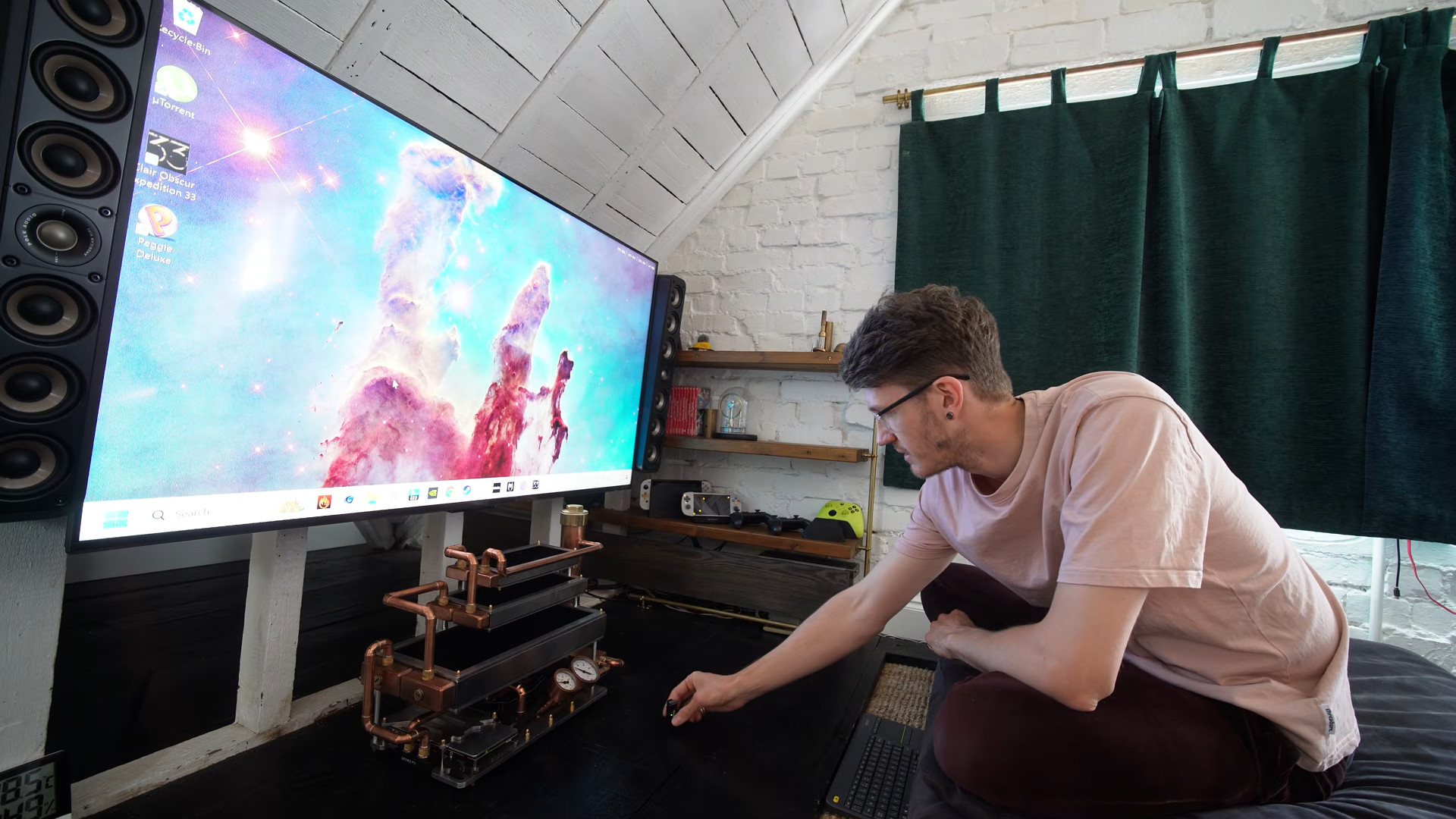
The cooling loop begins with three radiators: a big one, a small one, and a slightly smaller one. But raw metal PC radiators are difficult and expensive to come by these days. Some paint stripping and polishing will fix that problem. A few hand-made mounting brackets complete the aesthetic. All three radiators are stacked above the motherboard, and on top of each other, positioned horizontally to encourage passive airflow through them.
At this point, a normal PC would be plumbed up using standard flexible or, if you’re particularly ambitious, hard piping. But this is no normal PC. Instead, the plumbing uses household copper piping, soldered together. Two gauges sit near the front to show the water pressure and temperature. The reservoir is a larger diameter pipe with one end soldered onto a smaller pipe leading to the pump. The other end is a screw cap, with the corners machined off to match the pipe, to allow for filling of the loop. Soldering this took quite some effort because of the thermal mass in such a large pipe.
Once testing commenced, two issues became quickly apparent. The pressure gauge creates quite the racket as water flows past, and the stacked radiators are inadequate at cooling the PC. Rather show-stopping issues when the goal is gaming in silence. Was all this work for naught? No, the design proved the block of aluminum quite adept at cooling the motherboard and GPU. Moreover, adding a simple 120mm fan between the two smaller radiators and removing the pressure gauge effectively quelled the overheating and ticking issue. The result is a quiet (and quite pretty) living room PC with performance to match.