
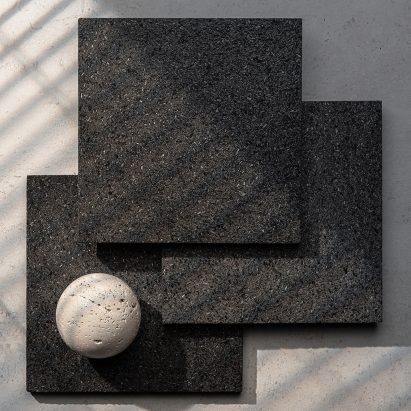
Finnish firm Elementic has unveiled MO6, a wall-surfacing material produced from forestry industry offcuts that is almost pure carbon.
Called MO6, the product takes the form of thick, lightweight tiles with a rough texture and an off-black colour.
Materials technology company Elementic established MO6 as a brand in May, with the debut collection, MO6 Eternal, launched on Wednesday at trade fair Habitare.
MO6 says its product can store carbon for thousands of yearsMO6 claims to be the most carbon-negative, or carbon-storing, building material in the world, with carbon molecules making up 90 per cent of its chemistry.
It uses lignin as a raw material – a by-product of the forestry and timber industry that is considered difficult to use and is usually burned for energy.
Through a patented process that remains highly secretive, impurities such as oxygen are removed from the lignin in a bioreactor to result in a material that is highly durable and fire-resistant with a dramatic aesthetic.
The tiles are already being delivered to projects"It's quite a challenging material, but we love lignin because it's a very carbon-rich raw material," MO6 general manager Johanna Normiala told Dezeen.
"In our process, the know-how is all about knowing how you transform lignin to make it something useful," she continued.
"We take the lignin, we create a kind of dough that we bake like a cake, and in the end we get a hard, resistant, durable material but which is lightweight."
MO6 is produced from lignin, which is usually burnedMO6, which describes itself as a "premium interior design brand", is already delivering product to projects, including a spa under construction in Paris.
"We are very much eager to help or support our customers whatever is the area of application, but I would say that the focused interest are in [the] area of hotels, restaurants – I think that's that's something where this material goes very well," said Normiala.
For the time being, MO6 is only being marketed as suitable for dry indoor spaces, but Elementic has ambitions for much wider applications and is currently developing bricks.
Read: Tarkett achieves "world's first" carbon negative linoleum"There's a huge potential for that, not only interior part, which is now our first business, but in future in a much larger scale in building," said Normiala.
MO6 Eternal tiles are available with a rougher or smoother finish, and can be coated.
According to Normiala, its thermal and acoustic properties are comparable to wood, but MO6 is hopeful that improvements can be made with tweaks to the manufacturing process in future.
MO6 parent Elementic hopes its innovation will soon be usable as a structural materialCarbon negativity refers to something that removes more carbon dioxide equivalent from the atmosphere than it emits.
In the case of a material, emissions are generally produced during manufacture and end-of-life.
The issue of carbon storage has attracted major focus among architects in recent years, driven by concern about the vast carbon emissions associated with constructing buildings.
Read: The Dezeen guide to carbonTimber has been the subject of renewed interest as a building material as a result, thanks to the carbon sequestered by trees.
According to MO6, one kilogram of its material stores approximately 2.4 kilograms of atmospheric carbon dioxide – roughly double the amount stored by wood.
MO6 says its material can keep carbon locked up for potentially thousands of years, because it does not decay and is easy to recycle.
For now, MO6 is only being marketed for use in dry interior spacesDezeen previously explored innovations seeking to store and utilise atmospheric carbon through our Carbon revolution series.
Other projects published on Dezeen that aim to put lignin to use include a bioplastic developed by German designer Basse Stittgen and a structural panel by Denmark's Natural Material Studio.
The photography is courtesy of MO6.
Habitare took place during Helsinki Design Week from 28 August to 6 September. See Dezeen Events Guide for more architecture and design events around the world.
The post Finnish company launches "world's most carbon-storing building material" appeared first on Dezeen.