
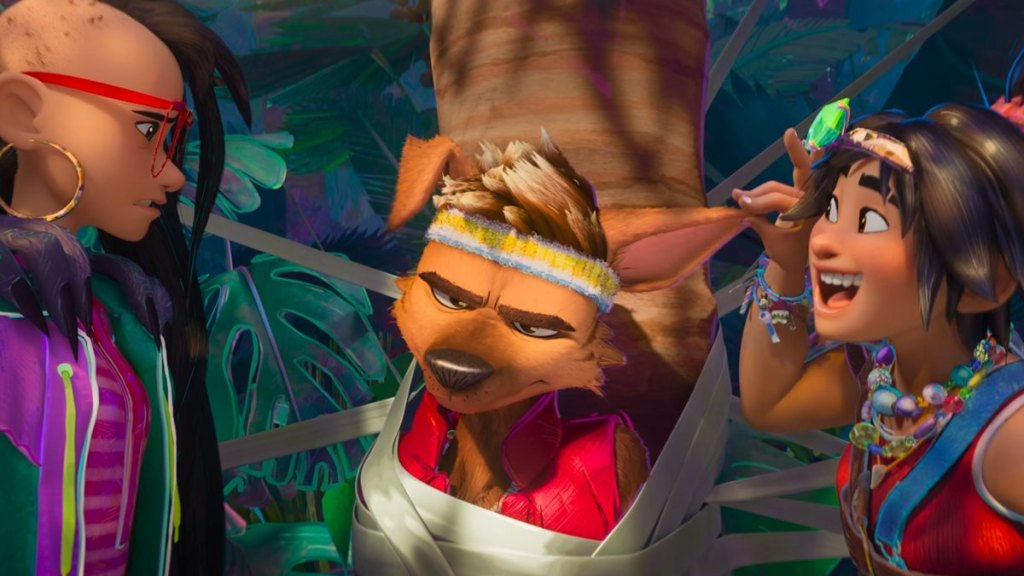
Forgotten Island directors Joel Crawford and Januel Mercado spoke with ComingSoon’s Tyler Treese about their fantasy movie. The duo discussed its personal roots, how they incorporated Philippine mythology, and more. DreamWorks’ latest film debuts exclusively on digital platforms on October 27, 2026, and on 4K UHD, Blu-ray, and DVD on December 1, 2026.
“On their last night before embarking on separate life paths, best friends Jo and Raissa find a mysterious portal that transports them to Nakali, a mythical island filled with magical creatures they learned about from their Filipino families,” says the official synopsis. “As Jo and Raissa search for a way home, they discover their memories are at risk. Will they find a way off the island before they forget each other forever?”
Tyler Treese: Joel, I love the art style in this film, and much like Puss in Boots: The Last Wish, it’s very outside what I would call the house style of DreamWorks. But the studio has gotten very varied and inventive with its style recently. How was it finding that right tone visually? Because it’s even a bit different from Puss in Boots, and it’s varied. You’re trying different styles. It’s very fun.
Joel Crawford: Thank you so much. Yeah, we always have fun, I think, with each story, figuring out, once you lock down what the central idea is, how do you visually tell it? Animation’s such a fun medium that you can do anything with, but we always want to have a reason behind it. With Puss in Boots, that was a cat who was living this fairy-tale life, oblivious to mortality, so we wanted it to look like a fairy tale.
With this, early conversations Januel and I had were, really, this movie, you’re experiencing memories. You’re celebrating the memories that make us who we are. And we thought we could have a lot of fun with the idea of when you look back on a memory or something, you and I might remember it differently. So using whoever’s telling or reliving moments to be able to switch up the animation style to really embody their character and that point of view was very freeing.
I think overall, one of the cool things about DreamWorks is that there’s been a specific kind of style we’ve been pushing the last few years with Puss in Boots: The Last Wish, The Wild Robot, and now Forgotten Island. But if you go way back to The Prince of Egypt, that was already outside the box and pushing things from, I’d say, what people are used to in the Disney house look. So one of the cool things is DreamWorks has always been boldly not owning one house style, and it really frees you up when you’re telling stories here.
Yeah, even Shrek was pushing things outside of that, with that kind of grossness to it.
Crawford: Yeah, the ugliness. Yeah, kind of story-reasoned. Yes, exactly. Making those fairy tales more actually relatable. So yeah, you’re right.
Januel, I was curious about the nonstop pace to Forgotten Island. We even see it early on where “Don’t Stop Believin'” is playing, and you’re cutting to different things based on the music, which I thought was wonderful. Can you speak to always keeping this film propulsive and why you wanted it to be this thrill-ride experience?
Januel Mercado: Yeah, and we’re big cinephiles who are always implementing things that inspire us, like the rhythmic cutting to shots and music. Edgar Wright does it a lot. Also, Blindspotting, set in Oakland, Bay Area. We were fans of Daveed Diggs, clipping., and their sensibilities of musicality with the visual storytelling.
But with more intent, though, to share with you, this movie is a coming-of-all-ages story, and it’s centered on this friendship and this last night. And it reflects the memories of your youth and those big parties, those epic party moments with your friends, that when you’re having fun, time flies, right?
Time flies when you’re having fun. So the propulsive pacing, especially in the middle when it gets into the fantasy island and the party adventure, is meant to reflect that concept of the best times in your life that just go by in a blur. And you remember this feeling of, “What a great, crazy party night,” but it’s a trip where it’s like, “Man, that went by fast.”
Crawford: And then you get the contrast by having this propulsive movie that, in the key moment, without spoiling anything in the third act, when the movie stops, when you’re in the moment, we always say that it’s because of the journey to get there. Because you’ve laughed and invested so much in Jo and Raissa’s friendship, and you feel like you’re inside that friend group the whole time. When that friendship is at stake, and when you’re in that moment, people laugh, they cry at the end.
Mercado: So it’s playing with the texture of it. Like what Joel’s saying, if you’re feeling the chaotic pace, but then when it slows down, it feels slower and you’re in the moment, and it means more.
And off of what Joel was saying, we actually have an appropriate line in the lyrics of the Bini song, “A Parallel World,” where they say, “Best times in our life, we laugh so hard, we cry together.”
Joel, this film was received so well from critics; audiences were responding to it, but there’s one reaction that’s more important than all. I know your wife is Filipino, so what was her reaction to the film? Did you get her approval?
Crawford: Yeah, you’re right. That’s the highest stakes. Especially on my side, my wife being born in the Philippines, came over to the U.S. when she was nine. So much of this story is, from my side, inspired by her and a tribute to her.
So, there’s actually one of the moments toward the end of the film, when Raissa is talking to little Jo, there’s a moment where, when I was taking my pass, we always swap when we’re writing the scenes, when I was writing it, I was picturing my wife. There’s this picture of her in the Philippines with this big smile on her face when she was nine.
In that moment, when we were watching the film together at the premiere, my wife turned to me and a tear ran down her cheek. And yeah, it is such a kind question from you because that is the biggest, most rewarding reaction of all. So thank you for asking that.
Well, thank you for sharing that lovely story. It’s very touching that it resonated with her and this art really found its audience.
Januel, a lot of people in the States don’t know a lot about Filipino mythology. It’s not like Norse or Greek mythology, where we have all of this widespread art. So Forgotten Island was a tremendous opportunity for you guys to introduce a lot of these mythological characters to a wider culture. It’s an opportunity, but I assume there’s also pressure for you to do it justice and get it right. So how was it approaching that from your end?
Januel Mercado: Yeah, I’m glad you asked that because I remember when we first announced our movie, we’re doing a feature on Filipino mythology, I made the mistake of looking at all the comments online. There’s all these comments like, “Oh, they better do this story. They better do this creature, and they better do justice to this and this.”
And I was like, “Oh, none of that is in the movie.” So definitely there was this reaction of feeling the pressure of, “I gotta listen to everyone, and you gotta get it all accurate.” Then I realized, wait, this is silly. This is how you put yourself in a position where you fail because you know that you can’t make everybody happy.
So I was reminded of, again, we need to just tell the story that we want to tell and that feels right. It’s already a big deal that we’re shining a light, like you said, on this mythology. So pretty quickly together, we were able to just stay eyes on the prize. Let’s be true to the story we want to tell and not worry about the outside noise.
Joel Crawford: It helped having our cultural consultant.
Mercado: Yeah, that helps us. Our cultural consultant, Kirby Araullo, amazing to work with. Because he’s an expert on the history and the folklore, we were able to just communicate with him our intent.
And so even if it’s not totally accurate to the source material, he understands why we’re adapting it that way. So that gave us leeway to pursue what we felt was necessary with creatures.
Crawford: He also gets our silly sense of humor. So you have a cultural consultant who can tell you what’s right, but then also know that for the entertainment and for the story and this weird, funny sense of humor in here.
Mercado: We talk about being inspired by Ghibli and Miyazaki movies. Spirited Away was a big inspiration for us. And that was also an approach, too, because I remember how beloved Spirited Away was and how we felt watching it.
You felt that Miyazaki brought you into this world. And I can tell there’s very specific mythology and folklore references there, but they don’t spoon-feed it to you. You’re just immersed in this fantasy world.
I think we explain a little more through the point of view of Jo and learning from her Lola, but we like that idea of respecting that audiences are smart, and you could be engaged and thrown into a world without knowing exactly the backstory to every single creature that you’re seeing.
Yeah, I think you guys made the right choice of making a personal, character-based story because if you just throw in everything, it’s going to overwhelm people. We need those character moments to really resonate.
Crawford: You get it. Actually, Tyler, that reminds me, your backdrop is amazing.
Mercado: Yeah, with your head and the portal.
Crawford: Actually, just seeing your face and the portal reminded me of something Januel said early on when we were making the film, which was that it’s so bold to have the portal be the sun of the Filipino flag. It’s this big invitation to the audiences that you literally, with the girls, jump into that portal.
It’s bringing the world into, for some, this unknown world of Filipino mythology, but a big invitation that, “Let’s go on this adventure together,” and maybe leaving the movie wanting to learn more. That would be the best outcome, where there’s more stories, not just from us, but that are celebrating and bringing the whole world into Filipino mythology.
Thanks to Joel Crawford and Januel Mercado for taking the time to talk about Forgotten Island.
The post Forgotten Island Directors Reveal Studio Ghibli Influence on DreamWorks’ New Fantasy Movie | Interview appeared first on ComingSoon.net - Movie Trailers, TV & Streaming News, and More.