
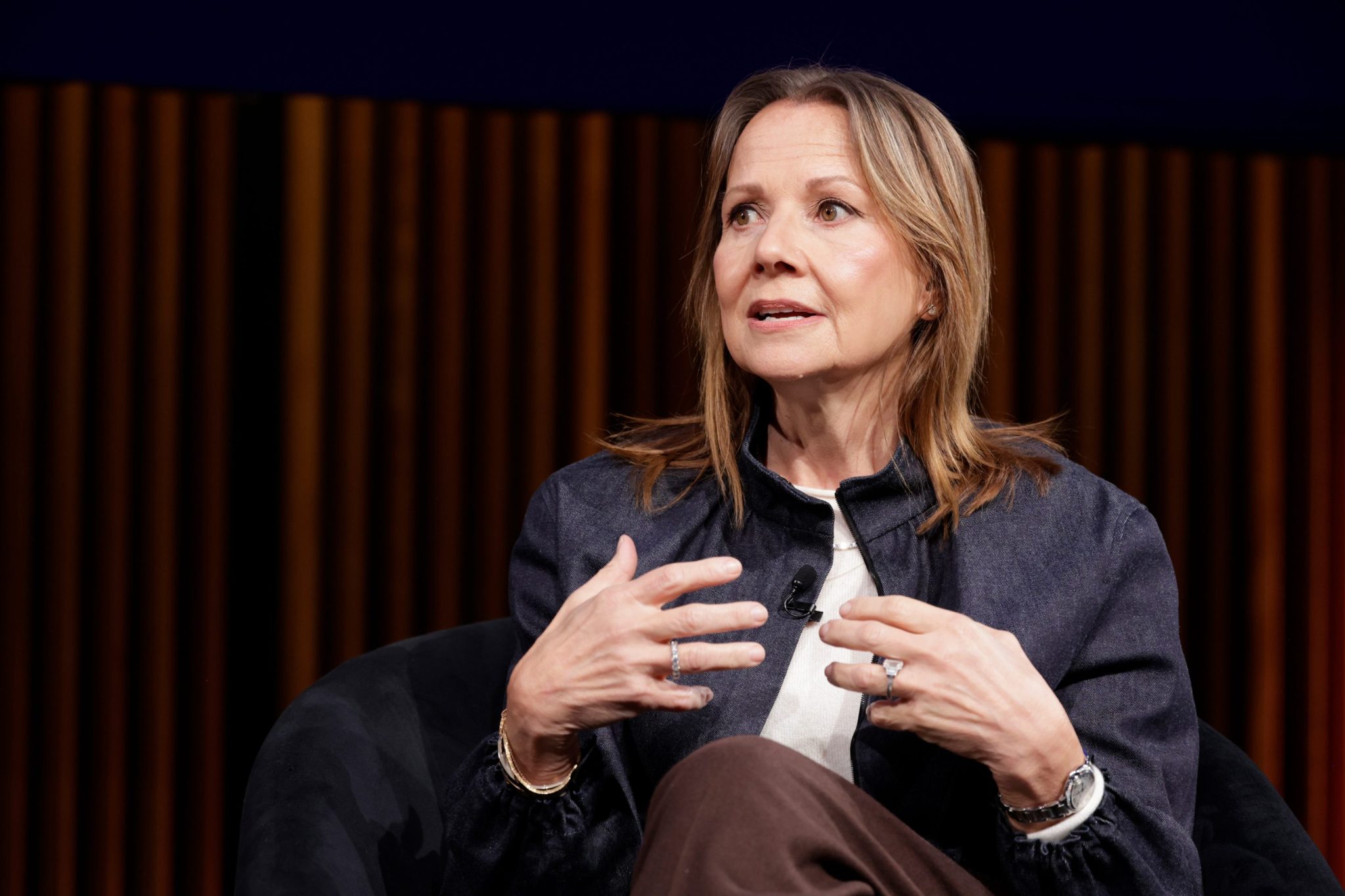
- In today’s CEO Daily: An interview with GM CEO Mary Barra
- The big leadership story: Jensen Huang declares the start of the AGI era.
- The markets: Mixed globally as Brent crude tops $100 a barrel
- Plus: All the news and watercooler chat from Fortune.
Good morning. Alyson Shontell, Fortune’s Editor-in-Chief, writing from New York this morning.
When I had the chance recently to interview Mary Barra for Fortune’s Titans podcast, the GM CEO made clear that the company has no plans to abandon EVs, even as consumer adoption has slowed, improvements to the charging infrastructure have taken longer than expected, and the Trump administration has pulled back on policies designed to accelerate the transition.
“I don’t think it’s shifted our mission,” she told me. “We still think EVs are the end game.”
That conviction matters, given that GM has spent years investing in electric vehicles, batteries, software, and charging. Going forward, Barra is applying a pragmatic framework: GM will keep selling EVs and hybrids; it will also keep selling the lucrative trucks and SUVs that many Americans still want. Investors by and large have applauded her embrace of the messy middle: The stock is trading near its all-time high, and is up nearly 6% YTD.
The mantra that Barra returned to again and again in our interview was choice. She invoked the goal of the legendary GM CEO Alfred P. Sloan: to reach “a lot of pocketbooks.” It’s an idea that feels newly relevant in an inflationary era, as automakers try to serve customers with very different budgets, driving habits, and comfort levels with electrification.
As for her broader management philosophy, Barra told me, “Agility is a superpower now.” It’s a lesson she learned early in her tenure as CEO, when it became clear that a disastrous ignition-switch malfunction had not been addressed for months because of what she called at the time a “deeply troubling” culture of bureaucratic inaction. Barra quickly instilled a set of protocols to prevent anything like that happening again: Solve problems immediately, build mechanisms for employees to surface concerns, and repeat the message until it becomes embedded in the culture.
That’s still her approach. “Rarely do problems get smaller,” she told me. Today, GM starts every meeting with a safety message—a way to keep the lessons learned from the ignition switch crisis top of mind—and maintains a “speak up for safety” culture.
Creating an agile organization also means anticipating what lies ahead. To that end, GM is investing in automation, aiming to offer eyes-off-the-road highway driving in a Cadillac Escalade IQ by 2028. It is spending more than $250 million on skilled-trades training, which Barra has told high school students may be “a little more AI proof” than some white-collar jobs. And it is experimenting with AI in factories and vehicle design to help its workforce move faster.
These approaches add up to a clear strategy other leaders can learn from: Play the long game and don’t let shifts in the landscape throw you off course. Address problems as they arise and retain the flexibility to meet customers where they are now.
Check out my full interview with Mary Barra here.
Contact CEO Daily via Diane Brady at diane.brady@fortune.com
This story was originally featured on Fortune.com