
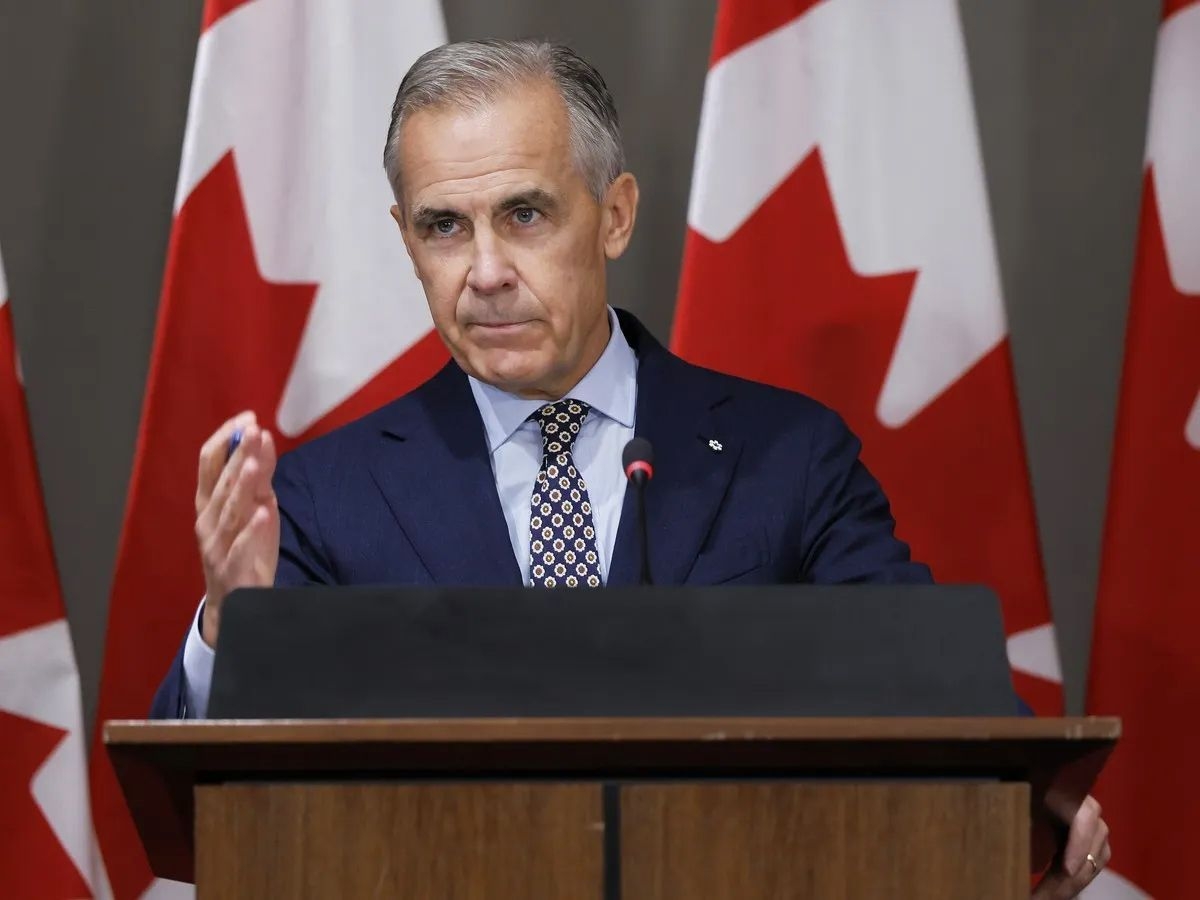
Prime Minister Mark Carney’s plan to bolster Canada’s economy while reducing our reliance on the U.S. economy is based on the claim we can spend ourselves rich.
That is, that reducing corporate taxes while simultaneously increasing capital spending – or rather, what the Carney government calls capital spending – will lead to long-term prosperity.
In an appearance before the Senate finance committee last week, parliamentary budget officer Annette Ryan said the approach the government is taking risks sending the costs of servicing government debt into the “danger zone” and that its abandonment of a key fiscal anchor on spending is “the opposite of prudence.”
In addition, the Carney government’s failure to define the reasoning behind what it now classifies as operational versus capital spending means even her office – an independent, non-partisan watchdog on government spending – can’t determine if the budget numbers add up.
In testimony first reported by Blacklock’s Reporter , Ryan said current government spending to pay interest on the federal debt is moving “very quickly right now” from 10 cents on every dollar of revenue to 14 cents in a couple of years and, if that pattern continues, “when you get up to 18 or 20 cents on the dollar, that’s a danger zone.”
She criticized the Carney government’s abandonment of using its debt-to-GDP ratio as a fiscal anchor on government spending, while substituting the promise of a balanced operating budget starting next year.
“I think it’s straightforward to say that a fiscal rule based on a debt-to-GDP ratio would be more prudent,” she testified. “You get a declining debt-to-GDP when you essentially have revenues surpassing expenditures through time based on your GDP and population. That really is at the core of prudence.”
By contrast, she said, the government’s “very ambitious” argument that significantly increasing its capital spending on infrastructure and other programs will boost GDP in the way it claims, “is prone to many, many risks and essentially that is the opposite of prudence, so I’ll stop there.”
RECOMMENDED VIDEO
Part of the problem is that the federal government has divided what was previously reported as the annual federal deficit into two parts – operating spending and capital spending financed by public debt.
It’s only the operating budget – the day-to-day costs of running the federal government – which Carney has said the government will balance next year, while it’s reclassified capital spending, financed by debt, as investments that will increase GDP.
But the PBO argues the Carney government has already wrongly classified many of its operating costs such as corporate tax cuts, investment tax credits and operating subsidies to companies as capital expenditures, contrary to international public accounting standards and practices.
In a previous report, the PBO said, $94 billion, or 30%, of the spending the Carney government classified as capital investments in its budget was actually operating costs of running the government, and if properly accounted for, would leave the operating budget in a deficit.
“Because the government has stepped away from the fiscal anchor of debt-to-GDP, which was that straightforward prudence, we wanted to really understand the fiscal anchor they said they would be governed by with this new creation of operating budget balance,” Ryan said.
- GOLDSTEIN: Canada’s bottomless climate change money pit
- GOLDSTEIN: Wasteful and ineffective, federal spending on Indigenous issues is out of control
- GOLDSTEIN: OECD downgrades Canada’s economic growth as Carney moves away from U.S.
But her office wasn’t able to determine that because the information was not contained in the most recent federal budget or the spring economic update, nor was it available when the PBO made its own inquiries to determine what the government classified as operational versus capital spending and its forecasts of their impact on the economy.
“Given that the government has set forward this operating budget as one of its two fiscal anchors, the other one being a declining deficit- to-GDP ratio, I would see it as really imperative that the government would make this detail available with each of its budget documents, to show how they are seeing their own fiscal discipline … I think the responsibility belongs to the government to clearly show how they see that this fiscal anchor represents an accurate discipline in terms of their expenses,” Ryan said.
To be fair to the Carney government, lowering Canada’s corporate taxes to attract more business investment is a sensible policy.
But doing it while simultaneously raising government spending is the opposite of fiscal conservatism, where a government lowers spending before cutting taxes.
That was the approach of the Liberal government of Jean Chretien and his finance minister, Paul Martin, during Canada’s debt crisis in the early 1990s, when paying interest on government debt reached as high as 30.7% of government revenues.
lgoldstein@postmedia.com