
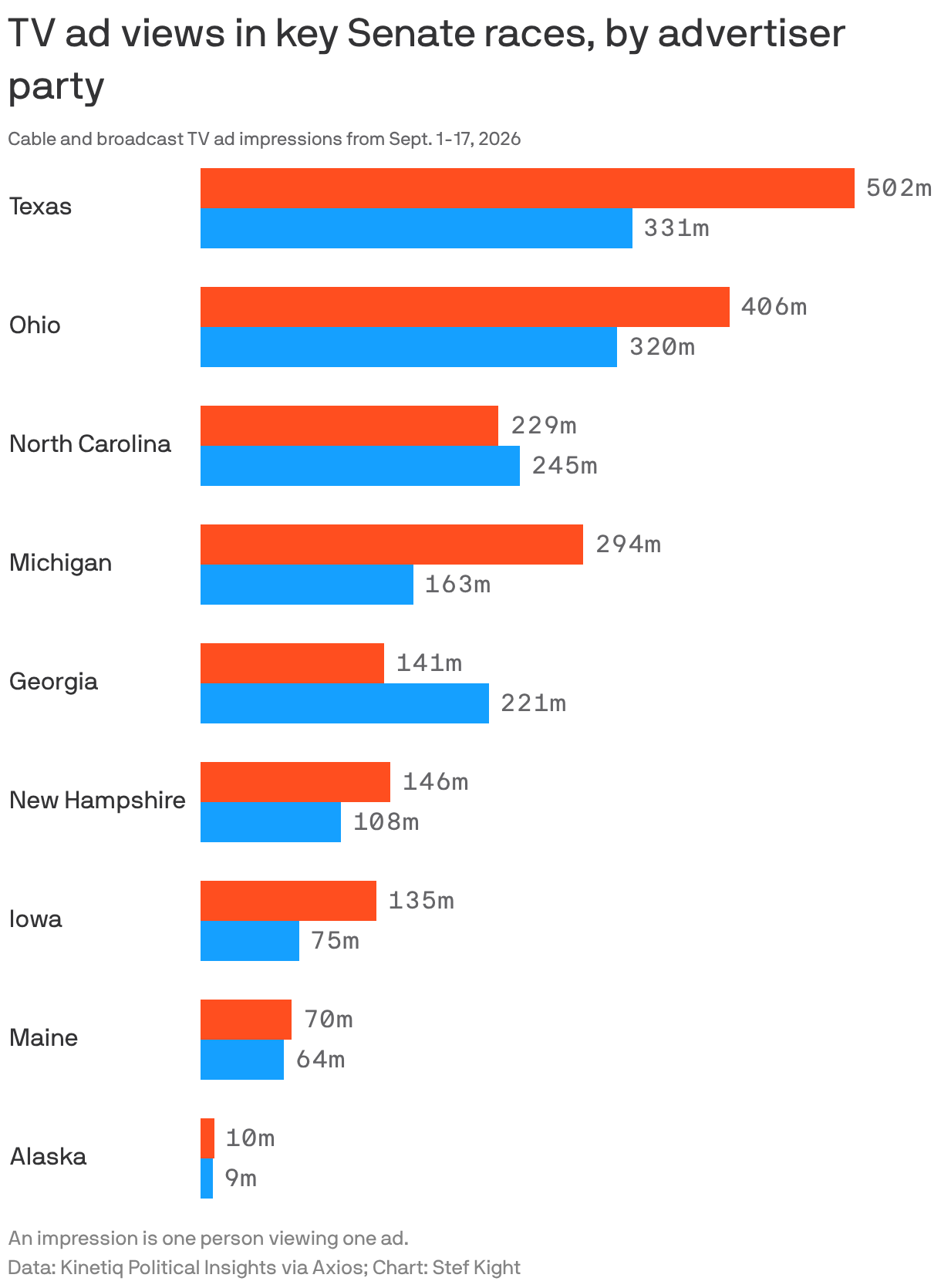
Republicans are starting to trounce Democrats in political spending across the Senate map, and that advantage is now showing up in one of the metrics campaigns care about most: impressions.
Why it matters: Money matters in a campaign's closing weeks, but what campaigns are ultimately buying is voters' attention — and the price varies, depending on who is buying and when they place their ads.
- Beginning in September, campaigns and super PACs start competing for the same finite supply of advertising inventory. But the campaigns are guaranteed lower rates.
- Republicans are generating substantially more impressions — an estimate of the number of times an ad is seen — but their advantage isn't nearly as large as the spending disparity would suggest.
The intrigue: North Carolina is the only key battleground where Republicans have been spending more for fewer impressions in the first weeks of September.
- Democrats generated 245 million impressions supporting former Gov. Roy Cooper, compared with 226 million for Republican Michael Whatley— even while being outspent by Republicans $10.6 million to $9 million.
- Whatley has been consistently trailing Cooper in the polls.
- It is forcing Republicans to weigh whether to begin pulling resources there. One key GOP super PAC took down $6.5 million worth of ads for October, as Semafor first reported.
By the numbers: From Sept. 1 through Sept. 17, Republican advertisers generated 502 million impressions in Texas, compared with 331 million for Democrats, according to data compiled by Kinetiq Political Insights.
- Republicans, relying heavily on super PACs to bolster Attorney General Ken Paxton, spent $37 million over that period.
- Democrats spent $9.5 million, with much of that coming directly from state Rep. James Talarico's campaign.
In Ohio: Republican ads generated 406 million impressions supporting Sen. Jon Husted, compared with 320 million for former Sen. Sherrod Brown.
- Outside GOP groups accounted for much of Husted's advertising, with Republicans spending roughly $22 million on his behalf. Democrats spent $14 million for Brown.
- Husted will get another boost. Fairshake, the crypto industry's main super PAC, has reserved $30 million in Ohio to oppose Brown.
Driving the news: Republicans opened up a massive spending advantage in September, outspending Democrats on air in nearly every competitive Senate race.
- Those gaps have widened as more GOP-aligned super PACs have entered the fray.
Zoom out: Candidates get lower rates from broadcasters, meaning they get more airtime for fewer hard dollars than outside groups and super PACs.
- Super PACs can raise unlimited sums, but often pay many times more than candidates for comparable broadcast inventory.
Zoom in: Democrats' strength in online fundraising has helped their candidates amass large hard-dollar war chests, while Republicans have countered with a significant advantage in super PAC and party money.
- This year, a Supreme Court ruling opened the door for party committees to combine their funds with campaigns and get the lower rates.
- The NRSC estimates that coordinated spending can make its advertising dollars stretch three to 10 times further than they did last cycle, Axios reported. It's committing $46.5 million to coordinated campaigns across eight states.
The bottom line: Republicans are relieved that the big-spending super PACs have arrived in force.
- But that relief is tempered by concern that the cash infusion has come after some voters' views of the races and candidates may have already hardened.