
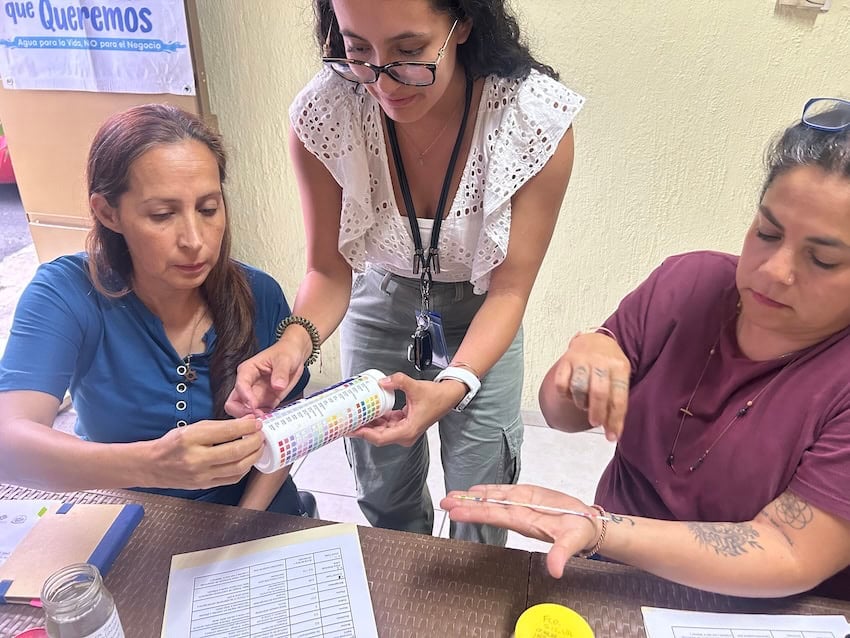
On a Saturday morning in Guadalajara’s historic Analco neighborhood, residents arrived at the Casa Bandera community center carrying bottles and jars filled with water from their homes.
At folding tables, researchers from ITESO, Guadalajara’s Jesuit university, showed them how to dip inexpensive reactive strips into the samples, wait for the colors to change and compare the results against a chart measuring pH, chlorine, lead, mercury and other indicators. Samples showing signs of possible bacterial contamination could undergo additional testing for E. coli.
It was the latest workshop in an expanding citizen water-monitoring network that has grown out of Guadalajara’s months-long water crisis — and out of residents’ frustration with what they see as inadequate information and action from the authorities responsible for providing safe water.
“We don’t claim to be scientific specialists or water experts,” Héctor Morales, one of the workshop presenters, told participants. “We are citizens contributing evidence from what we are observing and living through, and that is equally valid.”
“We’re not trying to compete with science,” he continued. “We’re trying to generate knowledge that comes from everyday life. That’s the approach of citizen science.”
Veyda Alcalá Camacho, an environmental engineer from ITESO, helps Analco residents compare the colors on test strips dipped in water from their home taps with a reference chart. The color changes can indicate possible problems with chlorine levels, pH, lead, mercury and other water-quality parameters. (Photo by Tracy L. Barnett) Sunday: Mega March + Agua KK FestGuadalajara’s water activists will be having some fun with the theme at Sunday’s festival — without losing sight of the very serious problem behind it.
When: Sunday, Aug. 23
10 a.m.: Gather at Parque Rojo
11 a.m.: Mega March for Water departs along Av. Juárez
Noon: Agua KK Fest at Plaza Liberación
The workshops will feature home water filters, rainwater harvesting, dry toilets and water testing, plus children’s activities, music, decorated water jugs, costumes and karaoke. The cheeky Agua KK name is a play on the word caca — a pointed joke about the dirty water that residents say has been coming from their taps.
From complaints to citizen evidenceGuadalajara’s water crisis reaches a boiling point
The network brings together neighborhood residents, scientists from ITESO University, the Mexican Institute for Community Development (IMDEC) and the citizen campaign #ElSiapaQueQueremos, or The SIAPA We Want — SIAPA being the city water utility.
The idea is not simply to tell residents what might be in their water. María González of IMDEC said the testing has two purposes: helping families take care of themselves, and creating a body of evidence that can be used to press authorities for action.
“This helps us protect ourselves. You are going to know what is in the water in your homes,” González told the group. But the results, she said, are also “our citizen evidence for legal action, for institutional action, for mobilization.”
Héctor Morales (second from left) explains the principles of citizen water monitoring during a workshop in Guadalajara’s Analco neighborhood. “We ourselves generate the evidence,” he told participants, describing the community-based approach. (Photo by Tracy L. Barnett)Before Saturday’s workshop, the network had analyzed roughly 184 samples from 90 neighborhoods in five municipalities. Organizers said residual chlorine was found in only 12 of the 184 samples. That’s a problem, they pointed out. Chlorine is added during water treatment, and a small amount should remain as water travels through the distribution network to help protect it from bacterial contamination.
The monitoring also detected lead in 20 samples, fluoride in 52 and mercury in an unspecified number, according to Morales. Four of the 184 samples tested positive for E. coli, a form of fecal coliform bacteria.
The citizen findings are not a statistically representative survey of Guadalajara’s water supply, a limitation organizers repeatedly emphasized. The low-cost tests do not measure all of the dozens of parameters required under Mexico’s drinking-water standard.
“What does this analysis tell us?” Morales asked. “It tells us when the water is not safe. What doesn’t it tell us? It doesn’t tell us when the water is good.”
Certifying water as safe, he said, requires much more extensive laboratory testing.
Feds and Jalisco state are joining forces to tackle water contamination in greater Guadalajara
Still, official testing has now documented some of the same warning signs.
In late July, Jalisco health authorities confirmed that E. coli had been detected in 18 of 297 samples analyzed between March and June in neighborhoods affected by water-quality problems. Officials also acknowledged insufficient chlorination in some areas.
The findings came after months of complaints about yellow, brown or foul-smelling water, as well as sediment and service interruptions across the Guadalajara metropolitan area. González said the #ElSiapaQueQueremos campaign has now received nearly 1,500 complaints, with water quality by far the most common problem, followed by outages and high rates.
A multibillion-peso responseThe Jalisco government and SIAPA, the metropolitan water utility, have acknowledged serious problems in the aging system and announced a long-term overhaul requiring more than 20 billion pesos in investment.
Among the major projects are the replacement of the aging Chapala-Guadalajara aqueduct and the modernization and expansion of Potabilizadora No. 1 in Miravalle. Governor Pablo Lemus said this month that the federal government had agreed to support both projects.
But for the citizen coalition, repairing infrastructure is only part of the solution.
The movement is increasingly focusing on who participates in decisions about the water system, how information is shared and whether communities themselves can have a formal role in monitoring and oversight.
That shift will be on display Sunday, when the same groups organizing the monitoring workshops will hold a “Mega March for Water.” Participants will gather at Parque Rojo at 10 a.m. and march along Avenida Juárez to Plaza Liberación, where the deliberately scatological “Agua KK Fest” — a play on caca, or “poop,” in reference to residents’ complaints about dirty water — will begin at noon.
The festival will combine protest with workshops on household filters, rainwater harvesting, dry toilets, urban gardens, community water systems and water-quality monitoring. Organizers describe the event as peaceful, family-oriented and nonpartisan.
Neighbors gather outside Casa Bandera in Analco to share concerns about Guadalajara’s water problems and discuss how to pressure SIAPA to provide safer, more reliable service. (Photo by Tracy L. Barnett) Beyond fixing SIAPAThe coalition’s demands now extend beyond cleaner water. Its latest statement calls for greater transparency, citizen participation in decisions over water quality, distribution and infrastructure, formal recognition of community monitoring and protection of the watersheds that supply the metropolitan area.
It also proposes “public-community agreements” that would bring SIAPA, universities, neighborhood organizations, workers and other sectors together to share knowledge and participate in water governance.
The organizers explicitly reject privatization as the answer to SIAPA’s failures.
“The alternative to an inefficient SIAPA is not a privatized SIAPA,” their statement says, calling instead for a public utility that is transparent, efficient and subject to democratic social oversight.
González said the campaign is also pushing for a permanent working group focused specifically on water quality, health and sanitary risks. Authorities have not yet agreed to participate.
But organizers do not intend to wait indefinitely.
The group, González said, “is going to be established with authorities or without authorities,” functioning independently if necessary to prevent health risks.
That determination reflects how far the movement has come since residents first began showing up at public meetings with bottles of discolored water.
Morales said citizen monitoring allows residents to reach places government agencies may not sample and to turn individual experiences into systematic evidence. He has watched workshop participants take what they learn back to their neighborhoods — and then into the streets.
“It’s beautiful to see people who come to the workshops later at demonstrations with signs saying, ‘There are nitrates and nitrites in our water,’” he said.
“The authorities never expected that.”
Tracy L. Barnett is a Guadalajara-based freelance writer and the founder of The Esperanza Project.
The post Guadalajara residents turn to citizen science as water crisis deepens appeared first on Mexico News Daily