
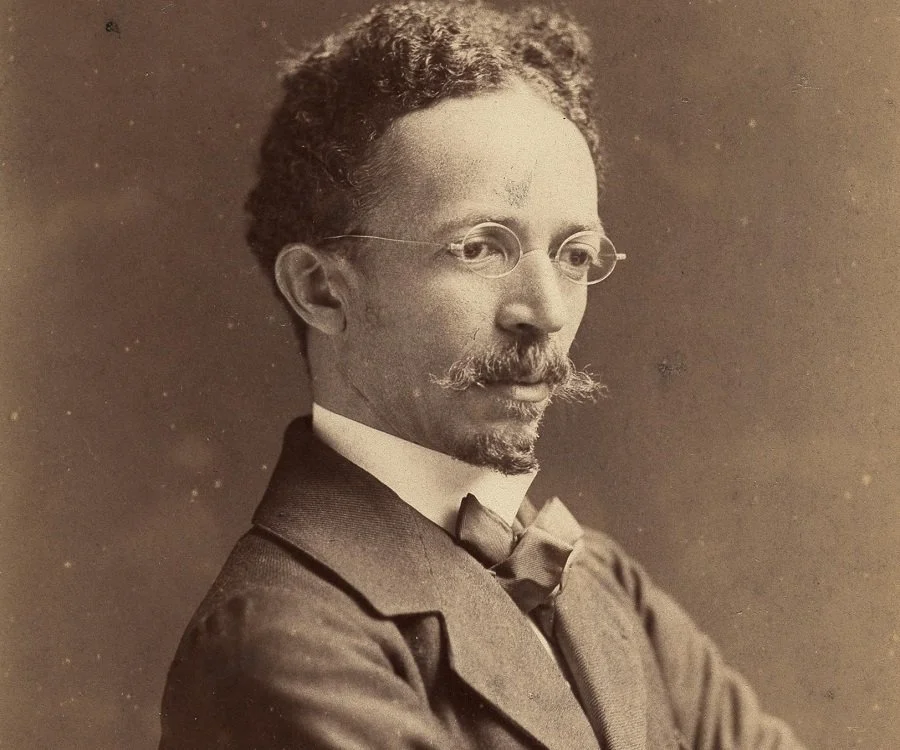
Some painters command attention with spectacle. Henry Ossawa Tanner achieved something rarer: he cultivated stillness. His finest canvases seem to breathe, inviting viewers into rooms filled with lamplight, dusk, prayer, and reflection. Across a career that stretched from the late nineteenth century into the early decades of the twentieth, Tanner became one of America's most accomplished painters, celebrated not for grand gestures but for an extraordinary command of mood, subtle color, and emotional restraint.
Brian D'Ambrosio explains.
Henry Ossawa Tanner by Frederick Gutekunst. Source: Public domain, Archives of American Art, available here.
Born in Pittsburgh in 1859 and raised in Philadelphia, Tanner demonstrated an early fascination with drawing. As a young man, he enrolled at the Pennsylvania Academy of the Fine Arts, where he studied under the demanding painter and teacher Thomas Eakins. Eakins emphasized anatomical precision, careful observation, and technical discipline—lessons Tanner absorbed with exceptional success. Yet his own painterly voice gradually evolved beyond realism toward something more lyrical. He painted faithfully from observation, yet he was just as interested in the emotions that lingered after first impressions faded.
His early works reveal an artist drawn to modest moments rather than theatrical subjects. Instead of fashionable society portraits or sweeping historical scenes, Tanner found lasting significance in humble interiors and everyday experience. One of his most admired paintings, The Banjo Lesson (1893), depicts an elderly man teaching a child to play. Every gesture feels deliberate, inviting viewers into an intensely private exchange. Warm amber light settles across the figures, transforming a simple lesson into a meditation on knowledge, affection, and continuity. Perhaps that explains why the painting remains among the most beloved images in American art.
Equally compelling is The Thankful Poor (1894), in which an older man and a boy bow their heads before a modest meal. Nothing lavish appears on the table. Instead, Tanner allows light to become the principal storyteller. Sunlight filters gently through the room, catching worn hands, coarse cloth, and simple crockery. The restrained composition leaves room for viewers to discover gratitude and companionship on their own, never slipping into sentimentality.
Seeking broader opportunities, Tanner moved to Paris in 1891 and enrolled at the Académie Julian. France proved both a creative refuge and the place where his reputation flourished. He exhibited regularly at the prestigious Paris Salon, receiving an honorable mention at the 1896 Salon for Daniel in the Lions' Den, a third-class medal in 1897 for The Resurrection of Lazarus, and later a silver medal at the 1900 Exposition Universelle. Critics admired both his technical sophistication and his distinctive handling of radiant color, while collectors increasingly sought his paintings.
Paris also deepened Tanner's fascination with biblical subjects. Rather than dramatizing sacred narratives, he sought emotional authenticity rooted in place. Repeated journeys through Egypt, Palestine, Syria, and other parts of the Middle East informed these works with careful observation of architecture, clothing, terrain, and regional sunlight.
No painting better represents Tanner's mature vision than The Annunciation (1898). Instead of presenting an elaborately winged angel, he renders the heavenly messenger as a radiant shaft of light. Mary sits on a simple bed, quietly contemplative rather than visibly astonished. The textured plaster walls, humble furnishings, and muted palette create a convincing domestic setting without sacrificing its spiritual mystery. More than a century later, the painting still feels remarkably modern because Tanner trusted radiance itself to carry the emotional weight.
Other celebrated works reveal the same mastery. Nicodemus Visiting Jesus unfolds beneath cool evening blues that seem almost velvety, while Daniel in the Lions' Den replaces overt drama with solemn resolve. Throughout these paintings, moonlight, lamplight, and shadow become narrative devices every bit as expressive as gesture or facial expression. Indeed, few American painters mastered light with greater subtlety.
What distinguished Tanner technically was his exceptional command of color and light. Thin glazes layered one over another created depth that seems almost ethereal. Edges soften naturally into surrounding color, while carefully placed highlights guide the eye without calling attention to themselves. Close inspection reveals weathered stone, woven fabric, polished wood, and even the coolness of evening air. Perhaps no element of his craft was more refined than his ability to make radiance seem almost tangible.
Recognition followed steadily. Tanner was made a Chevalier of the French Legion of Honor in 1923, became an Associate of the National Academy of Design in 1927, and was elected a full Academician in 1929. His paintings entered major museum collections on both sides of the Atlantic, and his influence extended well beyond his own generation. Indeed, artists and historians continue to admire the consistency of his vision and the disciplined craftsmanship that defined every stage of his career.
Today, Tanner's paintings remain among the treasures of the Smithsonian American Art Museum, the Philadelphia Museum of Art, and the Musée d'Orsay, among other distinguished institutions. Many visitors linger before his paintings, discovering new subtleties each time their eyes adjust to his restrained compositions. Their subdued rhythms, luminous surfaces, and emotional depth reward patient looking.
Henry Ossawa Tanner died in Paris in 1937, leaving behind a body of work distinguished by technical excellence, thoughtful composition, and uncommon emotional depth. He demonstrated that lasting paintings need not overwhelm the viewer with spectacle. Instead, they reveal themselves gradually through craftsmanship, patient observation, and an extraordinary understanding of how light can transform a familiar scene into something timeless.
Brian D'Ambrosio is the author of Montana Eccentrics, New Mexico Eccentrics, Italian-Americana: Explorers, Entertainers, and Eccentrics, and American Eccentrics: Mavericks, Misfits, and Visionaries. Available here: Amazon US | Amazon UK
References
Various obituaries, Newspapers.com
Smithsonian Archives of American Art, Henry Ossawa Tanner Papers, 1860s–1978 (bulk 1890–1937)
White House Historical Association
Encyclopaedia Britannica