
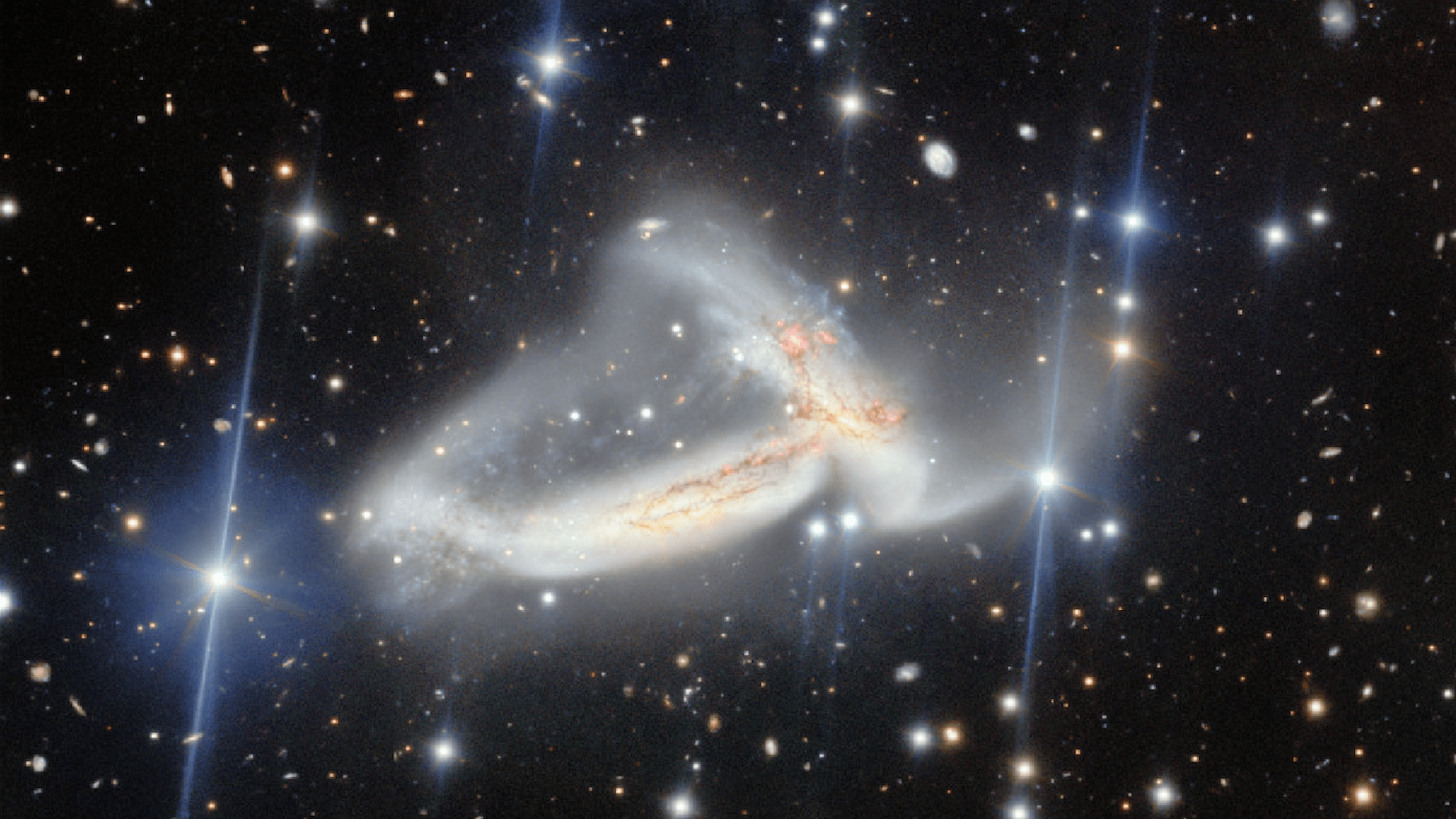
High school students interning at an observatory in Hawaii have successfully imaged a pair of colliding spiral galaxies located deep within overlapping cultural constellations. Formally classified as NGC 7253, the two galaxies are over 200 million light-years away, and reside in both Pegasus and Ka Lupe o Kawelo, or “The Kite of Kawelo.”
“NGC 7253 is a fascinating object because it’s two galaxies that are merging into one over billions of years,” said Project Hōkūlani intern Raiyan Rahman. “But we mainly picked this object because it was one of the few that actually lay within a Hawaiian constellation.”
Rahman and the other students from Waiākea High School and the Volcano School of Arts and Sciences spent one week in fall 2025 at the Gemini North Hilo Base Facility in Hilo to learn more about observatory operations, astronomy, and identify a deep space subject to study using the facility’s telescope. They selected NGC 7253 for its location inside a major navigational constellation utilized by Hawaiian sailors for generations.
Despite being separated by four million light-years, the gravitational pull inside NGC 7253 is strong enough that the two cosmic neighborhoods are on an inescapable collision course. Over a period of about one billion years, the spiral galaxies will smash into each other and merge into a single amalgamation. When this finally occurs, its spiral arms will generate a massive uptick in star formations. These newborn stellar objects will then ionize nearby hydrogen gas to form H II regions. In the image compiled by the high schoolers, these H II regions are already visible in the areas of bright pink light.
Earlier this summer, another three students from Keaʻau High School and Kamehameha Schools also participated in Project Hōkūlani. Continuing on the work of their predecessors, they decided on an official name for NGC 7253—Nā ʻUhane Māhoe Huki Pū i ke Ola, which roughly translates to “The Twin Spirits Pulling Together Creating Life.”
“After spending so much time on Maunakea, it was important to us to pick something that was both culturally and astronomically significant,” added Rahman.
The post High school students spot two spiral galaxies colliding in Hawaiian constellation appeared first on Popular Science.