
For decades, wealthy Californians have dodged their state's taxes by titling expensive cars to paper companies in Montana — but not any more.
The trick was simple and legal, and it cost California real money. Now a new law has rewritten the rules so that the dodge no longer works the way it used to. If you own a supercar, a six-figure RV, or any other vehicle registered to an out-of-state LLC while living in California, the arithmetic that made the scheme attractive has changed.
Montana made an attractive home for a vehicle that never actually lived there because the state asks for almost nothing in return. It charges no sales tax on vehicle purchases, levies no statewide sales tax at all, imposes no vehicle registration fees, and does not make owners put their cars through inspection or smog checks. On top of that, Montana's rules allow non-resident owners to buy and title cars there on paper, even when the vehicles are primarily driven somewhere else entirely.
That combination is why the arrangement earned its name. A Californian would register a limited liability company in Montana, buy the vehicle under that company, and bolt a Montana plate onto a car that would spend its life on California roads. The vehicle lived in one state; the tax bill lived in another, which is to say it did not live anywhere.
Now California already had a rule meant to catch vehicles registered to businesses, but it had a gap wide enough to drive a Ferrari through. Under the old law, as long as the majority of a business sat outside California, the vehicle could stay titled to that out-of-state business and skip the state's Use Tax. In practice this was a simple ownership-percentage test: keep the majority stake out of state, and the vehicle escaped taxation.
The problem was that the test only applied to companies and limited liability companies. It was built for a world where business structure mattered and residency followed the paperwork. People exploited it by registering fake LLCs in Montana, though Montana was never the only option. The 50-percent threshold was the whole game, and it was easy to clear.
California's existing law did contain other provisions that, on paper, should have caught these vehicles. Any car, boat, or aircraft a California resident ships or hauls into the state falls under the Sales and Use Tax Law whether registered there or not. And a vehicle bought in another state has to be sent there and remain for a full year before it can legally escape California use taxes. The shell-company structure was the workaround that made those rules hard to enforce against individuals hiding behind an entity.
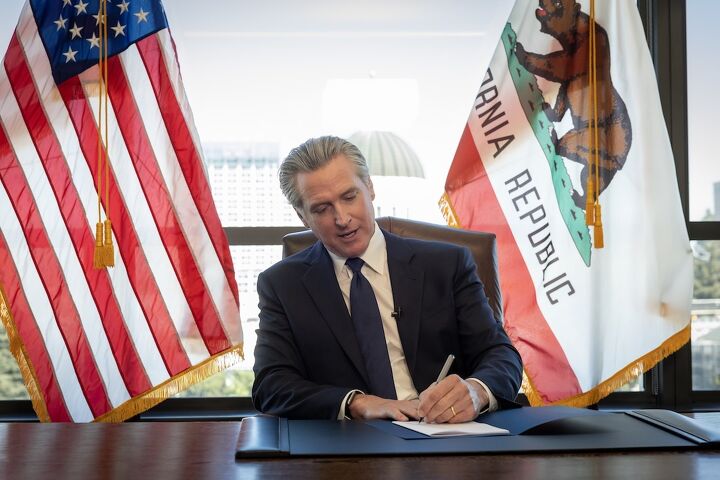
The fix is Senate Bill 1406, titled "Sales and Use Tax Law: vehicles: shell companies," which became law when Governor Gavin Newsom signed it. The core change is deceptively small and enormously consequential: it eliminates the old 50-percent test for determining whether a business counts as Californian.
In its place, the law expands the definition of a resident to sweep in shell companies owned by California residents. The bill's language is blunt. A shell company, as the bill defines it, counts as a state resident if even one of its shareholders, partners, members, or beneficial owners lives in California. Not a majority. Not half. One. If a single California resident holds any ownership stake, the company is Californian for tax purposes, and so is the vehicle it holds.
The law also widened the net of business types it applies to. Where the old rule only reached companies and LLCs, the new definition pulls in partnerships, limited partnerships, and limited liability partnerships as well. The structures people used to reorganize around the old test now fall inside the new one.
Calling something a shell company only matters if the state can prove it. SB 1406 spells out the evidence that marks a business as a shell. One criterion is that the business lacks a specific business activity or purpose. Another is that it keeps no physical location outside California. The law also looks at whether the business puts no one on payroll with W-2 wage and tax statements, and whether it skips filing federal tax returns or a return required in some state besides California.
Taken together, these tests describe exactly the kind of entity the Montana scheme depended on: a company that exists only as a filing, with no office, no employees, no real business, and no returns filed anywhere it actually operates. The law does not have to prove intent to evade. It just has to show the company is hollow.
The part that should concentrate the mind of anyone still running this play is personal liability. SB 1406 lets the California Department of Tax and Fee Administration put the tax bill on the shell company's individual members. It holds anyone who serves as an officer, manager, partner, beneficial owner, or member personally liable for unpaid taxes, along with interest and penalties.
The shell was always meant to be a shield. Under the new law it is more like a flag. Owning a piece of the entity now means owning the tax bill, and the bill does not stop at the taxes themselves. The law goes further still: nonpayment of taxes owed on a vehicle purchase by a shell company may constitute a crime.
The state's interest here is not abstract. The California Department of Tax and Fee Administration estimates the loophole drains roughly $20 million from California each year in lost revenue, money the agency notes could have paid for road repairs and other essential programs. Since 2023, CDTFA says the scheme has turned up in at least 2,500 vehicle sales tied to California residents.
Enforcement is already underway. A sweeping criminal investigation targeted the scheme, with 14 Californians allegedly running a tax evasion operation built on the loophole. That alleged scheme involved dodging more than $1.8 million in California taxes and failing to report more than $20 million worth of luxury vehicle purchases.
The bill was carried by state Senator Jerry McNerney, a Democrat from Pleasanton who chairs the Senate Revenue and Taxation Committee. McNerney framed the problem as a growing wave of tax evaders spinning up bogus shell companies to skip the sales tax on exotics like Ferraris and Porsches and on costly RVs. He said the bill would close the Montana Loophole for good and bring back the revenue needed to patch potholes and cover other essential road repairs.
If you live in California and your vehicle is titled to an out-of-state LLC, the single-owner residency test means that entity almost certainly now counts as Californian, and the vehicle with it. The percentage games that worked under the old law no longer apply, and reorganizing into a partnership does not help because the law now covers those too. If the company has no office, no employees, and files no returns outside California, it meets the bill's definition of a shell, and the unpaid tax can be assessed against you personally, with penalties and potential criminal exposure on top.
The practical move is to treat any existing Montana-titled vehicle as a liability to be resolved, not a position to defend, and to price California's use tax into the cost of the next exotic rather than assuming a paper company will make it disappear.
[Images: California Governors Office, Montana Dept. of Justice, Ferrari, Porsche, Lamborghini]
Become a TTAC insider. Get the latest news, features, TTAC takes, and everything else that gets to the truth about cars first by subscribing to our newsletter.