
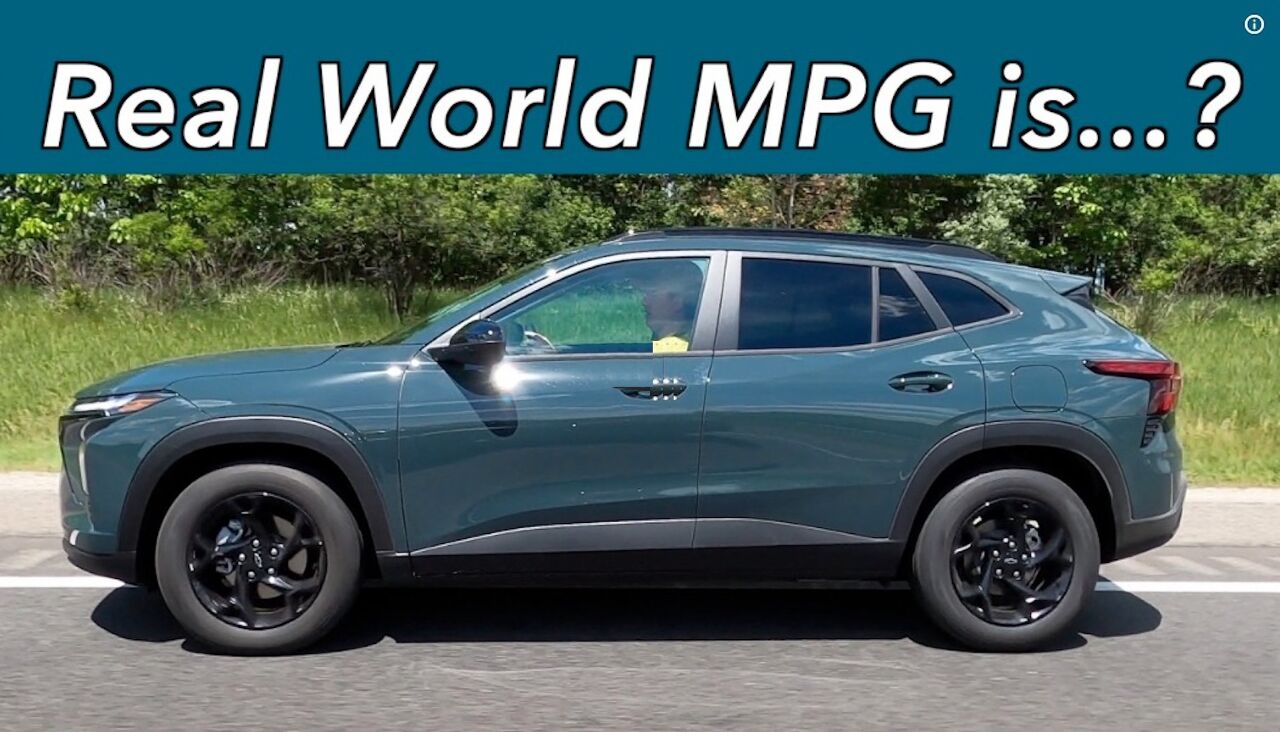
What fuel economy do you get in a 2026 Chevrolet Trax LT going through one tank of fuel? What about highway mileage? I test both!
Views on Vehicles focuses on new car reviews and news, presented by Robin Warner, a perennial car nut. The reason for the channel's focus becomes crystal clear when you look at Warner’s experience.
He spent five years of his adult life as an engineer: four years in traction and stability control calibration, and little over a year in vehicle dynamics. He also spent 15 years of his adult life as an editor at various magazines, including stints at Car and Driver, Road & Track, and Autoweek.
The TTAC Creators Series tells stories and amplifies creators from all corners of the car world, including culture, dealerships, collections, modified builds and more.
An AI-summarized transcript edited by a staffer is below.
[Image: YouTube screenshot]
Become a TTAC insider. Get the latest news, features, TTAC takes, and everything else that gets to the truth about cars first by subscribing to our newsletter.
Summary
Automotive journalist Robin Warner conducts a real-world fuel economy test of the 2026 Chevrolet Trax LT, tracking consumption over several days of driving around Metro Detroit and traveling to and from downtown Detroit. The test combines highway cruising with city driving and everyday use to determine how efficiently the small, front-wheel-drive crossover performs on a full tank of gasoline.
The results show that the Trax delivers respectable fuel economy, although it falls short of its EPA highway rating at a sustained 75 mph. Warner is particularly impressed by the vehicle's comfort, cabin refinement, and equipment given its affordable price.
Key Takeaways
1. Powertrain and EPA fuel economy
The 2026 Chevrolet Trax LT uses a turbocharged 1.2-liter three-cylinder engine producing 137 horsepower and 162 pound-feet of torque. Power is delivered to the front wheels, as the Trax is available exclusively with front-wheel drive.
The EPA fuel economy ratings cited in the video are:
- City: 28 mpg
- Highway: 32 mpg
Warner initially expects the small three-cylinder engine to be somewhat buzzy, but finds it smoother and better behaved than anticipated.
2. Real-world fuel economy over several days
Warner begins the test with a full tank and resets the trip computer. He drives aggressively around town initially, recording 23.7 mpg after approximately 72 miles.
As highway driving becomes a larger portion of the test, fuel economy improves. During trips to downtown Detroit, the display settles into the upper 20s, eventually reaching 27.8 mpg.
The overall test includes approximately two-thirds highway driving and one-third city driving. Despite spending more time on the highway, the Trax's average fuel economy remains close to its city rating.
The final tank results are:
- Total distance: 341.9 miles
- Fuel used: 12.352 gallons
- Trip computer average: 27.8 mpg
- Calculated average: 27.7 mpg
The calculated average is approximately 27.7 mpg, based on the recorded distance and fuel purchased. This closely matches the vehicle's displayed average of 27.8 mpg, suggesting the trip computer provides a reasonably accurate estimate.
3. Highway fuel economy at 75 mph
Warner also conducts a separate, approximately 40-mile highway test, driving out and back to minimize the effects of elevation changes.
With cruise control set at 75 mph, the Trax achieves 30 mpg during this test. That is respectable for an inexpensive crossover, but it falls short of the EPA's 32-mpg highway rating.
Warner suggests that driving at a lower speed would likely be necessary to achieve the official highway figure.
He also notes that wind and weather conditions can influence fuel consumption, making real-world results variable.
4. Driver assistance and technology
The fuel economy test provides an opportunity to explore some of the Trax's everyday technology.
One particularly useful feature is the ability to switch between conventional cruise control and adaptive cruise control. Warner appreciates having the flexibility to maintain a set speed without adaptive following in situations where he prefers to manage traffic himself.
Other features highlighted include:
- A following-distance indicator that displays the time gap to the vehicle ahead.
- Digital instrument and central infotainment displays.
- Wireless Apple CarPlay.
- Wireless smartphone charging.
- USB ports.
- A trip computer with fuel economy information.
- Vehicle gauges displaying battery voltage, coolant temperature, and maintenance information.
Warner praises Chevrolet for offering both conventional and adaptive cruise control, describing the choice as particularly helpful in changing traffic conditions.
5. Comfort and value exceed expectations
Although the Trax is relatively basic compared with more expensive vehicles, Warner finds it better equipped and more comfortable than expected.
He highlights the comfortable seats, reasonable cabin isolation, digital displays, smartphone connectivity, and practical interior layout. The cabin is not exceptionally quiet, but it is quieter than he anticipated for a budget-oriented vehicle.
The test vehicle costs approximately $28,000, while the Trax lineup starts below $25,000. Warner emphasizes that new vehicles at this entry-level price are increasingly uncommon.
He acknowledges that buyers can find more spacious, more refined vehicles with better fuel economy, particularly among hybrids. Nevertheless, he considers the Trax's combination of affordability, comfort, and reasonable efficiency impressive.
Overall Conclusion
The 2026 Chevrolet Trax LT delivers approximately 27.7–27.8 mpg in a mixed-driving test dominated by highway miles, while achieving 30 mpg during a separate highway run at 75 mph. It does not reach its EPA highway estimate, but its real-world consumption is consistent throughout the test.
Warner's strongest praise is reserved for the Trax's value. Its three-cylinder engine is smoother than expected, the cabin is comfortable, and the technology includes useful features such as wireless smartphone integration and flexible cruise-control settings.
The Trax is not the most fuel-efficient or sophisticated small SUV on the market. However, for buyers who prioritize an affordable vehicle with crossover styling, practical cargo space, and acceptable fuel economy, Warner concludes that it offers a compelling package.