
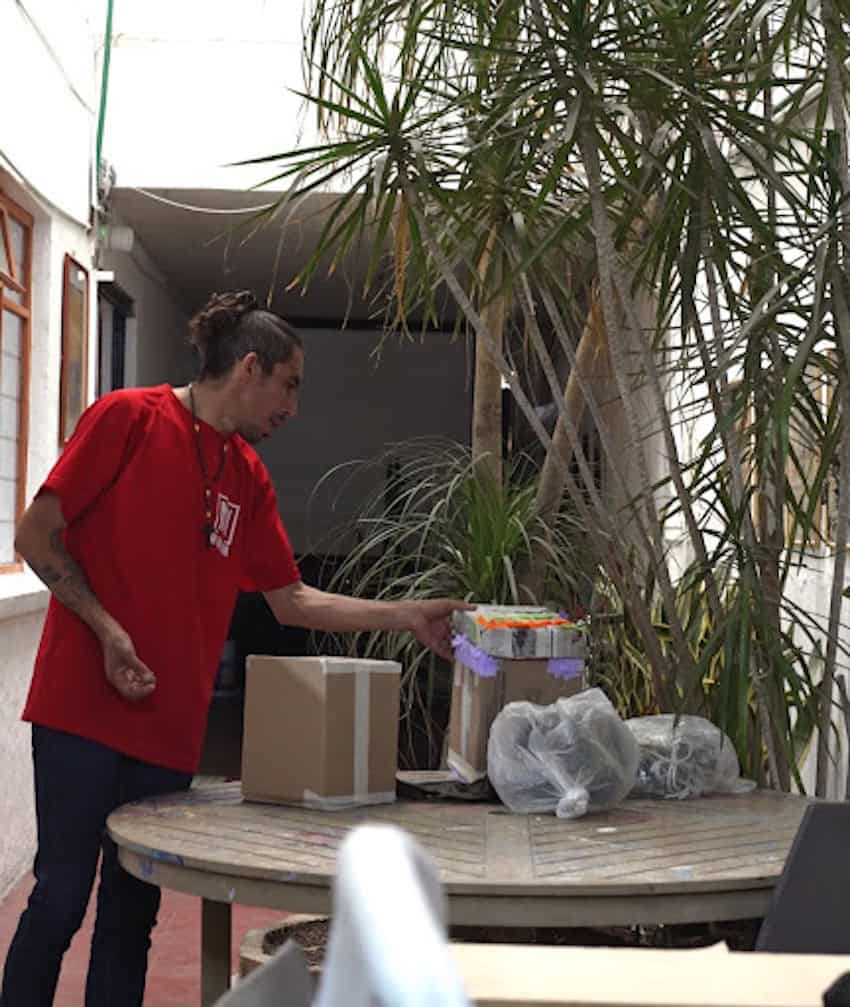
Alberto Mata Hernández grew up on the streets of Mexico City.
By age 14, he was sleeping on cardboard and living under bridges. For money, he laid on broken glass and sang, earning tips from passersby.
Eventually, he landed at Parque Delta’s viaducto, Alberto’s last home before meeting Mateo, a fieldwork coordinator with Mi Valedor, two years ago.
Mi Valedor is a Mexico City-based organization that publishes a street paper of the same name. Its mission is to improve the lives of “valedores” — people in vulnerable situations, often living on the street — who produce, sell and are featured in the publication.
“My life changed immediately when I walked in,” Alberto tells me.
Alberto in Casa Valedora’s courtyard. (Logan J. Gardner)Mi Valedor started 11 years ago. By 2019, it had won several awards, including Best Design and Best Online Presence from the International Network of Street Papers. The model — in which valedores resold Mi Valedor’s magazines on the street for profit — was working.
Pandemic problems become opportunityYet, as Arturo Soto Flores, Mi Valedor’s press director, says, it wasn’t enough.
“When the pandemic hit, we all had to go home,” he explains. “What happened to the people who had no home? The inequalities became very, very visible.”
At the time, Mi Valedor launched free services and art workshops for its valedores. Five years later, they’ve all borne fruit.
Alberto first came to Mi Valedor for a shower. That quickly turned into free use of Mi Valedor’s laundry and kitchen, a locker to safely store valuables, getting his ID and birth certificate, and free medical help from on-site professionals, including weekly therapy.
A group of valedores selling the street papers and zines in Mexico City. (Mi Valedor)Eventually, he joined a drawing workshop.
“There are people who can’t even write, and suddenly they realize they can draw,” Alberto says, adding that drawing allows him to express himself and has become a form of therapy.
It also opened a new path. “I’m now making a fanzine called ‘Pata de Perra’ [Mexican slang for a wanderer]. It’s about roaming everywhere, a process of understanding your own path.”
The zine will be sold alongside Mi Valedor’s signature magazine.
From the streets to galleriesFor valedores like Filemón Bazán Leal, personal zines have not only brought extra income but also launched successful art careers. Filemón’s debut zine, “Cuando no hay futuro,” now hangs in Mexico City’s Centro Nacional de las Artes (CENART).
As I walk around Casa Valedora, the quality of the valedores’ art is impossible to ignore. Important institutions supporting Mi Valedor’s art, from CENART to Patronato de Arte Contemporáneo, seem to agree.
Today, Mi Valedor’s art has outgrown the streets it comes from.
“Valedores no longer sell on the street,” Arturo tells me. “They sell at cultural events,” including museums, book fairs and art fairs around the world. It’s quite an accomplishment, given their lack of formal training.
The key, Arturo explains, “is connecting the valedores with their own voice,” adding, “In the end, what they make comes entirely from inside them, from their own perspective.”
‘Mi Valedor woke me up’For Alberto, art is more than a path to stability. He describes it as a “way of living” and “learning from life.” In that sense, Mi Valedor isn’t just providing an income — it’s rehabilitating valedores and integrating them into society.
“Mi Valedor woke me up,” Alberto says. “I’ve always said it unlocked the next level of my life.”
Today, Alberto has an apartment, a girlfriend, a job and a path forward. His dream, he says, is “to set an example” and “to know that people can hold on to me and I won’t fall with them.”
Arturo, meanwhile, is direct about what success means for Mi Valedor.
“We estimate that around 37 of the valedores we serve now live stably in housing. But that isn’t the organization’s fundamental goal.”
Valedor Andres working on an artwork. (Mariana Mendoza)Instead, they aim to support valedores while providing a path to rehabilitation, if they so choose.
The organization’s main challenge remains funding. Everything Mi Valedor does is supported by donations, both monetary and in-kind, as well as volunteers (they’re currently looking for an English teacher).
I ask Alberto what being a valedor means. The word is Chilango slang for “buddy,” but clearly carries more weight than the translation I’m given.
“You’re my valedor now,” he says, smiling. “The intention is to make you feel like family. Sometimes we lack a lot of things, so we give them to each other. A hug, talking with someone.”
You can learn more about Mi Valedor at their website and donation page.
Logan J Gardner is a writer, photographer, and filmmaker based in CDMX. His coverage includes culture, food & travel, and geoeconomics. He earned degrees from Wharton and the University of Cape Town and formerly worked at L.E.K. Consulting and Netflix. Sign up to receive his newsletter, Half-Baked, or follow him on Instagram for more.
The post How Mi Valedor helps Mexico City’s street community find its voice appeared first on Mexico News Daily