
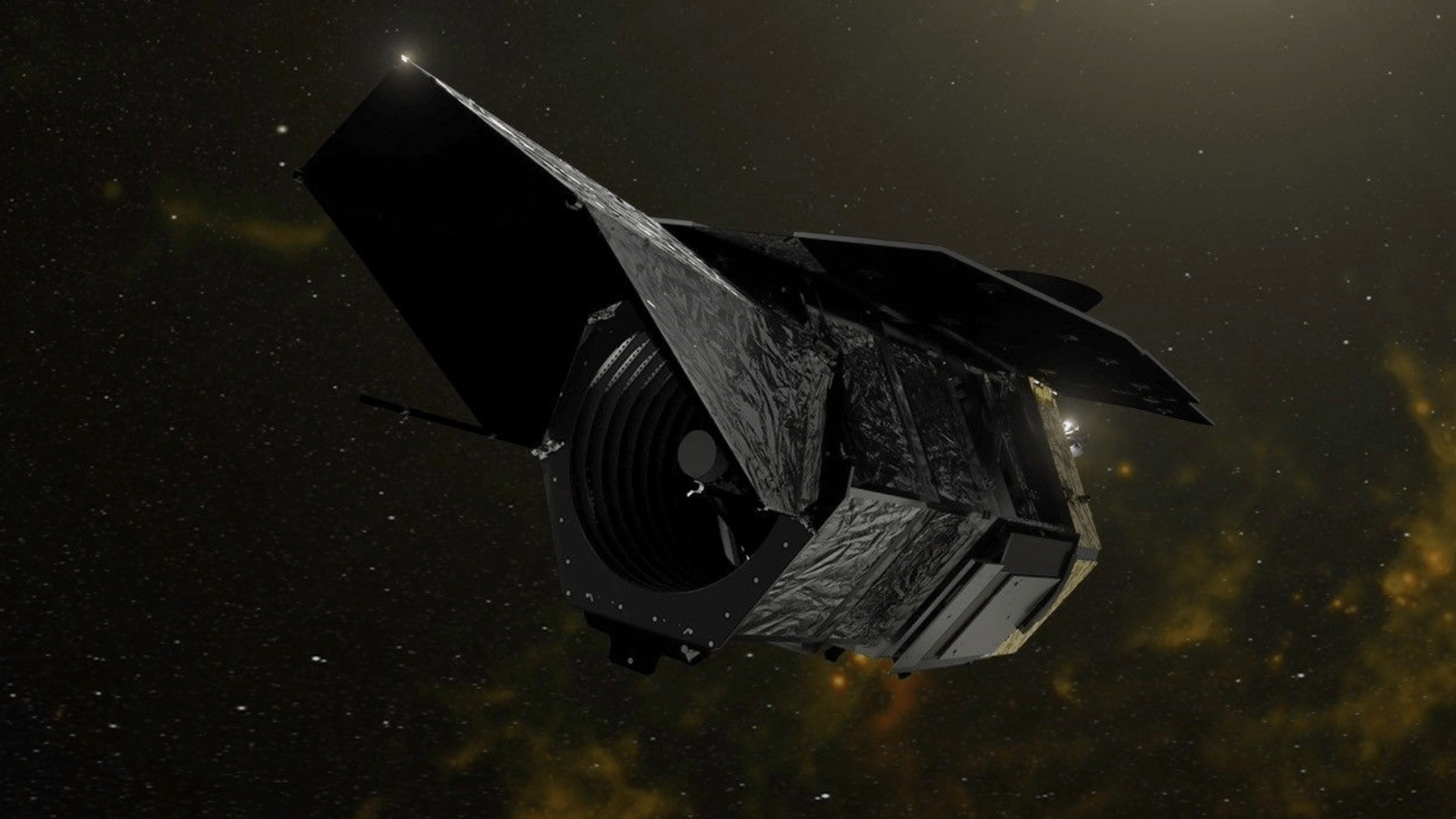
Less than five years after the revolutionary James Webb Space Telescope’s (JWST or Webb) debut, NASA is heading back to the launch pad to deploy another world-class space observatory—the Nancy Grace Roman Space Telescope. Called Roman for short, the space telescope will hunt dark matter, dark energy and exoplanets, as well as providing an unprecedented view of the cosmos to all sorts of astrophysicists.
With Webb and the venerable Hubble Space Telescope continuing to gather ever more observations, it’s easy to wonder what another mission will add to the mix. But scientists in the know can’t wait for Roman to really get to work early next year. Its unique capabilities will complement Hubble and Webb while creating its own hugely important legacy—even if people aren’t quite as familiar with it yet.
“Roman is kind of like a quiet underdog,” Elisa Quintana, an astrophysicist at NASA’s Goddard Space Flight Telescope who previously served as Roman’s deputy project scientist for communications, tells Popular Science. “All of the data they’re collecting is going to be a goldmine for many, many decades.”
This Roman Simulated Image (1/140th Roman field of view) of the center of our galaxy. Image: NASA Scientific Visualization Studio Roman’s missionThe mission has three massive research goals: hunt down the subtle signatures of dark matter and dark energy, identify tens of thousands of new exoplanets, and collect a flood of general astrophysics observations—data on hundreds of black holes, billions of galaxies and 100 billion stars. Named for NASA’s first chief of astronomy, the tour-bus-sized spacecraft will accomplish all that with just one instrument, although a second, experimental instrument is riding along to attempt to spot alien planets similar to our own Jupiter.
To tackle its packed agenda, Roman will pan across the skies in a carefully choreographed dance to which it is uniquely tailored.
“It is a big survey machine, but also at high resolution. “Usually, you have to pick one or the other,” Sabrina Stierwalt, an astrophysicist at Occidental College in California, tells Popular Science. Stierwalt is also the co-chair of the Roman Science User Panel, which is a liasion between the mission team and the global science community.
Roman’s focus on surveying is built into its very fabric in a way that NASA’s existing flagship telescopes can’t match.
“It’s not just that we have a field of view that’s much larger than Hubble and Webb,” Julie McEnery, an astrophysicist at NASA’s Goddard Space Flight Center in Maryland and senior project scientist for Roman, explains to Popular Science.
The mirror—the heart of any telescope—and the spacecraft as a whole are lighter than both Hubble and JWST.
“We have an observatory that can move nimbly, it can stop on a dime,” McEnery says.
Over the course of several hours, technicians meticulously connected the inner and outer segments of NASA’s Nancy Grace Roman Space Telescope. Image: NASA/Jolearra Tshiteya. Jolearra Tshiteya Roman vs. WebbWebb is a prime example of the other side of that talent tradeoff, with Webb prioritizing a truly massive mirror that offers super-deep penetration of the universe at the cost of a narrow field of view.
“You could think of Roman as the wide-angle lens and Webb as the zoom,” McEnery explains.
Neither of these approaches to observations are better than the other—each mode just serves different purposes. For example, Stierwalt says that if an astronomer is looking at a galaxy with Webb and notices that “it has some weird shape,” the galaxy becomes an intriguing puzzle to solve. An instrument like Webb can’t reveal the story behind that space oddity and what explains its strange shape. For that kind of cosmic detective work, Stierwalt says you need an observatory like Roman.
That balance of strengths between Webb and Roman should allow the pair to successfully collaborate.
In addition to these differences, the duo also share some similarities. Both observatories are located nearly 1 million miles away from Earth, on the side opposite the sun, where they naturally stay quite cold. That positioning is important, since both telescopes study predominantly infrared radiation, which heat interferes with. However, Webb covers a much broader range of this light and requires the extra protection of its trademark sunshield.
Roman vs. HubbleIn many ways, Roman is more closely related to the more senior Hubble than it is to Webb. Roman and Hubble each sport the basic lipstick-tube frame that’s common among space telescopes. A round mirror of the same size, 7.9 feet across, is at each observatory’s core, although Roman’s is one-quarter the weight of its predecessor’s, contributing to the spacecraft’s agility.
Unlike Webb, both Roman and Hubble are designed for in-space maintenance. In the 1990s and 2000s, Hubble was visited by five crews of astronauts for upgrades and other work, whereas Roman’s distant outpost means that NASA would need to develop robotic servicing operations that don’t currently exist in order to refuel it. So it won’t be nearly as easy to fix as Hubble.
For this pair, the real difference comes in sensors: Roman has significantly more of them and each is much larger than their Hubble equivalent. That means that at each glance, Roman will observe a patch of the sky that is a jaw-dropping 100 times larger than that of Hubble. That means that within Roman’s initial five-year initial, it will observe 50 times the amount of sky that Hubble did during 30 full years of work.
This infographic shows the complementary capabilities of select instruments on three of NASA’s flagship missions: the Hubble Space Telescope and the currently under development Nancy Grace Roman Space Telescope and James Webb Space Telescope. Hubble views the cosmos in infrared, visible and ultraviolet light, providing a more comprehensive, high-resolution view of individual objects. The Roman Space Telescope will expand on Hubble’s infrared observations specifically, using a much larger field of view to create enormous panoramas of the universe with the same high resolution. Webb will also conduct high-resolution infrared observations, peering across farther stretches of space with a narrower field of view. Image: NASA’s Goddard Space Flight Center.But that doesn’t make Hubble obsolete. NASA is dedicated to keeping the now 36-year-old observatory operational for as long as possible. One particular strength of Hubble compared with its successors is that it can observe in visible light and—even more importantly—ultraviolet radiation, which Earth’s atmosphere completely blocks from reaching ground-based observatories.
So although Roman represents major improvements, the beloved Hubble space telescope will always have plenty of work to do, even once its new colleague is fully operational early next year.
“Hubble is continuing to do all of the science that it always has done because we’re not going to be using Roman in a way that could duplicate Hubble science,” McEnery says. “Hubble is going to continue to do what Hubble has always done because Roman is going to be operating in a way that Hubble can’t.”
Roman is scheduled to launch from NASA’s Kennedy Space Center in Florida on Sunday, August 30 at 7:26 a.m. EDT.
The post How NASA’s new Nancy Grace Roman space telescope compares with Hubble and Webb appeared first on Popular Science.