
Doing your own research matters, but so, too, does checking your sources when you do that work. Source checking is a crucial skill, but it can be difficult, even for folks who are well-versed in it. The good news is you can always learn new techniques, and one of the most valuable tools at your disposal for learning is simply asking questions and going down some research rabbit holes.
Here’s an example of how to check your sources when you read the news.
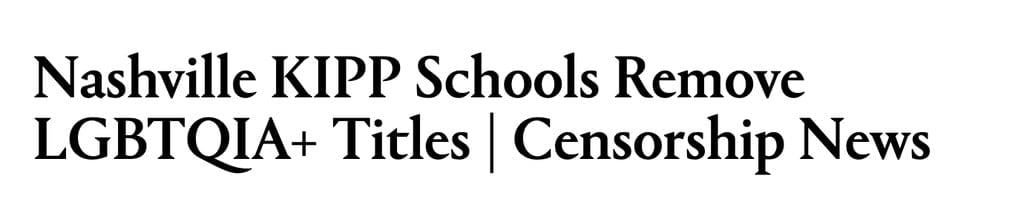
A couple of weeks ago, a headline from another outlet that does book censorship link roundups made me pause. It looked like this:
Below in the roundup, this was the text:
The outlet that shared this headline, link, and explanation of the link doesn’t matter too much. This isn’t about shaming them. Their work is good and relied upon by professionals nationwide. Instead, this example serves as a prime opportunity to talk about why doing the work of sharing book censorship news is so difficult and why it is that national organizations that track book censorship, including PEN America and the American Library Association, cannot have accurate counts, no matter how hard and well-done their work is. Good outlets can still make mistakes when it comes to sourcing information because we’re swimming in a mis- and dis- information ecosystem. Stepping back to do a deep dive takes time and sometimes additional background knowledge that not everyone has or knows to look for.
This summer, I talked about the work that goes into tracking book censorship and sharing the links every week in Literary Activism. It’s not as easy as a tracked Google search. In fact, I don’t track any keywords at all. I keep a list of about 12-15 terms that I do a hand search for every weekday, knowing that the list shifts depending on the information I’m reading about where and how schools, libraries, news media, and book banners themselves are describing book censorship.
The link roundup pictured above was published on September 3, 2026. That week, I kept coming across stories about LGBTQ+ books being banned by KIPP schools in Nashville in my searches. It’s a story that feels absolutely true, and it might be true. But as of today, three and a half weeks later, there’s still no definitive documentation or news story proving that this actually happened. There’s no proof that addresses how many books were removed, or which books they were. There are plenty of links talking about this book removal, but not a single one has been from a reputable outlet.
The work of sharing book censorship news involves verifying sources, and sometimes that can mean a lot of time spent going nowhere. This story is case in point.
From the very beginning of the example above: The Tennessee Star, the site referenced in the image above, is not, in fact, where the linked text goes. The linked text goes to WFMD, a Nashville radio station website. Clicking that WFMD link shows the following:
This isn’t an article by anyone on the WFMD team. The byline is “Breaking News on Fox News.” So from the get-go, the source of this news is biased based on the byline alone.
Reading a little bit further, though, that bias is further confirmed. Highlighted and linked terms include “Christian teacher” and “religious views be respected in schools.” These are terms that link to entire categories of news on FoxNews.com: the first to their “faith-values” reporting, and the second to their “first-amendment” category. Fox News has a vested interest in this story because it confirms and promotes their own worldview, and it serves as propaganda in their coordinated attacks on books, libraries, and education.
The Tennessee Star is cited in this story, though. Clicking over to the link in the Star looks like this:
As someone who looks at this stuff every single day, I immediately recognize that this is no actual news outlet. For those who don’t swim in these waters, though, it might be harder to make that connection.
Begin with the most basic pieces. The image for the news story isn’t real. It’s an image of someone in a suit pasted over a classroom image (the assumption is that it’s the educator’s photo, superimposed on a classroom background). Something about it feels off, and there’s no image credit anywhere. To the right of that image are two advertisements for political candidates. Both are unabashed in their “traditional values” stances. As you scroll down the right-hand column, it’s advertisement after advertisement for a host of conservative candidates, as well as for organizations like Tennessee Leads, which advocates “parental choice in education.”
There’s also this interesting promotion:
With an accolade like that, it could be easy to assume that raises the profile of the Tennessee Star. Except when you look up what the Dao Prize is, you learn that it’s an arm of the Young America Foundation, one of the most preeminent and controversial groups for young conservatives.
Indeed, the Dao Prize underlines that its mission is to recognize journalists ignored by other organizations and media outlets. Conservatives are always the victims, and this prize awards that narrative.
Before we have even looked at the story itself or the website’s about us page, the Tennessee Star has made it clear they’re not an unbiased source. Looking at the paper’s “About” page at the bottom, though, confirms the fact this is a conservative outlet.
And that’s just the text about the Editor-in-Chief.
What we’ve learned from a few clicks before even reading the story is that this newspaper is interested in conservative politics and that it’s one of many newspapers that appear to operate on the local level across the country. It appears there are 14 similar papers.
Reading the actual story further confirms that there’s no story here at all. Or at least, the story this is purportedly about is not what the story tells readers. This is a story about an educator at KIPP–a public charter school–who won a lawsuit against the school. It is not about books being removed from the school library. Here’s the beginning of the Tennessee Star’s reporting:
The word “removed” links to a press release from First Liberty Institute. The First Liberty Institute is “the largest legal organization in the nation dedicated exclusively to defending religious liberty for all Americans. We believe that every American of any faith—or no faith at all—has a fundamental right to follow their conscience and live according to their beliefs.” Among the victories this conservative Christian legal organization touts on its website? The time the Supreme Court ruled that a bakery owner was allowed to discriminate against a queer couple. So yes, while it’s true that First Liberty Institute is a nonprofit, it’s certainly not without bias; nonprofit does not equate to nonpartisan.
Bias of the legal time aside, the press release tells a slightly different story than what is reported in the Star.
The educator at the center of the story reached out to First Liberty earlier this year when KIPP, his employer, asked him to read from two books in the curriculum that mentioned same-sex marriage. It was against his sincerely held religious beliefs. That belief, plus the state’s “parental consent” laws, would make a good case that his rights were violated (who cares about the students or their parents who may not agree, but that’s neither here nor there).
The press release states the following:
The school agreed in March 2026 to provide reasonable religious accommodations to all staff, and now, they have eliminated books that could violate Tennessee law regarding parental consent.
[…]
[H]e objected to two books featuring same-sex marriage. Following a demand letter from First Liberty, the school agreed to accommodate any reasonable religious requests. Further, in light of Tennessee law requiring parental consent to the teaching of sexual orientation or gender identity, KIPP Nashville proactively informed the Tennessee Attorney General’s Office that it removed substantial controversial materials, including numerous books, from its 2026-2027 curriculum in an effort to respect the religious beliefs of its staff, students, and parents.
Nowhere in this press release are the titles of the books that were removed from the curriculum listed. There were two, and neither was from the library, as reported by the Star. The First Liberty Institute further noted that the State Attorney General confirmed that KIPP removed “numerous books” from its curriculum for the 2026-2027 school year.
There’s a lot to unpack in that statement, beginning with the fact that this still wasn’t the library, as reported by the Star (and repeated by Fox News, which then spread onto other “news” sites). It was the curriculum, which operates differently and independently from the library. But using the word “library” allows this story to land on search results pages and captures the known attention being paid to book censorship in libraries.
Another thing worth noting is that neither the press release nor the State Attorney General names the books removed from the curriculum (we will get there). The Tennessee State Attorney is one of the signatories on an Amicus Brief in a case currently in the 11th Circuit related to Florida’s book bans. This means he’s among those eager to force book censorship wherever and however he wishes in Tennessee–and last fall, we saw Tennessee’s Secretary of State demanding book removals in public libraries statewide in response to Trump’s Executive Order on “Defending Women from Gender Ideology.”
At this point, the story doesn’t add up, and none of its sources deserve to be taken seriously. So now it’s time to do another search, this time using keywords related to the misinformation to see if we can find a better source.
It’s worth mentioning a couple of additional important factors here, too. First, KIPP is a public school, so it is possible to submit public records requests. This is a key tool in uncovering book censorship, and it’s a key tool reporters use to share these stories with verified facts. Second, and especially important here, Tennessee restricts those public records requests to state residents. That means anyone without a Tennessee address cannot request those materials, limiting who may verify these reports and stories (more accurately, non-residents can request them, but can be easily denied).
Here’s what a new search for a story about the removal of LGBTQ+ books from KIPP Nashville, time restricted to the date of the First Institute’s press release (August 28, 2026) and the start of this week (September 21, 2026).
Fox News, The Center Square (a conservative outlet focused on “taxpayer sensibility”), Christian Post, Yahoo (reposting a National Enquirer story that names one of the books Rivera refused to read as In Our Mothers’ House), and a site called Belief Net pop up in this search. Trying various combinations of those same keywords brings up the same few sources.
When you expand the search beyond Google’s News tab, it doesn’t get better:
Now there are even more blatant pro-religious sites popping up sharing the same story. The CBN story (Christian Broadcast Network, not to be confused with CBS)–both the video and the link seen in the image above–does shed light on the second title that Rivera refused to read, Stella Brings the Family.
There is one outlier. A YouTube link to a page called Queer News Tonight–a queer nonprofit outlet–claims that KIPP removed 20 titles from the curriculum. They don’t cite where they get this number, nor name the books. It’s the only outlet that gives a number, begging the question of where that came from. Interestingly, they reference the SCOTUS bakery case, which was handled by the same group representing this educator.
Again, there’s zero question that at least two books were removed. But they were removed from the curriculum and not from the library. It is very possible that other LGBTQ+ books were removed. But not a single outlet has done more than parrot the talking points provided by the First Liberty Institute. That is not an unbiased source, and their goal in getting the word out is to continue planting the seed into the minds of news consumers that there are “naughty” books in schools and school libraries and that people’s religious liberties are at stake by sending their children to public schools.
The pro-“educational choice” ad on the Tennessee Star‘s page was no accident.
Accuracy and confirming information matter. It can look easy to round up links and share them, but it’s not. Accidents happen, and failing to fully investigate one’s sources can lead to sharing inaccurate information. But we are all responsible for learning to be media literate and news-savvy. Taking the time to walk back through stories when they’re shared can teach you untold amounts about where and how news is told, and whether it should be shared as fact.
Professional news has been withering for decades, and we’re in an era where more and more consumers get their news from social media, rather than from professional journalists. We’re also struggling beneath the reality of needing paywalls to sustain news media, with the fact that right-wing outlets have untold amounts of money that allow them to spread their lies and misinformation widely and freely.
Always look at who is telling the story and what benefit they get from it. In the case of KIPP removing books from the library in Nashville, it’s First Institute, it’s right-wing news rags, and it’s folks who’ve been spewing the same “parental rights” nonsense in an effort to defund public institutions for years. There’s no question that there’s been book censorship here; the question is what that actually entails, and no one has provided a real answer yet. This is a story crafted from a press release written by a source with a vested interest in spreading lies and encouraging fear in the minds of those doing their jobs as educators and librarians.
Related: How to Read a Press Release from the Federal Government.
Related: How to Own a News Cycle
Book Censorship News: September 25, 2026- A Judge has given the green light for the lawsuit in Utah over the state law banning books from all schools to move forward. This is the one where several authors sued when their titles were removed. We’ll see what happens here, and I know I’m especially interested if we’ll see a flurry of additional titles banned in the interim. That’s what happened when the lawsuit was filed earlier this year.
- The Florida Department of Education released the annual list of books banned at school districts across the state. The article here notes how there’s such a divide between schools banning en mass and those not banning at all in the state. (One of my books was banned in three districts).
- The First Circuit was troubled by Trump’s plans to dismantle four federal agencies–including the Institute of Museum and Library Services (IMLS)–but they couldn’t articulate what going “too far” meant. This is an interesting development in one of the two federal lawsuits against the dismantling of the IMLS, Rhode Island v. Trump–Trump’s team appealed, saying that they had to right to implement executive orders under the Administrative Procedures Act (the thing that the original decision said they did not have the right to do).
- After demanding schools remove books from the “state’s list” of over 2,200 titles, Texas’s Lieutenant Governor Dan Patrick is now claiming he didn’t say that there’s a list and that books like Night are fine to be in schools. Whoops.
- Residents in Alamance County, North Carolina, are concerned how many conservatives have been appointed to the library board and how that doesn’t represent the county.
- The fight over The Perks of Being a Wallflower staying or being removed from Readington School District (NJ) is so intense that a police officer will be at every board meeting the rest of the year. Recall…New Jersey has an anti-book banning law.
- The real news from this year’s release of the books banned in Florida schools last school year is that TWO districts accounted for 66% of the total bans. Those districts are naturally ones where some of the national book banning leaders complain on the regular.
- We always know the ban on trans books for minors in Alabama public libraries would never be “just” the trans books for minors. It’s all trans books, and those coordinating this on behalf of the GOP–the Alabama Public Library Service in this case–are eager to engage in the censorship. Librarians are pushing back.
- Knox County Schools (TN) are redoing their review committees–something they vowed to do following the removal of Roots in the district. This committee’s structure is going to take a lot of work to accomplish, and they’ll be trained on how to ensure materials are aligned with the state’s laws on age-appropriate materials. But there’s a helluva line here that begs the question of whether or not a committee reviewing books for appropriateness to a law created by a right-wing conspiracy theory can ever be neutral: “Members will also receive training from an outside legal expert to help ensure the review process remains neutral.”
- This is a really good piece about the realities of librarianship and bookselling in Arkansas under ACT 372: “The political rhetoric behind this law has been directed at libraries and librarians, not corporations like Walmart and Target, who sell these same sexually explicit “harmful” books for profit. In fact, some who defend Act 372 deny that they are banning books by pointing out that the books they are censoring in libraries are still available for purchase. This is a culture war crusade against libraries, not corporate book-sellers. I don’t want any of the nearly 1,700 employees who work at the more than 225 public libraries in Arkansas to be prosecuted. Even if they are ultimately acquitted, the process would be frightening and scarring.”
- The Human Rights Defense Center is suing Dallas County, Sheriff Marian Brown and Chief Deputy Shane Sowell (TX) for their new rules creating a near total ban on books and periodicals for those experiencing incarceration in the county.
- Hollidaysburg Area School Board (PA) is finally allowing an AP Human Geography textbook to be approved for use in the classroom. Why was it denied before, you may ask? You know why–a board member crying that the book’s inclusion of gender identity is “indoctrination.”
- King George County Schools (VA) wanted to deny middle schoolers the right to a GSA club. The students were suing and before litigation were to happen, guess what the school decided to allow? There is legal precedent for GSA and other Rainbow Clubs legally, thanks to the Equal Access Act of 1989, section 20.
- Peoria Unified School District (AZ) will reconsider their anti-DEI policies, renaming them something that is…also pretty anti-DEI. All of this stems from the banning of several books by marginalized authors in the district.
- The 10th US Court of Appeals is allow