
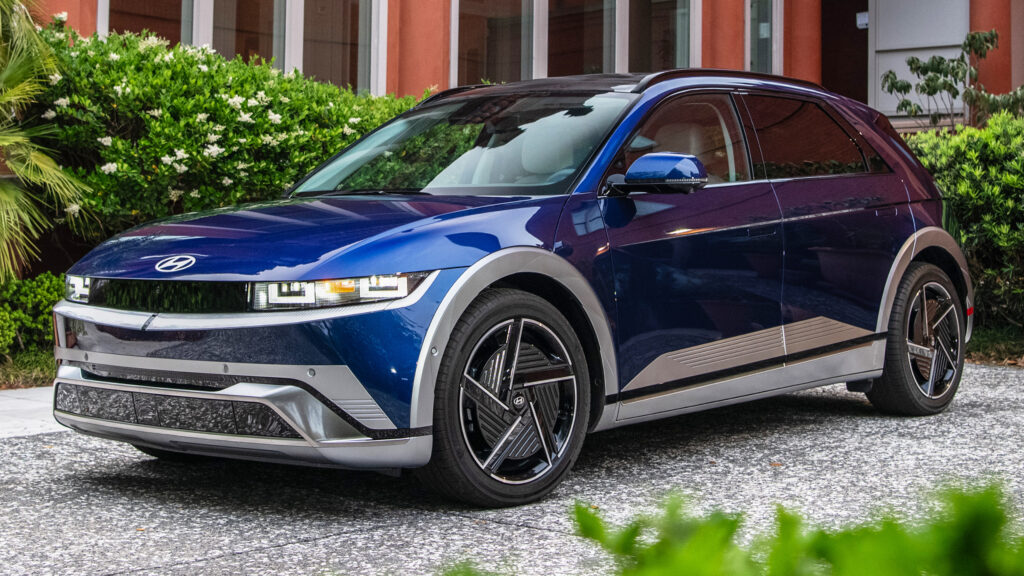
- Hyundai’s range of EVs will soon be expanded with two new SUVs.
- A new Ioniq 7 will be positioned between the Ioniq 5 and Ioniq 9.
- An Ioniq 4 is coming as a more traditional SUV alternative to the Ioniq 3.
No one could accuse Hyundai of dragging its heels on electric vehicles. While some of its legacy rivals have been a little slow to embrace EVs, the South Korean brand continues to grow its fleet of battery-powered cars at an impressive rate, and it’s already working on at least two more.
One of these all-new EVs will be the Hyundai Ioniq 7. For quite some time, the brand’s flagship electric SUV and compatriot to the Kia EV9 was referred to as the Ioniq 7, but it ended up launching as the Ioniq 9. Wearing the Ioniq 7 name will be a new SUV positioned between the Ioniq 5 and the Ioniq 9.
Read: Hyundai Strips The New Ioniq 3 Down To Its Cleaner, Cheaper Self
Like most other EVs from Hyundai, the Ioniq 7 should launch with an 800-volt electrical architecture and be sold in both single- and dual-electric motor configurations. Although prototypes have yet to be seen testing out in the wild, AutoExpress understands this model will be closer in size to the Ioniq 5 than the Ioniq 9.
An Elexio Alternative
Hyundai Ioniq 9If so, then it may end up being similar in size to the Chinese-built Elexio, which we drove earlier this year. If that’s the case, the Ioniq 7 may inevitably snatch some sales from the Elexio in markets where both are sold. Crucially, Hyundai’s ‘Ioniq’ branded models are positioned as slightly more premium offerings, helping to differentiate the two. In addition, the Elexio uses a 400-volt system and front-wheel drive, so the Ioniq 7 will have it beat on the powertrain front, too.
A Kia EV3-Sized SUV Is Also Coming
Hyundai Ioniq 5Hyundai isn’t just working on the long-awaited Ioniq 7. The company is also developing a smaller EV that may be badged the Ioniq 4. It’s expected to be similar in size to the new Ioniq 3 hatchback, but unlike that model, it will be a slightly more conventional SUV and similar to the Kia EV3.
In morphing the Ioniq 3 into an SUV, Hyundai’s designers are believed to have given it a boxier, more upright design, so it may hold slightly broader appeal than the somewhat odd Ioniq 3. In addition, it’ll offer more interior space than the Ioniq 3, so it should be better for young families.
Hyundai will probably use the same battery packs and electric motors as the Ioniq 3 in the new Ioniq 4, meaning 42 kWh and 61 kWh batteries will be available.