
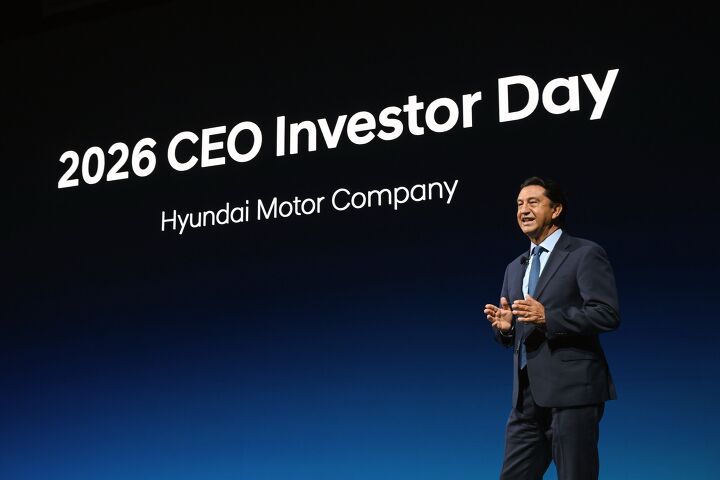
Range anxiety gets a new answer from Hyundai, and it arrives wearing the boxy sheetmetal of the Santa Fe. At its annual CEO Investor Day in Seoul, Hyundai confirmed the midsize SUV will become the brand's first extended-range electric vehicle.
Hyundai Motor Co. President and CEO José Muñoz said the three-row Santa Fe EREV is projected to achieve a maximum range of 600 miles without refueling. That figure is the headline, and it's the one meant to peel buyers away from full battery-electric commitment.
The Santa Fe currently comes with a turbocharged four-cylinder and a conventional gas-electric hybrid. The EREV variant slots in above those, using a dual-electric-motor layout to deliver all-wheel drive.
Timing lands in the first half of 2027, likely badged as a 2028 model. Production is expected at Hyundai's Alabama plant, which already builds the Santa Fe, so the domestic-manufacturing box gets checked without much drama.
For the uninitiated, an EREV drives like an EV but carries a gas-powered motor generator to top off the electric range when needed. The battery is smaller than what you'd find in a pure EV but larger than a traditional hybrid's pack. Owners can plug it in to charge, or lean on the onboard generator when a charger isn't around.
It's a middle-ground architecture with a mixed history. The reference points cited are the BMW i3 and Scout's Terra pickup and Traveler SUV — the latter still firmly in vaporware territory. So the concept is proven in theory, less so in commercial staying power.
The more interesting engineering news sits under the range figure. These EREVs will run Hyundai's new proprietary battery, built with high-performance cells using Mid-nickel NCM chemistry. Hyundai says the pack carries less than half the capacity of the Ioniq 5's battery while matching its power output.
The claimed advantages are the kind that move the needle on a spreadsheet: roughly 30% cheaper to produce, charge times cut by 40%, and mass production expected by mid-2027. If those numbers hold, they matter more to Hyundai's margins than any single range headline, because cheaper cells with faster charging is the problem every automaker is trying to solve.
The luxury division isn't sitting this out. Genesis will also debut a GV70 EREV in early 2027, Hyundai confirmed, with a maximum range of more than 640 miles — edging out the Santa Fe by 40 miles on paper. Beyond the range figure and the timing, no further details are available on the GV70 EREV yet.
The Santa Fe EREV fits into a broader electrification pivot. Muñoz said Hyundai plans to offer more than 10 hybrid models in the U.S. by 2030 and expects hybrids of all types to make up about half of its sales by then.
That's a notable hedge from a company that spent the last few years positioning the Ioniq line as its EV future. Betting half the lineup on hybrids and range-extenders by decade's end reads as an acknowledgment that the all-electric transition is arriving slower than the marketing promised. The Santa Fe EREV is the first concrete piece of that recalibration to reach American showrooms.
[Images: Hyundai]
Become a TTAC insider. Get the latest news, features, TTAC takes, and everything else that gets to the truth about cars first by subscribing to our newsletter.