
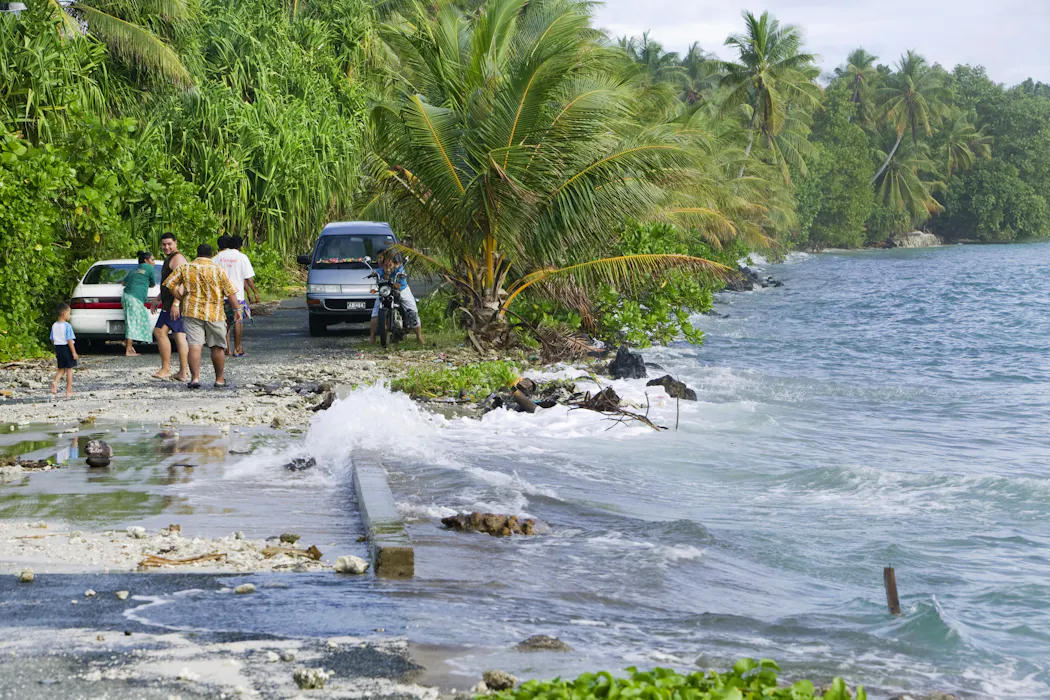
Heatwaves in the United Kingdom, vast forest fires in Canada and flash flooding in Nepal – the evidence of climate change is everywhere. And no region faces a more existential threat than the Pacific, where residents of low-lying nations are witnessing the seas creep higher.
On Monday, leaders and delegates from countries including Australia, Germany, Mexico and Thailand will meet in the Pacific nations of Fiji and Tuvalu. Their discussions aim to highlight the climate threats faced by small island nations and the need to rein in carbon emissions.
These meetings are a curtain-raiser for the annual United Nations climate summit known as COP31, being held in Turkey (also called Türkiye) in early November. It’s fairly unusual for a pre-COP meeting to take place in a different part of the world to the main UN summit.
Australia will jointly host and lead these Pacific climate meetings with Fiji, as part of a compromise deal struck at last year’s COP30. This deal will also see rival bidder Turkey host the UN summit in the city of Antalya in November.
So, what will be on the agenda during the Fiji meeting and the main COP31 event in Turkey? And why does it matter?
Remind me, what is COP?The Conference of the Parties, or COP, is the annual UN summit that brings countries together to negotiate climate goals. The figures added to the name reflect how many times the UN meeting has been held since its inception; this year is COP31.
The summit will determine the climate actions nearly 200 nations, which have all signed up to the UN Paris Climate Agreement, are expected to take in the coming years. Decisions coming out of the COP reflect political consensus on the way forward, but are generally not binding on countries or enforceable through international litigation.
This year’s co-hosting arrangement has divided the responsibilities between the two nations: Turkey’s Environment Minister Murat Kurum is COP31 President-Designate, while Australia’s Minister for Climate and Energy Chris Bowen will be President of Negotiations.
In practice, this means Turkey will ensure compliance with UN procedural rules, including setting the agenda and adopting decisions. Australia will steward the negotiations, affording it substantial political and technical leadership, but not necessarily control over the overall outcomes of the summit.
Australian Prime Minister Anthony Albanese walks with Minister for Climate Change and Energy Chris Bowen and the Minister for Defence Pat Conroy at the Pacific Islands Forum Leaders meeting in Palau in early September. Saeed Khan/Getty Conflict or consensus?This unprecedented co-hosting arrangement between Australia and Turkey raises questions about how power should be shared between the two parallel roles.
Leadership through consultation forms the foundation of official UN communications from the COP31 summit. In the event of any difference of opinion, both countries will be expected to hold talks to reach a mutually satisfactory conclusion.
However, there is little detail around what this will actually look like. This risks slowing the pace of negotiations, even creating a stalemate if Australia and Turkey fail to reach an agreed decision. Controversial issues could be put off to the next session or sidelined altogether. That happened last year when Saudi Arabia declared any mention of fossil fuels in the decision outcomes an unacceptable “red line”.
What’s at stake?A recent UN report found the world will likely overshoot the target of holding global warming to 1.5°C, with every increase bringing more extreme weather and environmental harm. But if we substantially increase global efforts to phase out fossil fuels and reduce emissions, peak warming could be limited to 1.8°C.
Carbon removal methods, such as conserving or planting forests, in theory could then bring temperatures back to 1.5°C or below this century. But to achieve this, nations must agree – and follow through – on urgent commitments to cut emissions.
At the heart of the November climate negotiations will be the question of who should pay for a “just transition” away from fossil fuels – one that ensures a fair distribution of the economic burdens and benefits.
With the UN declaring climate finance must reach US$1.3 trillion (almost A$1.9 trillion) a year by 2035, the spotlight is on heavily polluting rich countries to deliver on finance promises.
What will be top of the agenda?Negotiations at COP31 are likely to focus on implementing countries’ existing commitments. It is the start of the next cycle of the global stocktake – the Paris Agreement process for assessing progress on climate action – which will wrap up in 2028.
The last stocktake in 2023 concluded there was a big gap between countries’ policies and the Paris Agreement’s temperature goals. Whether countries are beginning to bridge that gap depends on how seriously they aim to fulfil their emissions reduction pledges.
Climate finance, as always, is likely to be a major issue of dispute. That’s especially true given funds for loss and damage finance are running low, while countries such as Nepal suffer catastrophic damage from climate disasters.
Why is the Pacific so important?Australia’s initial bid to host COP31 was made in partnership with the Pacific, to give voice to small countries in the region. Yet Australia continues to face Pacific criticism for failing to shift its economy away from fossil fuel production.
Many Pacific leaders were disappointed at Australia’s acquiescence to Turkey’s bid. But in the face of criticism, Bowen and Australian Prime Minister Anthony Albanese insist they have attracted more high-profile leaders to the Fiji-Tuvalu pre-COP meeting than ever before.
The power of this global climate summitAs a leading voice in the upcoming negotiations, Australia must demonstrate a real commitment to robust climate policies and good-faith relations with its Pacific neighbours.
In previous years, initiatives launched at COP for greater renewable energy deployment and energy efficiency attracted strong support and have helped drive action on the ground. The Turkey and Australian COP31 presidencies will be hoping their 35% electrification target by 2035 has similar cut-through.
If successful, the two countries’ shared leadership model could pave the way for international actions that spotlight the needs of the developing and low-emitting countries that have the most to lose from the climate crisis.
Jacqueline Peel receives funding from the Australian Research Council for her Laureate Program on Global Corporate Climate Accountability. She is affiliated with the Intergovernmental Panel on Climate Change, serving as a Coordinating Lead Author in Working Group III (mitigation) for the Seventh Assessment Report.