
Moving cars around the car park at Autocar HQ on a weekday morning can be a stressful start to the day at the best of times. Unfamiliar cars in tight spaces between concrete pillars before your morning coffee has kicked in is tough enough; throw in the beeps and bongs many modern cars make and you've got a sensory challenge to overcome on top.
"Hi, I'm Deepal," said an AI-voiced Changan as I entered it, which was about as unwelcome a welcome in that scenario as you could wish for, this being the fifth car already I'd grabbed the keys for in just a few short minutes. That kind of always-on, in-your-face (and ears) 'assistance' is the tip of the modern car iceberg. Badly coded ADAS are the worst culprit for, in several cases, distracting the driver from the task in hand.
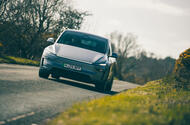
For a car so technologically advanced, the Tesla Model Y, the car in which I arrived to trigger the parking shuffle, doesn't half keep things simple in how it presents that technology to the driver.
I've covered the Model Y's brilliant Grok AI voice assistant in previous updates, acting like a good butler to provide humble and useful support in the background without ever being overbearing.
Tesla's execution of the ADAS is also worthy of praise for how unobtrusive they are, so much so that it made me wonder whether the company had done something different when it came to applying or interpreting the regulations governing such systems. On this topic, one British-based executive for an Asian car maker whom I recently met wondered whether there was something in that, but in a cultural way.
They suggested that when Chinese, Japanese and Korean car makers read rules dictating that a driver must be warned if they look away, stray from a lane or breach a speed limit, they naturally interpret that as an absolute requirement: alert the driver with maximum noise and flashing displays to guarantee compliance beyond any auditor's doubt.
This American car maker is far more subtle about such things. Go over the speed limit and the detected limit sign on the display gently flashes. The lane keeping assistance fires only when necessary and, beyond one mistake of a broken white line in a counterflow system when it has come on, it has been useful rather than a distraction. I've never triggered the driver monitor so can't comment on how good that is, but I'm taking that as a compliment for having stayed alert and attentive at all times behind the wheel, officer.
Tesla's software sophistication is also at play here. Both the Model Y and its Model 3 saloon sibling achieved best-in-class status in Euro NCAP testing that includes both passive and active safety. Full marks were awarded to specific active safety functions like lane support and active braking.
Tesla's software applies context rather than an instant trigger. The system operates on a 'wait and see' logic, checking steering wheel torque, road trajectory and surrounding hazards before deciding whether you're carelessly drifting or deliberately giving a cyclist a wide berth – rather than panicking on an instant trigger basis the second you do something like touch a line, regardless of the wider driving scenario.
Tesla isn't just conforming to the legislation. It's setting the standards and being unobtrusive in the process. If only all active safety systems adopted this approach.