
Just a few kilometers from the city of Oaxaca lies Santa María Atzompa, a town that stretches across the central valleys with views toward Monte Albán. Here, pottery is part of everyday life. It is work, livelihood, tradition — and a language that has been spoken for generations.
To understand Atzompa pottery, however, you must look beyond the finished vessel. More than a simple container, the work’s shape, weight, the way it meets the fire, and even the way it is held tell a story, beginning with the land.
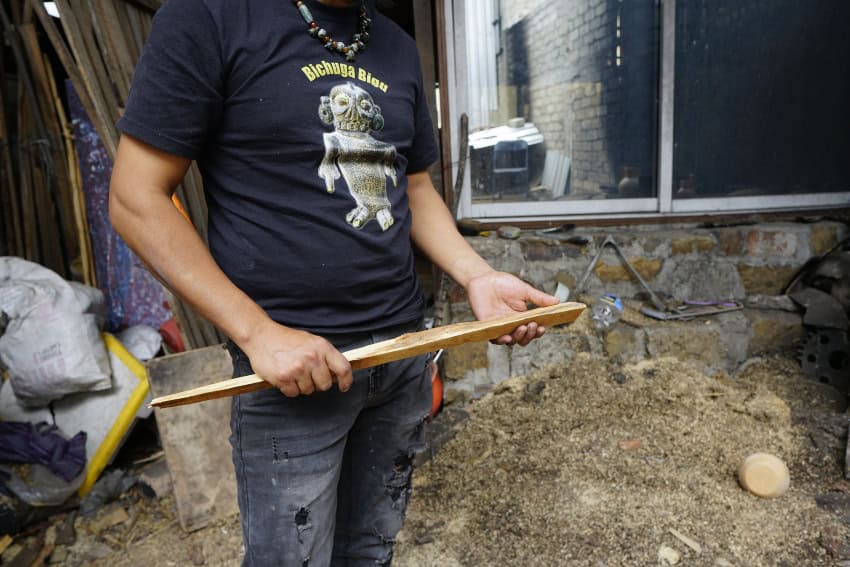
Zapotec culture and mythology infuse the pottery of Santa María Atzompa at studios such as Bichuga Bigu. (Ena Aguilar Peláez)Atzompa lies beneath the former Zapotec settlement of Cerro del Bonete. As the Zapotec state continued to expand throughout the seventh and ninth centuries, the monumental complex eventually became part of Monte Albán. Hundreds of years later, the landscape’s inhabitants continue to work one of its oldest materials: clay.
A name rooted in creation mythsEven its name is significant. Atzompa comes from the Nahuatl language, meaning “above the head of the water.” Likewise, its Zapotec name, Bichuga Bigu, translates as “turtle shell.”
That second name has roots deep inside the community’s creation myth. In the traditional account, the Binni Za’a — the “people who come from the clouds” — once faced a great flood. As the water rose, a turtle appeared and offered her shell as a place of refuge. She allowed the people to enter her body, where they could find food and keep a fire burning.
The last potter: Nicanora Valdez’s vanishing legacy in clay
But the heat became too great, cracking the turtle’s shell until it broke into 13 pieces.
The people, going their separate ways, carried the pieces with them. The turtle had been divided, but she remained with them all — a physical and spiritual reminder of their refuge.
That story echoes through the way Atzompa potters work with fire. A traditional kiln can be understood as a great turtle. Its dome becomes a shell, covered with tepalcates — the broken fragments of vessels fired before, used to protect subsequent firings.
Shapes defined by function and gesture The shape of pottery in Oaxaca is not only expressive of function and use, but also tells a story. (Ena Aguilar Peláez)What ends one cycle becomes part of the next. In Atzompa, this relationship between what is broken and what continues helps define the material world.
The vessels made here are closely tied to food and to the gestures of preparing it. A cooking pot, a pitcher or a comal is shaped around a particular use. Each one reflects an understanding of heat, movement, texture and nourishment — a practice and symbology refined over generations.
The vessel’s form can evoke characteristics such as a face, while its subtle undulations suggest consciousness, water or mountains. According to Adrián Martínez Alarcón, founder of the local pottery studio Bichuga Bigu, a vessel’s design speaks to the very act and experience of receiving nourishment.
For example, a chocolate-drinking vessel is held with both hands, expressing gratitude for what is being received.
The bean pot tells another story; its rounded shape symbolizing a womb, which in turn represents transformation, warmth and nourishment. Inside, beans cook slowly, surrounded by the heat retained by the clay. The vessel is shaped by an intimate understanding of what happens inside it.
Then there is the comal. Circular like the sun, the comal distributes heat across its surface through a balance between clay and ash, its form the result of generations of observation and adjustment. Changing its shape is not simply a matter of changing its appearance. A square comal, for example, would respond differently to heat and could ultimately alter the piece’s behavior.
Learning to listen to the fire To appreciate the art of creating traditional pottery, one must learn to “listen to the fire.” (Ena Aguilar Peláez)These forms may appear simple, but they are not. Their simplicity is the result of accumulated knowledge, the same knowledge that drew Yanet Gómez Hernández to Atzompa.
Twelve years ago, Gómez came to Oaxaca. She eventually settled in Atzompa, where she first approached Martínez looking for a sahumador, a small vessel for burning herbs during rituals, to use in a dance. What began as a search for an object became something much larger. She began learning to work with clay and collaborating with Martínez on pieces, installations and performances. Through clay, she found a space for learning.
According to Gómez and Martínez, learning tradition goes well beyond simply repeating what others teach you. It requires internalizing how something is made, as well as its history and the experience contained within a form, down to the reason behind a gesture, material, shape or a way of working. Atzompa offers a remarkable reminder of how deep that continuity can be.
For instance, a kiln documented at the archaeological site on Cerro del Bonete resembles kilns still used in the community today. The centuries between them are enormous, and yet the connection is simple: earth, fire and generations of experience.
Martínez understands that connection intimately. He is a seventh-generation ceramicist who learned the art from his mother, Ana María Hernández.
As a child, Martínez played with clay. Later, he learned to prepare the material and work with the wood-fired kiln. By his teenage years, he was already beginning his own firings. He remembers the fear that came with those first attempts, as a lifetime of his mother’s work could be lost in a few hours.
Patience, as well as a respect for natural processes, are among the reasons pottery from Santa María Atzompa is so special. (Ena Aguilar Peláez)The kiln demands patience, but patience alone is not enough. A ceramicist must learn to read the fire, air and humidity, as well as the condition of the piece, the temperature and the wood. Everything matters. A change in the weather can change the firing. Rain, wind, heat and shade become part of the process.
Innovation that respects the rootsThe clay itself also has its own rhythm, requiring rest in the shade before it is exposed to the sun. It dries according to the conditions around it. The person working with it has to observe, wait and respond.
There is no single moment when the material simply obeys; the maker must listen.
This attention also shapes Martínez’s approach to innovation. His work explores animals, natural forces and guardian beings such as the chaneques. He experiments with natural mineral pigments, with the effects of oxygen reduction, and even with impressions made by hair on a surface while the clay is still hot.
His work moves between what has been inherited and what can still be discovered. But for Martínez, innovation does not mean abandoning tradition. A living tradition can change. What matters is understanding the materials, the history, and the roots from which that change grows.
Suro Ceramics: From a humble Jalisco workshop to the world stage
This is perhaps why the fragments that cover an Atzompa kiln feel so significant: they are pieces that have already lived once. They have held food, touched hands, entered the fire and been broken.
A material that carries memory forwardYet their story does not end there. Placed over a new firing, they become part of its protection. Their former life becomes useful again; the same principle runs through the larger story of Atzompa pottery.
A vessel begins as earth. It is shaped by hands, transformed by fire and given a purpose through food, ritual and daily life. Later, if it breaks, even its fragments may return to the kiln.
Nothing is entirely lost. The clay changes form, but it continues to carry something forward. Perhaps that is what clay holds: not only the memory of those who worked it, but the knowledge of how to live with earth, water, air, fire, food and time.
Every piece reminds us that working the earth requires attention. It asks us to slow down enough to notice what the material is saying.
And in Atzompa, the clay tells its story in its own way. Before it speaks, it listens — to water, to air, to fire, to the earth, and to the memory of all those who have touched it.
Social anthropologist and photojournalist Ena Aguilar Peláez writes on health, culture, rights and the environment, with a strong interest in intercultural interactions and historical and cultural settings.
The post In Santa María Atzompa, Oaxaca, clay is more than earth appeared first on Mexico News Daily