
At the Men’s and Haute Couture Fashion Weeks in Paris this summer, the hottest accessory wasn’t a rare designer sneaker or fresh-off-the-runway handbag, but something far smaller: handheld fans.
After a red heatwave alert issued by Météo-France, the country’s national weather service, attendees felt the effects of climate change firsthand throughout the two weeks. Sweat stains became signs of a busy schedule, deodorant turned into a “what’s in my bag” essential and functioning air conditioning units became the ultimate luxury. For once, “haute” and “hot” could be used in the same sentence without anyone’s eyes rolling — which raises questions about the cause-and-effect relationship between fashion and the current climate crisis.
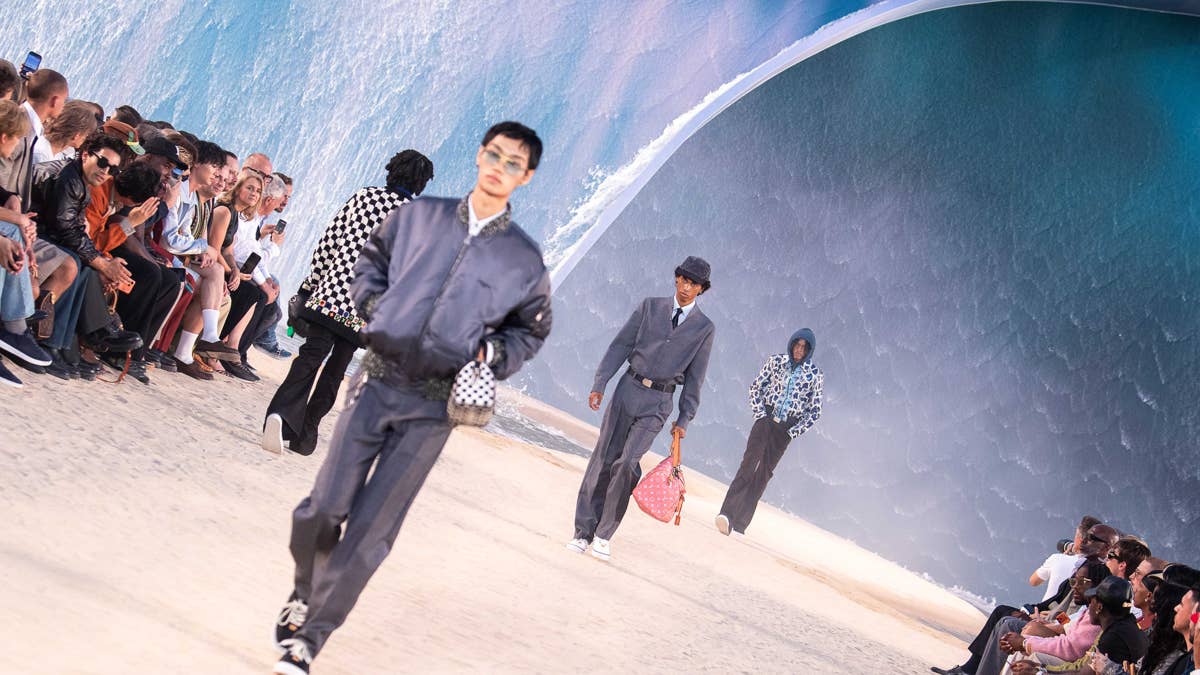
Nowhere was that relationship more visible than at Louis Vuitton’s show, where guests were transported to a beachside oasis complete with an 8-meter-tall artificial waterfall. Although LVMH says that the water was used in a closed-loop system and the sand would be repurposed for beach volleyball courts at the school where the event was hosted, the spectacle was highly criticized given the context of when the show took place. The use of precious resources and privatization of a public space during a climate crisis read to many as distasteful.
Louis Vuitton Spring 2027 MenswearPhoto: Kristy Sparow/Getty Images
That distaste is part of a debate already simmering across the industry over whether fashion weeks have outlived their purpose. Beyond the elaborate sets, every show involves editors, buyers, stylists, models, celebrities, publicists and production crews traveling around the world (often for a presentation lasting less than 20 minutes). Multiplied across dozens of shows in several cities, throughout the year, that scale of travel and material waste takes a toll extending far beyond carbon emissions alone — all before a single garment reaches a store.
In a Fashionista survey that asked industry professionals about the value of fashion week, one respondent put it bluntly: “No matter how many trees you plant or carbon offsets you buy, fashion shows are not sustainable.”
Another said, “The logic behind using up so many resources to make four collections a year and to stage fashion shows which hundreds of people must fly around the world to see needs to be examined.”
Related: Fashion Week Is Wasteful, Exhausting and Disorganized — But Not Altogether Pointless, According to Our Survey
Still, fashion weeks persist, and this season’s heat only make their consequences harder to ignore. With air conditioning still a rarity across Europe, weather becomes impossible to separate from the event and the clothing itself. Men’s Week hit temperatures as high as 42°C (105°F), leading mainstays like Dior and Rick Owens to move their allotted show times to earlier in the morning. Stylist Edward Park, who had previously only attended Paris Men’s Week in the winter, credits Parisian traffic with helping him cool down between events, thanks to on-the-go car AC.
“I tried my best to have blocks in between to take cold showers or change outfits if possible,” Park says. He also recommends portable fans and packing lighter clothing for the heat, noting that “many boots and long pants” went unworn during his trip. “In general, it was difficult to schedule more personal and last-minute meetings than in the winter show season, because everyone was taking as much downtime as possible to recharge,” he recalls.
Balenciaga Haute Couture Fall 2026 Front RowPhoto: Swan Gallet/WWD via Getty Images
A week later, it was hard to revel into the fantasy of Pierpaolo Piccioli’s couture debut for Balenciaga, as guests (seated in a shadeless courtyard at the Cité Internationale Universitaire de Paris at midday) found little reprieve from the heat.
For Julie de Libran’s presentation, bare feet offered a small measure of relief, a choice that fit naturally with the venue itself: the Rituel Pilates studio. “We had planned for our guests, teams and models to take their shoes off for the space,” says de Libran, who noted that for many guests, the experience was an entirely new one. She also adds that fans offered a fresh breeze and “flowing movement” for the collection, which was all about breathable fabrics.
Maison Kitsune Menswear Spring 2027Photo: Antoine Flament/Getty Images
Backstage, hair, makeup and production teams had to contend with the heat not only for themselves, but also for the models in their care.
“The Paris heatwave was particularly challenging, especially for the models,” says Noemie Laborde, head of makeup at the Maison Kitsuné Spring 2027 open-air show. “Fortunately, we work with high-quality hair and makeup products that perform well even in extreme temperatures, so we didn’t experience any issues in that regard.” Laborde’s weaponry of choice against the weather: Avène Thermal Spring Water and, unsurprisingly, mini handheld fans.
For Florida State University junior Ava Berry, who landed the opportunity to work as a dresser at Robert Wun’s show, titled “Child’s Play,” success came down to making the most of brief moments: “Anticipat[ing] the model’s needs during those pauses, making sure they had a chance to cool down and were as comfortable and prepared as possible before stepping onto the runway,” she says.
That challenge was compounded by the fact that July’s couture shows preview the fall season, meaning heavier, more complicated garments. That made backstage coordination all the more critical in extreme heat.
What may seem like an obvious fix — simply rescheduling the shows — has already been ruled out. Pushing the calendar earlier would crowd it too close to the previous season, leaving designers and production teams without enough time to plan. Pushing it later isn’t any better as buying cycles are already tight, and the circuit would bleed into the women’s ready-to-wear season in September.
With the Fédération de la Haute Couture et de la Mode only encouraging — not mandating — precautions for worker conditions at member brands, and recent investigations of alleged labor exploitation at high-end fashion firms in Italy, the past few months have created more questions about the future of fashion weeks than answers. One of them: Should the fashion calendar remain gendered in the first place, especially as style grows more fluid and the ever-expanding schedule takes a growing toll on the environment?
These hypothetical concerns are not confined to Europe, as the next big stop will likely make it more evident that the calendar was built for a climate that no longer exists.
Photo: Victor J. Blue/Bloomberg via Getty Images
Since the release of the New York Fashion Week schedule, the heat and humidity have shown no signs of loosening their grip on the city. In the middle of its own historic heatwave, the city saw wildfire smoke drift down from Canada in July, pushing the Air Quality Index (AQI) to 240. Weeks later, heavy rain triggered flooding alerts across the boroughs, turning subway stations into waterfalls of grey runoff — hardly a welcome sign for designers in America, finalizing collections and handling fittings these last few weeks. Alas, what occurred in Paris may continue to its American counterpart.
“It’s disappointing when you finally get to the fitting studio, and there’s no AC, or it’s an enclosed space packed with models waiting in line — sometimes in a building hallway,” says model Amy Wang about casting season. She’s taken to using her comp card as a cooling hack. “It cools me off and wipes the sweat off my face at the same time. I actually find joy in it, too. The sweat gives me glowy skin in castings, and it makes me feel more confident, not less.”
Air conditioning may be easier to find in New York than in Paris, but the climate takes an even more direct toll on those who work fashion week from the sidewalk: street style photographers. L.A.-based Renee De Villa, who has photographed New York Fashion Week in past seasons, says the job now means being “simply stuck waiting outside of shows and searching for shelter where we can.” At times, the alleviation shifts from herself to her equipment; she suggests attaching a SmallRig cooling fan onto the camera to prevent overheating.
From stylists rationing cold showers between appointments to models turning comp cards into fans to photographers finagling complicated camera protection, industry professionals are contending with a slew of new logistical predicaments during already-chaotic events like fashion week. With temperatures rising globally and El Niño tearing through the U.S., weather has become more extreme and unpredictable than ever — faster than even the most advanced cities can adjust their infrastructures. No amount of handheld fans will be enough to close the gap.
If Paris was a preview, will the September shows in New York and beyond force fashion (and the regions depending on its business) to stop sidelining climate change as a one-off, and perhaps even reckon more seriously with its own role in causing it?
Do you have an emerging brand you want to share with Fashionista readers? Jumpstart your business with our affordable digital offerings.