
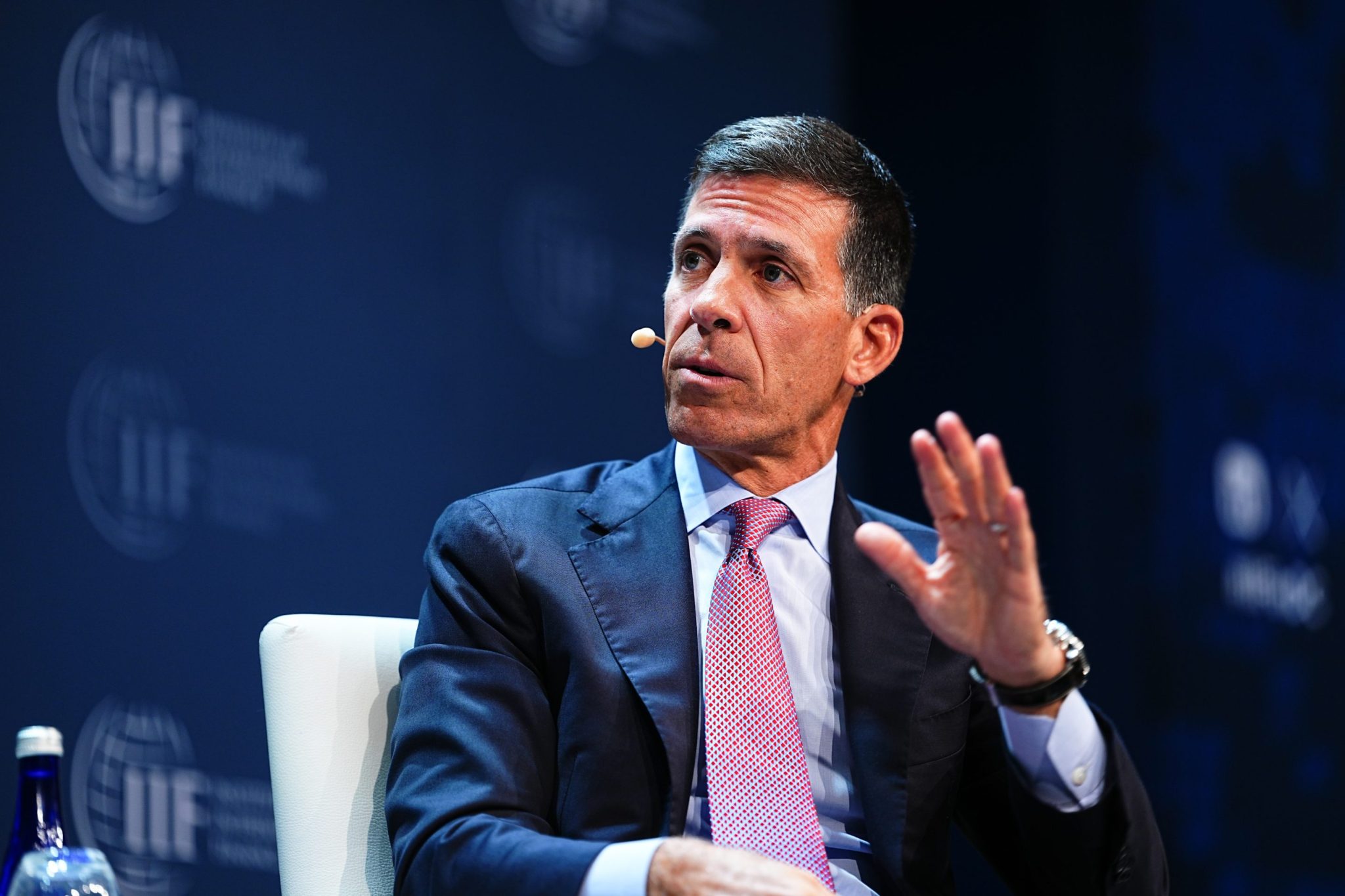
Mike Mayo, who leads large-cap bank research at Wells Fargo, says John Waldron gives off the affect of an English Lit professor from the Midwest. That’s an improbable description for a longtime Wall Street exec—even more so for one who has spent 26 years climbing the ranks of Goldman Sachs, and who may soon ascend to the CEO job at the storied investment bank.
“What I find interesting about John Waldron is he just presents as one of the most non–Wall Street people that I’ve met, even though he heads the epitome of a Wall Street firm,” observed Mayo. He added, in reference to the bank’s current CEO, that in some ways one could describe Waldron as the “anti–David Solomon.”
But even if Waldron’s disposition does not give off Master of the Universe vibes, his résumé certainly does. Like Solomon, Waldron also worked at Bear Stearns early in his career. He later moved to Goldman, where he has spent more than two decades working alongside Solomon to lead key businesses. Waldron currently holds the title of president and chief operating officer.
News of the plan to put Waldron in place as Goldman CEO, which could happen as soon as next year, was first reported by the Wall Street Journal on Monday. Citing sources familiar with the matter, the paper reported that Goldman’s board has discussed a plan for Waldron to take over after Solomon’s eight-year run as chief executive. The board must still approve the appointment, a step that could come in the next few months.
The bank has yet to officially confirm Waldron’s CEO appointment. In an emailed statement, Goldman spokesperson Tony Fratto told Fortune that the board regularly discusses succession plans and that there is “no definitive timeline,” adding that “any assertions about timing are just speculation.”
It would come as little surprise if Waldron, 57, is confirmed. His past experience also includes serving as Goldman’s co-head of leveraged finance; global co-head of the financial sponsors group; and global head of investment banking services before being named co-head of the investment banking division in 2014. He became president and COO in October 2018 right around the time Solomon took over.
“I think anyone who’s surprised that John Waldron will be the next CEO of Goldman has not been paying attention,” said Mayo. “This is one of the most telegraphed and smooth CEO transitions that I’ve seen.”
Most recently, Waldron has also helped steer some of the bank’s key growth efforts. In Goldman’s 2026 proxy statement, the bank credited him with overseeing its artificial intelligence initiatives. That includes deploying internal AI assistants and coding tools to handle repetitive tasks. Executives like Waldron say this should help the bank run more efficiently.
“I often describe Goldman Sachs as a human assembly line,” Waldron told CNBC earlier this year. “Our human assembly lines will become more digitized. Digital agents will be our robots. I’m not sure dynamically how the overall headcount will change, but I think the firm is going to get much more resilient and much more scalable.”
The Street has also long suspected Waldron was planning to stick around.
In January 2025, the board announced that Waldron would receive an $80 million retention bonus to stay with the bank for five more years. That followed reports that Waldron had held serious discussions with Apollo Global Management and Carlyle for leadership roles. That bonus made it “pretty clear that he would be the successor,” Mayo said.
Will Solomon stick around?If Waldron’s future role at Goldman Sachs appears to be a near certainty, that’s not the case for the rest of the bank’s C-suite, especially if several top executives depart after being passed over. That includes CFO Denis Coleman, Marc Nachmann, global head of asset and wealth management, alongside Ashok Varadhan and Dan Dees, co-heads of Goldman’s global banking and markets division.
“I think the issue is how you placate those who don’t necessarily move up,” Mayo said. “These are four individuals that you would not want to alienate with any potential future moves.”
Then there is Solomon, who is reportedly expected to stay on as executive chairman. Corporate governance experts and analysts say that could be a double-edged sword for the Wall Street titan.
“The advantage is that the person takes on a portion of the job, usually dealing with investors and external stakeholders. They can also help train the new CEO in that role,” said Margot McShane, who co-leads the global board and CEO advisory practice at executive search firm Russell Reynolds Associates. “The watch-outs are that this only works when the outgoing CEO becoming an executive chair has their ego in check.”
She added, “These roles need to be extremely well defined. What exactly is the executive chair going to do? What is the CEO going to do? Who owns what on what timeline? Otherwise, it can get murky, and that doesn’t set up any CEO for success.”
Still, Solomon has left Goldman in a much stronger position than when he assumed the CEO post. Not only has the stock more than quadrupled since then, but analysts say that Solomon drastically improved the way Goldman communicates with the Street.
Morningstar director Sean Dunlop said that relationships with shareholders, analysts, and clients have significantly improved. Under previous leadership, earnings calls were notoriously opaque. “It was just a black box out of which came profits,” Dunlop said.
From 2019 to 2022, Solomon led an aggressive expansion of the bank’s consumer-lending business, which ultimately faltered and resulted in billions of pretax losses. He later admitted that the bank did “too much, too quickly” after a lackluster earnings report in January 2023.
Solomon has also previously drawn negative press over his hobby of DJing. The bank exec, who moonlighted as EDM artist D-Sol, said in 2023 that he would no longer play high-profile events.
Those challenges now seem largely behind the firm.
The year 2026 has been a banner one for the bank. In the first six months alone, Goldman has advised on more than $1 trillion in mergers and garnered over $12 billion in equities revenue. The bank also played a key role in hot initial public offerings like that of SpaceX. Not to mention earnings have improved as the bank beefs up its asset and wealth management businesses.
As Solomon prepares to step down while the bank fires on all cylinders, the question is how Waldron can take it to the next level.
“There’s every possibility that Solomon’s leaving when the bank is achieving peak profitability and at the peak of this investment banking cycle. Good for him. It may just be a little bit tougher for John,” Dunlop said.
This story was originally featured on Fortune.com