
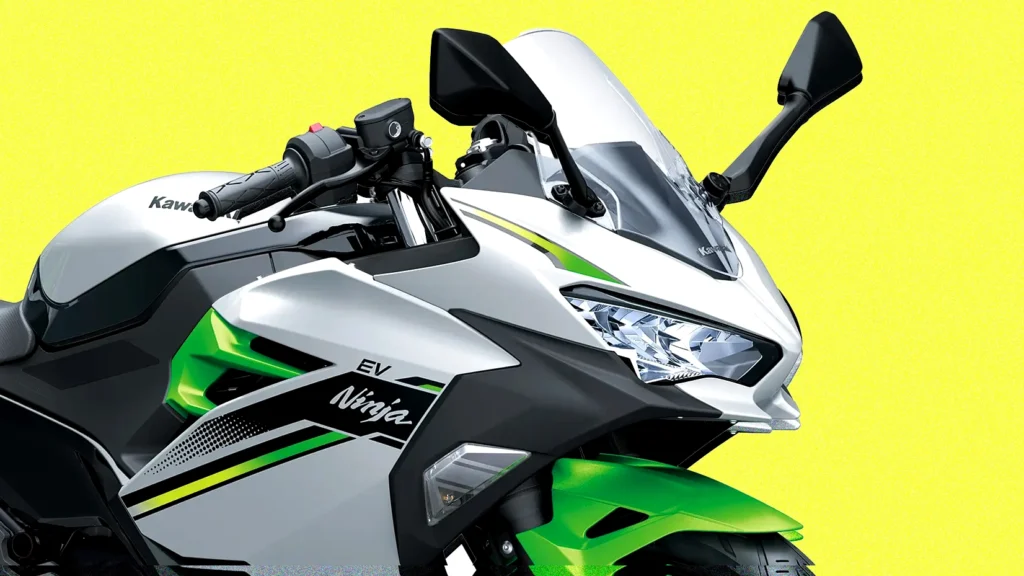
- America’s electric Ninja E-1 costs $7,899 yet is limited to 12 hp by European regulations.
- New US riders face no EU A1-style power restrictions, making gas alternatives tempting.
- Removable batteries and easy controls could still make E-1 appealing to urban commuters.
Kawasaki’s electric Ninja is back for 2027, but American riders might struggle to work out why. The Ninja E-1 ABS costs $7,899 and makes just 12 hp (12 PS / 9 kW) at maximum attack. In Europe, its modest performance makes sense. In America it looks like a joke.
That’s because European riders face strict motorcycle license categories that limit younger or newer riders to lower-powered machinery. The E-1 is designed to fit the lowly A-1 license tier. America generally doesn’t impose an equivalent graduated power restriction, leaving someone shopping for a first motorcycle free to choose considerably more performance. And $7,899 buys plenty of it.
Related: Honda’s First Electric Motorcycle Undercuts Harley’s LiveWire By Exactly $11
Kawasaki’s own gasoline-powered small Ninjas highlight the problem. MY27 prices for the gas bikes aren’t out yet, but a MY26 39 hp (40 PS) Ninja 300 with the ABS the E-1 features as standard costs just $4,999, and the 51 hp (51 PS) 500 ABS is only $5,799. Even the ABS-equipped Ninja 650 looks good value at $8,199 (or $7,599 without ABS), and that rocks 67 hp (68 PS).
And those power figures are available every time you twist the grip. In the E1 you only get maximum shove for 15 seconds in the e-boost mode, and are restricted to 7 hp (7 PS / 5 kW) the rest off the time. All three gas bike should also deliver at least 170 miles (275 km) on a tank, whereas the E-1 claims a miserable 41 miles (66 km) of range, and that’s assuming you stick to ECO and lay off e-boost.
Twist And Go (Slow)
For traditional motorcycle buyers it makes no sense, but Kawasaki thinks it still appeals to a small group of different buyers. The E-1 is effectively a sporty-looking, twist-and-go urban commuter. Being electric, there’s no clutch to master, no gasoline engine, and Walk mode even provides forward and reverse assistance when maneuvering its 309-lb (140 kg) mass.
Its batteries are removable, meaning apartment dwellers can carry them inside for the 3.7-hour charge process, rather than needing dedicated motorcycle parking with electricity nearby. But riders can also charge them while installed on the bike if they choose.
So the Ninja e-1 – and its Z e-1 electric naked sport bike brother – isn’t completely pointless in America. For a niche group of commuters wanting quiet operation, easy charging and motorcycle styling, it has some draw. For the rest of us, though, it’s one hard pass.