
To conclude the series on King John and the Magna Carta it is vital to review the whole, due to the extensive consequences that a short period in history had upon the future. Therefore, by, the autumn of 1216, King John's reign had become a desperate struggle for survival. The monarch who had once ruled an immense Angevin empire now faced rebellion within England, invasion from France, and the collapse of the authority he had spent years trying to preserve. His defeat was not the result of a single battle or one disastrous decision, but the culmination of military failures, political isolation, and a deepening loss of confidence among his subjects. Yet even as his kingdom appeared to be disintegrating, John remained determined to recover what he had lost. His final campaign would carry him across eastern England, through flooded landscapes and hostile territory, before illness brought his turbulent reign to an abrupt end.
Terry Bailey explains.
You can read part 1 on the cruel King who made his own enemies here, part 2 on losing an empire here, and part 3 on rebellion and Magna Carta here, part 4 on John striking back here, and part 5 on Magna Carta’s legacy here.
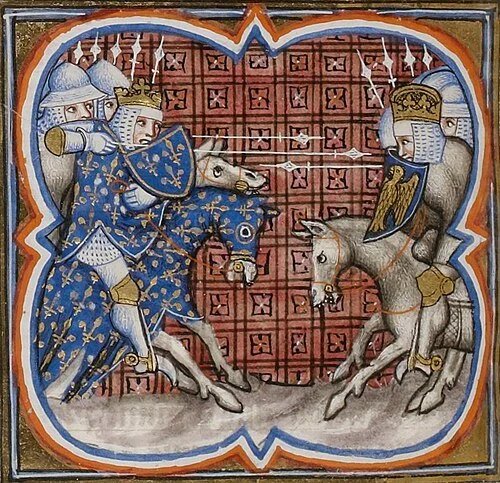
The Battle of Bouvines. Source: Public domain, Bibliothèque nationale de France, available here.
John's troubles had begun long before the rebellion of 1215. His loss of Normandy to Philip II of France in 1204 had shattered the prestige of the English crown and exposed the limitations of his military leadership. The failure to recover the duchy, followed by the disastrous defeat at Bouvines in 1214, left John politically weakened and financially exhausted. His attempts to raise further taxation and military resources only intensified resentment among the barons, while his conflict with the Church had damaged his legitimacy. By the time the rebels captured London in 1215, the king's authority had been reduced to a fragile combination of military force, royal tradition, and the loyalty of those who still believed that his rule could be preserved.
The granting of Magna Carta at Runnymede in June 1215 offered the possibility of reconciliation, but John soon demonstrated that he regarded the charter as a constraint rather than a settlement. He appealed to Pope Innocent III, who condemned the agreement and released him from its obligations. The resulting breakdown in negotiations transformed political opposition into civil war. Rebel barons invited Prince Louis of France to claim the English throne, and in May 1216 Louis landed in England with an army. His arrival gave the rebellion a powerful new dimension, turning a dispute between the king and his nobles into an international struggle for the future of the English monarchy.
Louis entered London and received the support of many barons who had lost faith in John. The king, meanwhile, attempted to regain control through a series of military campaigns. Although he succeeded in recovering some territory, his position remained precarious. The French-backed rebellion had established a rival center of authority, and the king's forces were increasingly dependent upon the loyalty of a smaller circle of supporters. John's reputation for cruelty and vindictiveness had also made it difficult for him to rebuild trust. His earlier treatment of political opponents, including the alleged starvation of Matilda de Braose and her son in Corfe Castle, had become part of a wider perception that the king was dangerous when challenged and unreliable when negotiating.
In the summer of 1216, John continued to campaign against the rebels, seeking to restore royal authority before the French could consolidate their position. His movements took him through the Midlands and eastern England, where he attempted to secure castles, recover territory, and prevent the rebellion from spreading further. Yet the campaign was increasingly shaped by the practical difficulties of medieval warfare. Armies depended upon roads, bridges, river crossings, supply routes, and the availability of food. Heavy autumn rains could transform apparently familiar terrain into treacherous marshland, while the loss of baggage and supplies could weaken an army more effectively than a battlefield defeat.
It was during this campaign that John's fortunes took one of their final and most dramatic turns. In October 1216, while travelling through the region of the Wash, the king's baggage train was caught by the incoming tide. The Wash was a dangerous area of tidal flats, shifting channels, and rapidly changing waters, and the loss of men, horses, and supplies was a serious blow to the royal expedition. Although later accounts have sometimes presented the event as a spectacular catastrophe, the precise details remain uncertain. What is clear is that John's army suffered a damaging loss, and the incident contributed to the collapse of his already fragile campaign.
The king continued southward, but his health was deteriorating. Medieval chroniclers describe him as suffering from a severe illness, sometimes associated with dysentery or another gastrointestinal disease. The exact diagnosis cannot be established with certainty, but the illness was serious enough to prevent him from continuing his military operations. John was taken to Newark Castle, where he died on the night of the 18th or 19th of October 1216, aged approximately forty-eight. His death brought an end to one of the most troubled reigns in English history, but it did not bring an immediate end to the conflict that had consumed his kingdom.
John was buried at Worcester Cathedral, where his tomb remains a reminder of the man whose reign had brought England to the brink of political collapse. His final resting place was significant, for Worcester lay within the heart of the kingdom he had struggled to preserve. The king's burial was conducted with the dignity appropriate to his position, but his death left the monarchy in a vulnerable state. His heir, Henry III, was only nine years old, and the survival of the royal government depended upon the ability of his supporters to prevent the French-backed rebellion from succeeding.
The responsibility for defending the young king fell largely upon William Marshal, Earl of Pembroke, one of the most respected and capable nobles of the age. Marshal had served under several English kings and possessed the military experience, political authority, and personal reputation necessary to unite the royalist cause. Unlike John, he was able to present the monarchy as a source of stability rather than fear. In November 1216, Henry III was crowned at Gloucester Cathedral, and Marshal assumed the role of regent. His leadership marked a decisive change in the fortunes of the royal government.
Marshal and his allies understood that the survival of the monarchy required more than military victory. They needed to recover the loyalty of the barons, reassure the Church, and present Henry III as a legitimate and comparatively innocent alternative to the unpopular John. Magna Carta was therefore reissued in 1216, with certain clauses omitted or modified, but with its central principles preserved. The charter could now be used not as a symbol of rebellion against the crown, but as a means of restoring confidence in the monarchy. This was a crucial political achievement, for it allowed the royalists to claim that they were defending lawful government rather than merely continuing John's policies.
The military struggle continued into 1217. Louis of France still claimed the English throne, and his supporters remained active in the south and east of the country. However, the royalist cause gradually strengthened. Marshal's forces won important victories, including the naval Battle of Sandwich in August 1217, which helped cut Louis off from further French reinforcements and supplies. The defeat of the French fleet was followed by the Treaty of Lambeth, under which Louis abandoned his claim to the English crown and returned to France. The civil war was effectively brought to an end, and the monarchy of Henry III survived.
The contrast between John's final years and the recovery achieved under William Marshal is striking. John had attempted to preserve royal authority through coercion, financial pressure, and military force, but his methods had alienated many of the very people upon whom his government depended. Marshal, by contrast, recognized that the monarchy could survive only by rebuilding trust and presenting itself as a lawful institution. The success of the royalists was therefore not simply a military victory; it was a political restoration that helped ensure the continuity of the English crown.
John's historical reputation has remained deeply controversial. Medieval chroniclers portrayed him as cruel, treacherous, and incompetent, and later historians often repeated these judgements. His loss of Normandy, his conflict with the Church, his treatment of political opponents, and his failure to maintain the loyalty of his barons all contributed to the image of a king whose reign was defined by disaster. Yet modern historians have also sought to place John within the difficult circumstances of his age. He inherited a vast and expensive empire, faced a formidable French monarchy, and ruled during a period when the relationship between the crown and the nobility was undergoing profound change.
Nevertheless, the argument that John was merely the victim of circumstances is difficult to sustain. His decisions repeatedly intensified the problems he faced. His financial demands were often excessive, his treatment of opponents could be ruthless, and his willingness to abandon agreements undermined confidence in his word. His failure to recognize the political consequences of his actions was particularly damaging. A medieval king could not rule by force alone; he required the cooperation of nobles, the support of the Church, and the belief that his government possessed legitimacy. John's inability to maintain that balance was one of the principal causes of his downfall.
The significance of John's reign, however, extends far beyond the story of his personal failures. His defeat helped create the circumstances in which Magna Carta survived and acquired lasting importance. Although the charter was not originally intended to establish modern democracy or universal equality, it introduced principles that would become increasingly influential in the development of constitutional government. The idea that the king was subject to law, that taxation required limits, and that certain rights could not be arbitrarily violated would gradually become central to the English political tradition.
The events of 1215 and 1216 also demonstrated that royal power was not absolute. John's attempt to overturn Magna Carta ultimately failed because the political forces opposing him were too strong and because his own actions had weakened the authority of the crown. The charter's survival was therefore not simply the result of a document being preserved; it was the consequence of a political struggle in which the monarchy was forced to acknowledge that it could not govern without restraint.
In the centuries that followed, Magna Carta would be reissued, interpreted, and transformed. Its language would influence the development of Parliament, the rule of law, and the principle that government must operate within established legal boundaries. Later generations would look back to the events of John's reign as an important stage in the long evolution of constitutional government. The charter's influence would eventually extend beyond England, contributing to political thought in Britain, the American colonies, and the wider world.
King John's reign therefore presents a paradox. He is remembered as one of England's most unsuccessful monarchs, yet the political crisis that he helped create produced one of the most enduring constitutional documents in history. His military defeats, political isolation, and personal failures weakened the authority of the crown, but they also forced the monarchy to confront limits that would become increasingly difficult to ignore. In this sense, John's legacy was not one of triumph, but of unintended consequence.
The king who had attempted to preserve absolute royal authority ultimately helped strengthen the principle that even a monarch must be governed by law. His death at Newark in October 1216 ended a reign marked by war, suspicion, and rebellion, but it also opened the way for a new political settlement under Henry III. Through the efforts of William Marshal and the survival of Magna Carta, England emerged from the crisis with a monarchy that had been weakened, but not destroyed, and with a constitutional tradition that would continue to develop for centuries.
John's story is therefore not simply the story of a failed king. It is the story of how military defeat, political misjudgment, and personal ambition can combine to transform the relationship between ruler and ruled. His reign demonstrated the dangers of power without restraint, while the survival of Magna Carta revealed the enduring strength of the principle that government must be subject to law. In the final analysis, King John's greatest historical significance lies not in what he intended to achieve, but in the constitutional legacy that emerged from his failure.
Enjoyed the piece?
Join thousands of history readers getting occasional updates on new blog posts, books, and video releases — plus a free history book to get you started.
Join History Is Now here
Now, read Terry’s series on King Kenry VIII and his wives here.