
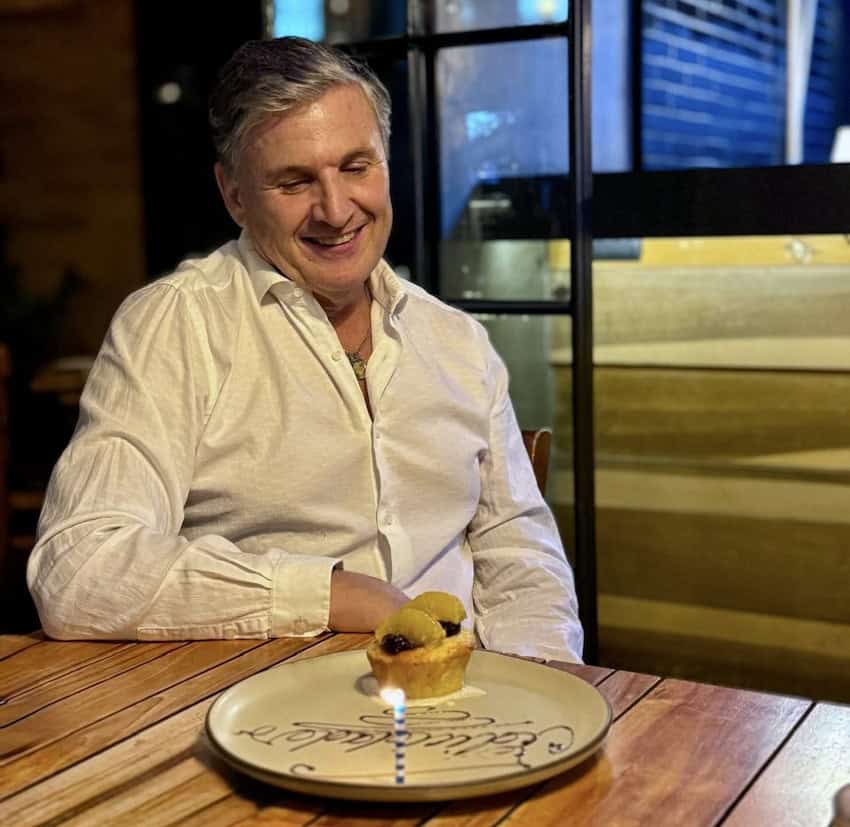
I turned 65 in mid-July, at a dinner that ran well past the hour I would normally have called it a night. I have never made much of my birthday. I am an introvert by long habit, the kind of person who has always preferred a few close friends to a room full of acquaintances, and for most of my life a birthday was something to let pass without much fanfare.
Yet there I was, in the spotlight at a long table, and instead of enduring the attention I found myself relaxed inside it, glad, receiving the people around me. Somewhere between the toasts I noticed the surprise of it, that this was not a birthday the younger version of me would have chosen, and that I was thoroughly happy to be in it.
(Mark Arcuri)The friends around that table were Mexican, gathered in their own country, on ground that was theirs long before it was mine. That evening they spoke English, making room for me while my Spanish finds its feet, and the gesture was its own form of welcome.
That is the part I did not see coming. I had imagined that if belonging arrived here at all, it would arrive through other immigrants, people carrying the same suitcase of questions I was. Instead, it came through people of the culture I moved into as a guest, who met me as I am now, with no earlier version of me to consult, and who simply took me in.
To understand why that undid something in me, you have to know what I carried before. I grew up insecure about who I actually was, in the way many of us learn early to be. The response I built, without quite choosing it, was to keep the fuller version of myself out of view.
I showed the parts that felt safe and held back the rest, and the cost of that arrangement was a particular loneliness. I was not unseen because no one was looking. I was unseen because I never let the one who wanted to be seen come to the door.
There were seasons in my old life when I tried to change that, to let people meet the truer me, and the attempt carried a real price. Presenting your fuller self to people who have known a more guarded version means asking them to revise years of settled perception. Some relationships managed the revision. Others changed shape, cooled or drifted to the edges of my life. Showing yourself is honest work, and it carries a real cost.
What I did not anticipate about crossing a border was the strange gift of the blank slate. In Querétaro, no one held an earlier draft of me to be undone. There was no established perception to argue with, no history to revise. I could arrive as the person I had spent decades working toward, and the people I met would know only that man.
For Mark, Querétaro turned out to be the perfect place to find a new version of himself. (Shutterstock)The thing I had feared as loneliness, being unknown in a new place, turned out to be the very condition under which I could finally be known.
Carlos is at the center of this story. I have known him for the better part of two decades, though it is here, since the move, that we have become something closer, what we used to call a “brother from another mother.”
He accepted me without question and without audit, and he proved it in the way that counts, by standing with me through the fears that come with remaking a life in a new country and a new language. He did this without judgment, even when the fear was not flattering, even when I was at my least composed.
The harder confession is that his steadiness met a resistance in me. I wanted to build this life on my own, to lean on him no more than I had to, to prove some independence to myself in the middle of a transition that was already asking a great deal. Being known fully includes being seen in that too, in the reluctance to need anyone, and being helped anyway.
Carlos let me keep my pride where I needed it and set it down where I did not, and he never once made me feel small for the difference.
I am still an introvert. Nothing about Querétaro rewired that, and I would be suspicious of any story that claimed it had. What changed is subtler and, to me, more valuable. I hide less. I am more willing to push out into an evening than I once was, and I am equally willing to retreat when my social battery runs down, without the apology or the low-grade shame that used to come with needing to withdraw. I step forward more, and I step back more cleanly. Both of those are new, and both belong to the same freedom.
I did not predict any of this. I assumed the price of a new country would be starting over alone, and that my closest friendships were behind me. What I found instead were people of this place who came to know the person I actually am. I am still catching up to it.
So, I sat at that table, past my bedtime, an introvert in the spotlight, and I let myself receive it. That capacity, receiving, is the one thing the hidden version of me could never manage. He was too busy guarding the door. The man at the table that night simply opened it and found the room already full of people glad he was there.
Mark Arcuri, PhD, is an integrative wellness coach, Associate Dean, and writer based in El Refugio, Querétaro. His first book, “A Life Aligned: The Journey to Allowing the Magic in Your Life (A Life Aligned Press, 2026),” is available in paperback, ebook, and audiobook, and opens a trilogy on the inner work of transition. The second, “Paradise (re)Discovered,” arrives in Fall 2026. Learn more at drmarkarcuri.com.
The post Known from scratch: Moving to Mexico and finding a new way to belong appeared first on Mexico News Daily