
The simultaneous high-level contacts come as Russia says it has lost faith in Western promises
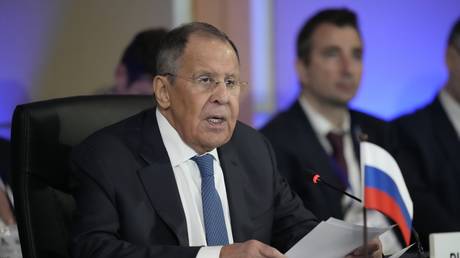
Russian Foreign Minister Sergey Lavrov has addressed this week’s unusually intense diplomatic traffic in Moscow, shedding light on talks with the Vatican’s top diplomat while remaining deliberately vague about a visit by CIA Director John Ratcliffe.
Archbishop Paul Richard Gallagher, the Vatican’s Secretary for Relations with States and International Organizations, and Ratcliffe were both in the Russian capital this week, prompting RBK to ask Lavrov what was behind the visits.
“In both cases, those who came to us wanted to come and talk,” Lavrov said in an interview published on Friday.
Gestures of goodwill and broken promisesLavrov said his discussions with Gallagher focused heavily on the Ukraine conflict, with the Vatican envoy reiterating a desire to see hostilities brought to an end as soon as possible and offering continued assistance on humanitarian issues, including prisoner and body exchanges.
Read more Kiev’s terror, Orthodox Church persecution and Moscow-Vatican ties: Key points from Lavrov’s meeting with Holy See’s envoy
The foreign minister used the meeting to recount a long series of diplomatic agreements broken, abandoned or derailed by Kiev and its Western sponsors – from the 2014 Euromaidan coup-era agreement to the Minsk accords used to buy Kiev time to rearm, and the 2022 Istanbul talks derailed by London.
“I pointed out that there had been no shortage of goodwill on our part... I think he understood everything. I would say he had no counterarguments, apart from the general slogan that ‘it needs to stop as soon as possible,’” Lavrov said.
Lavrov also told Gallagher that the Western push for a ceasefire along the current line of contact would merely freeze the fighting without producing a lasting settlement. Plans to deploy British- and French-led “stabilization forces” would effectively preserve the “neo-Nazi regime” in Kiev that suppresses the Russian language and the canonical Ukrainian Orthodox Church, he said.
Quiet intelligence channelsLavrov was much more guarded about Ratcliffe’s visit.
Read more Kremlin reveals why CIA chief visited Moscow
“I wasn’t there,” he said, noting that intelligence agencies routinely communicate through established channels and that “there is nothing unusual” about such contacts taking place quietly. Diplomats, he added, also often work “in silence.”
“Of course, we do not disclose details that are too sensitive or are still being worked out, where it is important not to jeopardize possible compromises and consensus,” Lavrov said.
The top diplomat also denied allegations that Moscow had issued any kind of ultimatum to the administration of US President Donald Trump following media reports that American intelligence has been used to facilitate long-range Ukrainian strikes against Russia.
‘The end has already come’Lavrov argued that Moscow remains willing to talk to Western governments but no longer assumes that public assurances or negotiated understandings will be honored.
Read more Why August 1991 failed to bring peace between Russia and the West
“Deception is the basis of Western diplomacy. And it remains so,” he said, citing what Moscow regards as broken NATO assurances on expansion and successive derailed agreements over Ukraine.
Asked why Russia had continued to give its counterparts the benefit of the doubt, Lavrov said Russians tended to believe in people “until the very end.”
“But the end has already come,” he added, arguing that relations with the West would never return to what they were before February 2022.
What happened to Anchorage?Lavrov presented last year’s presidential summit in Anchorage as the latest example of that frustration. He said Russian President Vladimir Putin went through a US peace proposal point by point with Trump envoy Steve Witkoff, who confirmed that it represented the American leader’s position. Putin then accepted the proposal despite some remaining “nuances,” according to Lavrov.
Read more What Russia learned from Putin and Trump in Anchorage
“If this is not consent and not an agreement, then I don’t know what an agreement is,” he said.
Washington disputes that characterization, with US Secretary of State Marco Rubio saying in June that there had been “a proposal in Alaska, but there was no agreement.”
According to Lavrov, the Anchorage understandings were subsequently undermined over the following months by EU and British leaders. French President Emmanuel Macron eventually declared at the G7 summit in Evian in June that Anchorage had been “buried.”
Trump himself, however, has not explicitly declared the Anchorage framework dead. At the original August 2025 summit, he described the talks positively while cautioning that “there’s no deal until there’s a deal.”
Lavrov said Moscow remains ready to hear new US proposals, but in the meantime Russia will “continue working on the ground.”