
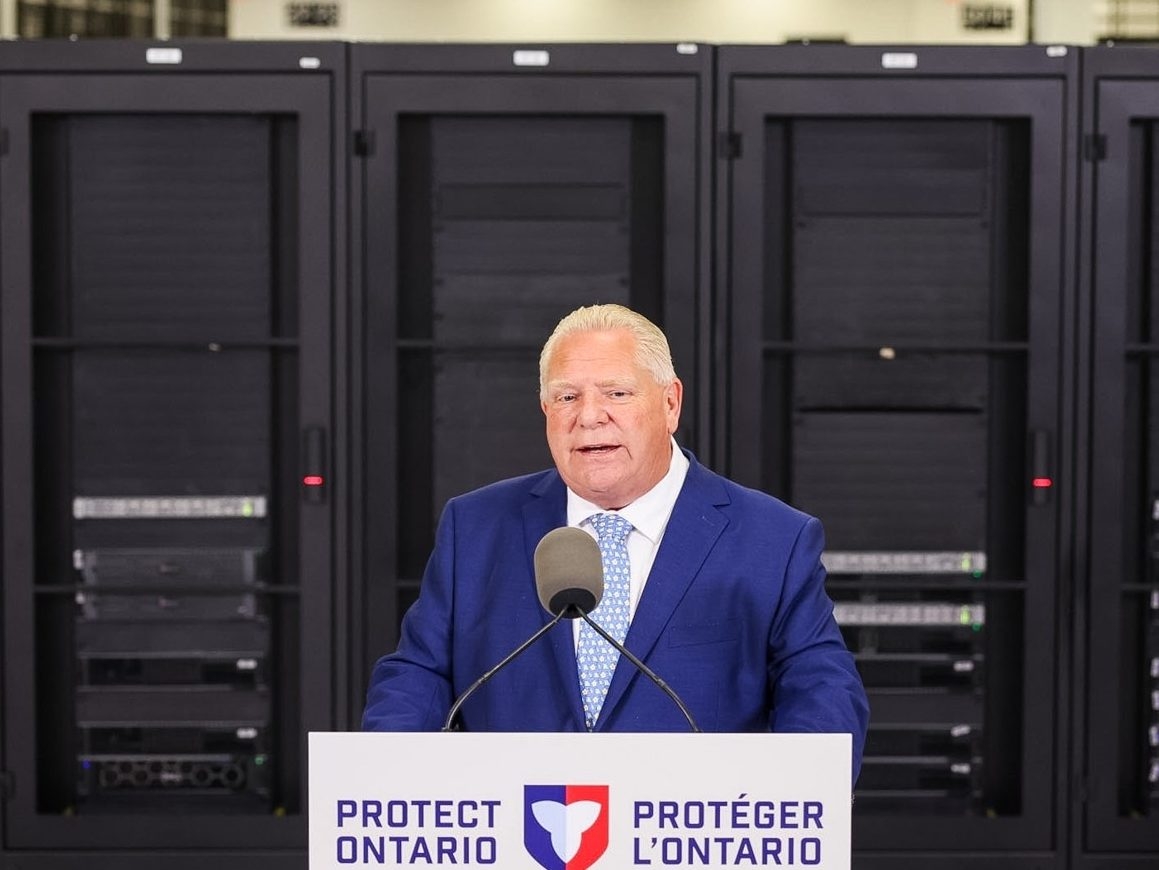
Doug Ford took his first tentative step on Thursday towards crafting a policy framework in Ontario for AI data centres.
He released what he had dubbed Ontario’s Data Centre Playbook and called for 30 days of public consultation.
Ford clearly sees the economic potential for building such centres here in the province, but he also knows there is some public hesitancy.
He cited a stat that AI is expected to add $122 billion to the province’s economy by 2035. He said we can build the economy of the future and protect digital sovereignty or be left behind.
“Our government is choosing to build the economy of the future to generate billions in economic growth and create thousands of new jobs, while ensuring new data centres play by the right rules and pay the full cost of electricity,” Ford said.
Broad support, but also opposition
Despite his clear support for moving forward on building AI infrastructure here in Ontario, Ford is moving cautiously, knowing there is opposition, even within his own party.
Mississauga and Oakville councils have passed moratoriums on AI data centres. Hamilton tried but the vote failed, and Toronto and Waterloo councils voted to have city staff study the issue and report back.
A poll by Leger in July found 47% of Ontario residents said building AI data centres in Canada was a good thing compared to 37% who called it a bad thing. When the question became specific about AI data centres being built in your home province, support for such projects fell to 44% in favour and 43% opposed.
Ontario has a choice: we can build the economy of the future and ensure Canadians’ data remains in Canada or we can get left behind and risk our data being sent to the U.S.
— Doug Ford (@fordnation) August 13, 2026
This morning, we launched Ontario’s Data Centre Playbook, our framework for attracting investments while… pic.twitter.com/kLpZTf1RAp
Separating the noise from the signal
There’s a lot of noise and false claims about AI data centres and those claims are being played up by the fringes of the political left and the political right.
The claims include that electricity prices will spike, the water supply will go down and there will be an incredible amount of noise. Maybe these have been problems in the past, but that doesn’t mean they need to be how AI data centres work going forward.
Ford’s playbook includes commitments that local electricity rates not increase, that government will not offer financial incentives or subsidies, and that those proposing the data centres must invest in local infrastructure in the communities they build in.
In many ways, Ford’s plan is similar to the plan put forward by Alberta Premier Danielle Smith.
- Ontario sets strict rules for power-hungry AI data centres
- Amazon data centre could become America's biggest polluter
- AI data centres: What are they and why so controversial in Canada?
Alberta’s big bet
Last month, Meta announced a $13 billion investment for a massive AI data centre to be based in Sturgeon County, Alta., just outside of Edmonton. The plan includes the building of a new power plant that will supply the centre with electricity generated from Alberta natural gas meaning it won’t tax the grid.
The planned development would also see the massive numbers of computers cooled in part by a closed loop cooling system using minimal amounts of water. Before the Meta project was approved, Smith and her team spent months ensuring the plans answered common concerns.
Despite landing the massive investment, and putting forward what at this point is the gold standard for AI planning in Canada, she’s still facing some pushback. This week she released a nine-minute video answering what she called the six most common questions she hears from residents.
Ford is going to face similar skepticism and organized campaigns critical of data centres. Some of those campaigns will be driven by political opponents, others by people scared of a future driven by AI.
The fact is, AI is here, we all use it already every time spellcheck corrects a document, our email app suggests an ending for the sentence we are typing, or Google Maps offers up a new route that avoids an accident. It’s true that AI is going to disrupt the economy and change the way we work. Some jobs will be lost but others will be created, just as with every new technology.
It’s natural for people to be nervous, cautious, and distrustful in the face of this change.
Ford gets that and is moving cautiously, but we do need to move, to adopt this technology and ensure we aren’t left behind in the new economy.
blilley@postmedia.com