
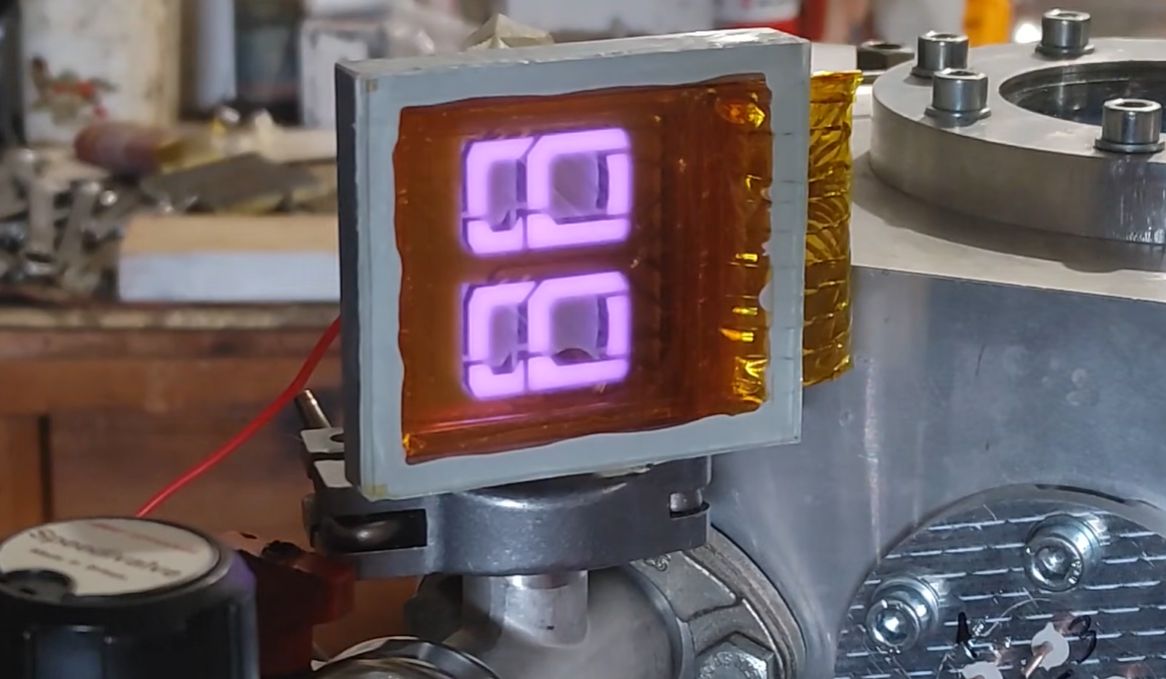
Before the advent of effective semiconductor LEDs many display types existed to display things like numbers and other characters. The Nixie tube is a well-known one, along with VFDs and there are also lesser known ones such as Burrough’s Panaplex, which all saw plentiful use in everything from calculators to audio equipment. The design that [Witchcraft and Alchemy] made appears to lean heavily on this Panaplex design.
Rather than neon, this uses argon as the gas. The anode is formed by the indium-tin oxide layer on a piece of glass, with the cathode sputtered onto the other side in the form of first a titanium layer followed by platinum. This combination helps to prevent the latter from flaking off due to incompatibilities between the molecular matrices of the glass and platinum.
Since this is an early prototype, only five segments were sputtered onto the glass and driven with a 74141 Nixie driver IC, creating the expected purple glow in a vacuum chamber. Following this a self-contained prototype was created, but this proved to be less successful, with the prototype quickly failing to light up as expected.
For a next attempt no tape or epoxy for sealing the device will be used, but rather a gasket instead of gluing the front glass onto the device. The use of conductive vias should make the device’s vacuum more permanent, and enable those last two segments to make it a seven-segment display. The final change should be to use a Penning mixture instead of pure argon.