
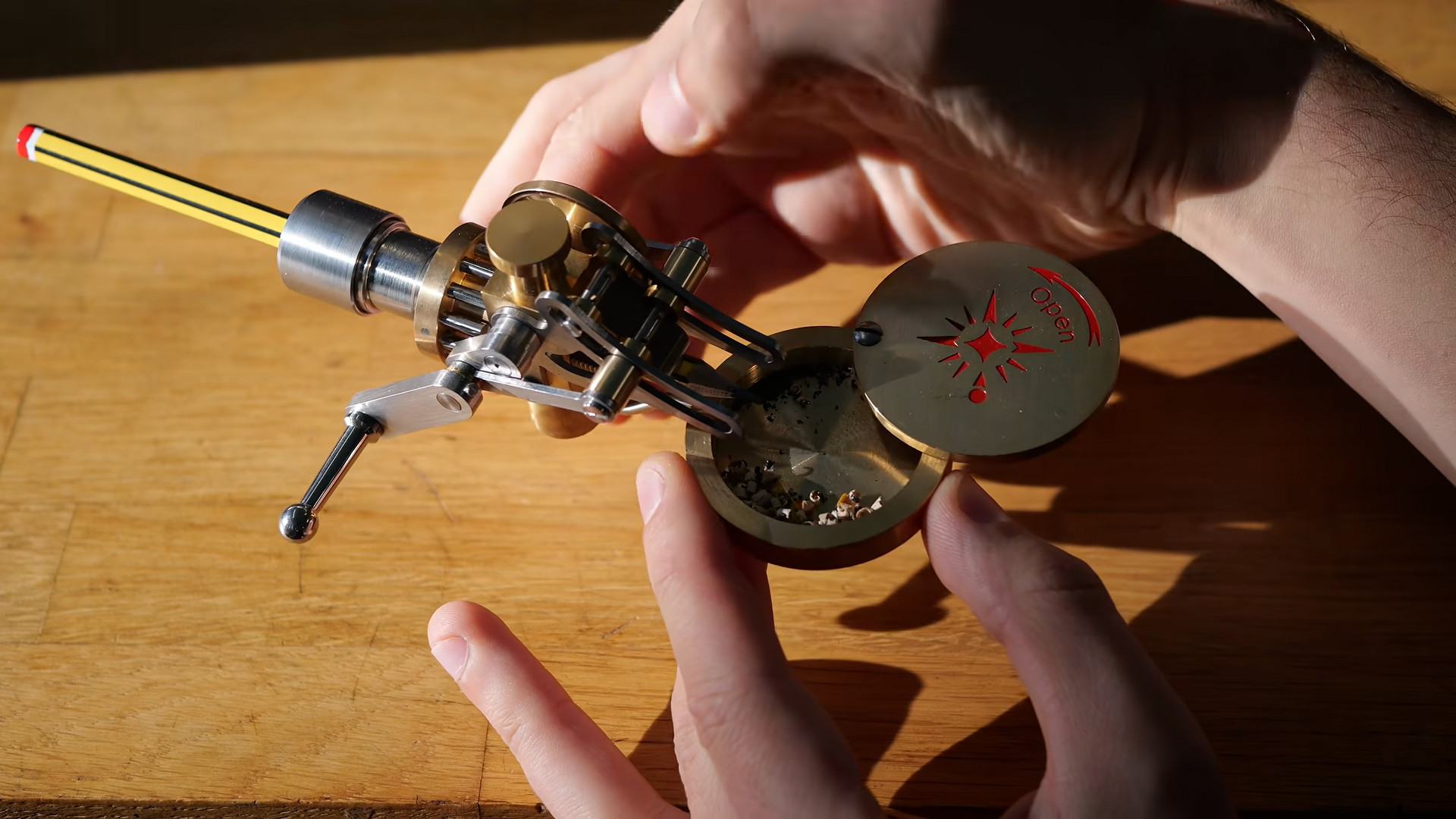
An engineer’s greatest tool is the writing utensil. Be it pen or pencil, we use them for everything from making diagrams to marking out cuts. But as with any practitioner of an art, we can tend to become rather particular about the details. [Choronva Engineering] is not different, and to that end set out to re-invent the pencil sharpener.
In this case, [Chronova]’s ideal pencil tip shape is a concave cone. This is a shape quite trivial to make by using a knife, but rather impossible with a traditional twisting motion. But what if one automatized the knife whittling motion? This is actually a very old idea, with examples dating back to at least 1910. In this example, the blade is guided along two tracks with a particular curvature to enable the concave cone. This is driven by a cam shaft connected to a little cranking mechanism. Initial tests showed the mechanism works quite well at producing a cutoff of the desired shape, but lacks a pencil rotation mechanism.
CAD mockup of the lantern-pinion mechanism.Inspired by the Geneva wheel, [Chronova] developed a fresh intermittent mechanism for improved satisfaction in the sharpener’s operation. Instead of two gear-like mechanisms on a flat plane, the input and output can sit at a 90 degree offset from each other giving room for the blade’s motion. Rotation is input on a part called the indexing pinion which outputs on a lantern pinion.
At every full rotation of the indexing pinion, it interfaces with the lantern pinion moving it two teeth. Because of this quirk, by making the lantern with an odd number of teeth, twice the number of indexing positions are available in the output. At all other points in the pinion’s rotation the lantern is locked in place.
The pencil is held in place with a collect chuck and mounted on a screw coupled to the lantern pinion’s rotational output. This enables the pencil to move forward slightly with every turn of the crank. The project is topped of neatly with a shavings catcher and handle.
It works rather well, but a practical pencil sharpener that does not make. It takes a rather long time, and is fairly laborious to use. But over-engineering machines to do simple tasks is still quite fun!