
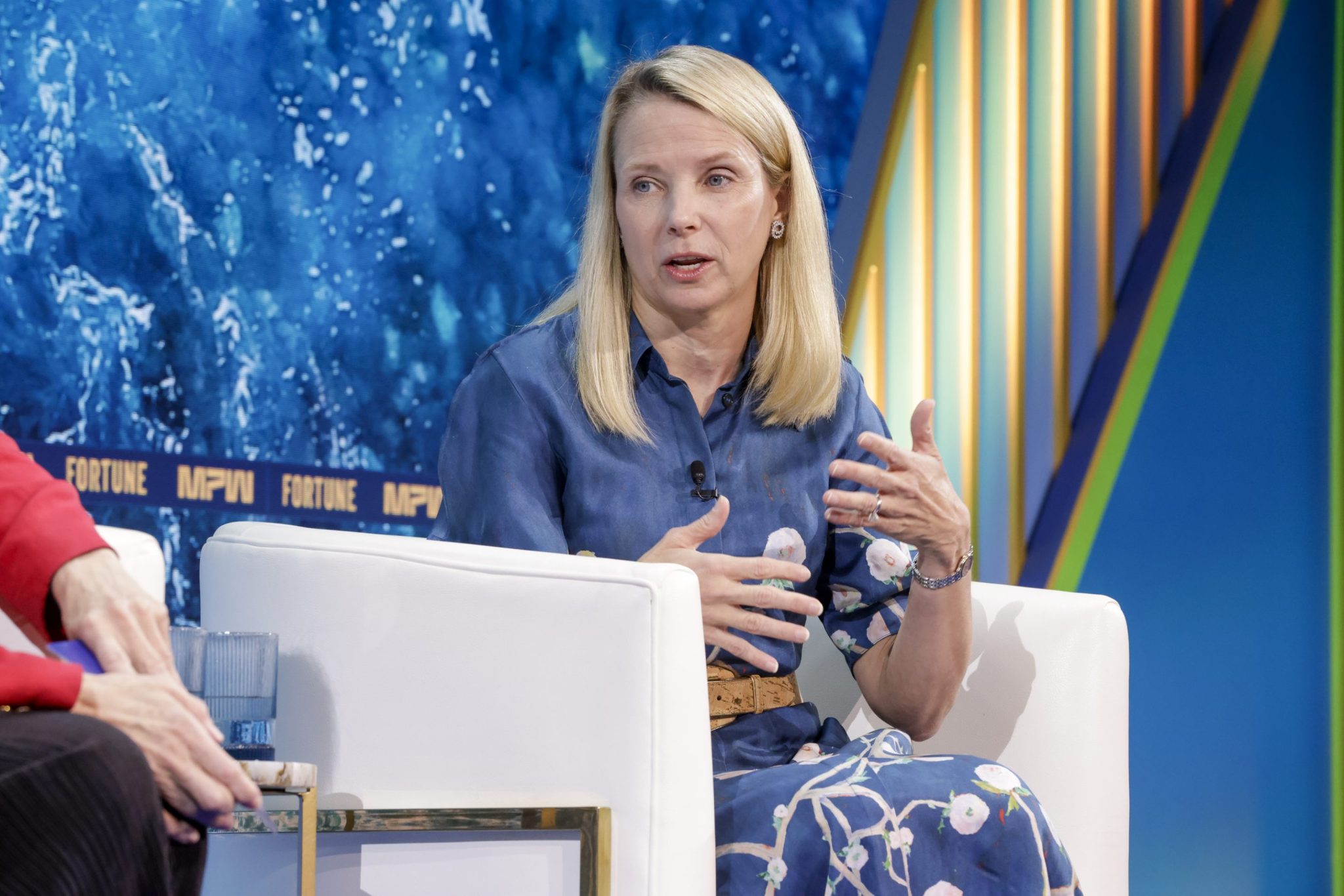
Marissa Mayer has been a builder in Silicon Valley since the dawn of Google. But even she says the honest answer about where AI is headed is that nobody knows.
“We have a new form of intelligence, and anyone who says they know how this is going to play out is either lying or arrogant or both,” Mayer told Fortune executive editorial director Diane Brady on stage at the annual Most Powerful Women Summit in California, when asked about the debate raging over the frontier AI labs.
The uncertainty cuts both ways, said Mayer.
“We have to acknowledge that there is a possibility that things won’t go well,” she said. But Mayer put the odds of a negative outcome at “well less than 50%,” noting that even some AI doomers would agree with her. “What that really means is the odds are in our favor,” she said, pointing to potential medical and science breakthroughs and “freeing people up to spend their time and live their lives the way they want to.”
She admitted to being an optimist, but welcomed discussions about regulation and collaborations across frontier labs as they advance. She also acknowledged, in responding to a question from Brady, that public sentiment in the U.S. has turned against AI, and she said the industry probably bears some of the blame. The early positioning of the technology was “perhaps too cavalier,” she said, leaving people to question what the enterprise-level embrace of AI will mean for jobs, families, and children’s futures.
“I personally think it can make all three of those things better,” she told Brady.
From Yahoo to DazzleMayer has had a long run at the top of tech, joining Google as an early engineer and becoming one of its most high-profile executives before taking over Yahoo as CEO in 2012, becoming the youngest woman to be a CEO in the Fortune 500 at the time. Accordingly, her tenure drew an intense spotlight, including her decision to take a short maternity leave. Looking back, Mayer said people missed the context. “Yahoo couldn’t afford to have a CEO who was out for three or six months,” she said.
Mayer left Yahoo after the sale of its core assets and real estate to Verizon for $4.8 billion in 2017. After Yahoo, she founded contacts and photo-sharing startup Sunshine, before winding it down in 2025 and selling its assets to Dazzle AI. The new startup raised $8 million in a seed round that same year at a $35 million valuation, and formally announced its launch on September 29 this year.
Dazzle, the new venture, is a personal AI assistant that learns from the photos on a user’s phone, said Mayer. The idea grew from her work at Sunshine, where Mayer’s team concluded that about 60% of a typical camera roll is worth sharing. The other 40% is “all the stuff we need to get done,” she said, pointing to appointment cards at the dentist’s office and photos of children’s cleats as a reminder to buy a larger size. Dazzle, says Mayer, pairs that context with human and AI agents that can act on it, creating what Mayer described as a to-do list “that gets itself done.”
“If I had to be your personal assistant for a week—booking travel, buying gifts, buying clothes, keeping track of kids’ schedules—I’d ask for your camera roll,” she said.
As for privacy, Mayer said users can grant Dazzle full, partial, or no access to their photos and images that are sensitive are immediately discarded. For now, Dazzle is invite-only and eventually Mayer said the company will charge subscription fees, transaction fees, or both, but will keep a free tier.
One surprise that isn’t all that surprising is that early Dazzle adopters are men, said Mayer, but she said she hoped the product—and AI more broadly—will find a home with women.
“I hope that there’s more women that are inspired to actually build,” she said. “I think it’s really important for us to have a voice in how AI develops.”
This story was originally featured on Fortune.com