
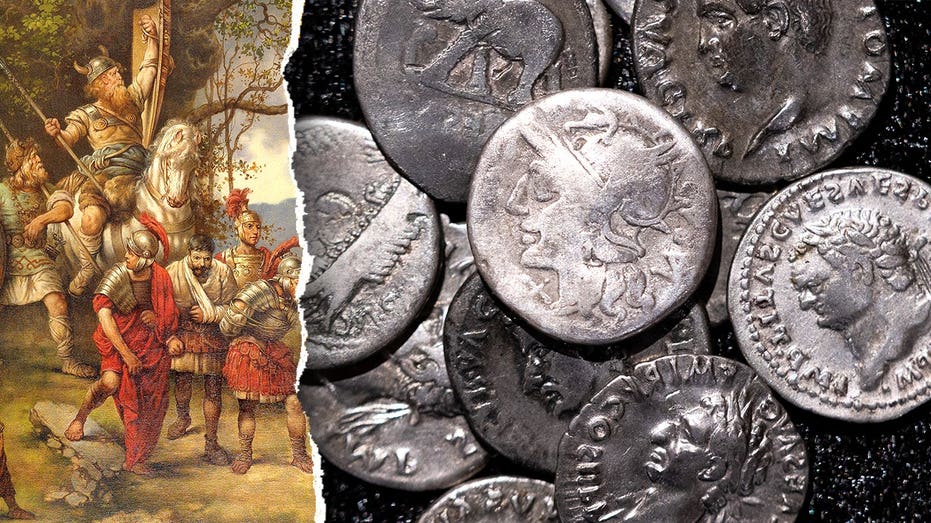
A man searching a German field with a metal detector stumbled upon a remarkable discovery.
He found 934 ancient Roman silver coins — and an expert says the nearly 2,000-year-old treasure and "huge hoard" may have been someone's life savings.
The coins, found near Wesseling, south of Cologne, were uncovered by Oliver Riedl, according to The Associated Press (AP). Though the hoard was discovered last year, officials only recently announced the find, calling it the largest coin hoard from the reign of Roman Emperor Hadrian ever found in Germany.
PUZZLING SOUND IN BACKYARD LEADS HOMEOWNER TO MASSIVE 1,000-YEAR-OLD TREASURE
A licensed metal detectorist, Riedl immediately alerted archaeological authorities after realizing more coins were buried beneath the surface.
The hobbyist told the AP he suspected there were more coins beneath the surface after his metal detector continued picking up signals.
"It was clear to me there was something bigger buried here," he said.
Pictures show the ancient Roman silver denarii after they were carefully cleaned, some bearing portraits and inscriptions.
ARCHAEOLOGISTS UNCOVER MASSIVE ANCIENT SITE DURING RAIL PROJECT, INCLUDING RARE ROMAN FIND
The coins were likely buried intentionally between 125 and 150 A.D., according to the LVR Office for the Preservation of Archaeological Monuments in the Rhineland.
The staggering hoard weighs 6.8 pounds and is currently on display at the LVR-LandesMuseum Bonn.
The most striking aspect of the hoard was its unusual size, said Johannes Wienand, a professor of ancient history at the Technical University of Braunschweig in Germany.
Wienand was not involved in the discovery or its research but told Fox News Digital the hoard is "a huge treasure."
POLICE OFFICERS SPOT STRANGE OBJECTS UNDERWATER, THEN MAKE REMARKABLE ANCIENT DISCOVERY
"It's certainly the largest Roman coin hoard of that sort from Hadrian's time," he said.
"It's a time capsule of the money the people in that period actually used day by day."
A Roman legionary would have earned a gross salary of around 300 denarii per year, Wienand said, meaning the hoard was roughly equivalent to three years of a soldier's gross salary.
"A Roman soldier would need six, seven, eight, even more years to save this amount of money, maybe for his retirement," he said.
CLICK HERE TO SIGN UP FOR OUR LIFESTYLE NEWSLETTER
The coins were discovered in a rural area near the Rhine frontier, which marked a border of the Roman Empire at the time, he noted. The Roman city of Cologne and a legionary fortress in Bonn were also nearby — raising the possibility of a military connection.
While a military connection is possible, Wienand said the identity of the hoard's owner remains unknown.
CLICK HERE FOR MORE LIFESTYLE NEWS
"It seems to have been the life savings of one person who put this treasure together and put it in a pot, buried it in the soil to save it for later," Wienand said.
"And obviously the owner was never able to recover this treasure."
Above all, Wienand said the discovery highlights the importance of responsible metal detecting and reporting archaeological finds.
TEST YOURSELF WITH OUR LATEST LIFESTYLE QUIZ
"It's actually a story of how to do things right," he said. "The metal detectorist was licensed. He had permission to look for finds like that. He immediately called the heritage officers."
Wienand added, "He reported the find, and he contributed to an orderly exploration of this remarkable find."
"These coins and this hoard [are] now part of our cultural heritage. And I think that's a very good outcome of this story."
The Associated Press contributed reporting.